Reading Time 6
Number of Words 1179
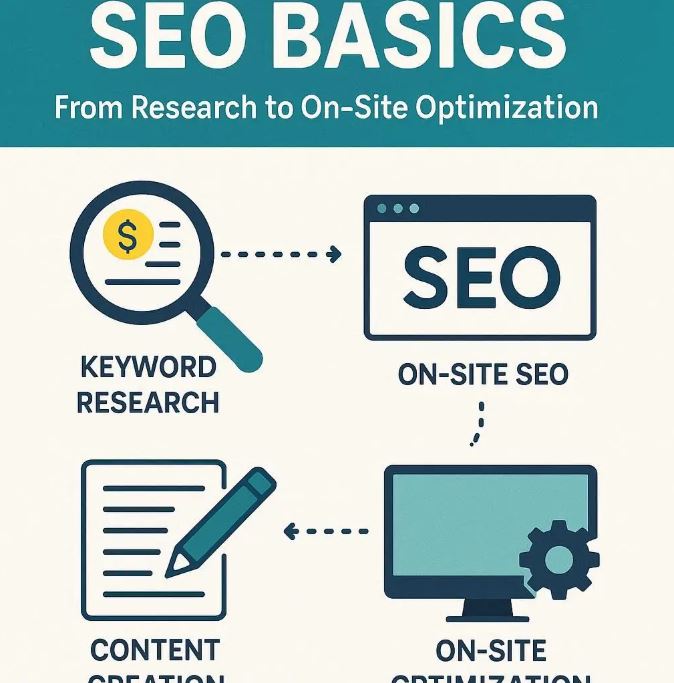
Search Engine Optimization (SEO) is the process of optimizing your website so that search engines can discover, index and rank it — and users can find it when they search. It’s a combination of strategy, analysis and technical work. Doing SEO well means ensuring your content matches user intent while making it easy for search engines to understand your site.
This guide takes you through the major stages of SEO — from keyword research, through content and on-site (on-page) optimization — so you can build a strong foundation for long-term organic visibility.
1. Understanding How Search Works
Before you dive into tactics, you should understand how search engines like Google LLC crawl, index and rank pages. At a high level:
-
Crawling: Search engine bots (crawlers) follow links to discover content on the web.
-
Indexing: Once discovered, pages are processed and stored in the search engine’s index — enabling them to be retrieved for queries.
-
Ranking: When a user searches, the engine evaluates many signals (content relevance, site authority, user experience, etc.) and ranks pages accordingly.
If your site is not crawled or indexed, it’s invisible in search results. If you don’t satisfy user intent or match relevant signals, you won’t rank highly.
2. Keyword & Audience Research
a) Define Your Audience and Their Intent
Start by identifying who you’re trying to reach and what they are searching for. Search intent is key: are users looking for information (informational intent), a specific website (navigational intent), or are they ready to buy/convert (transactional intent)? The better your understanding, the more relevant your keywords and content will be.
b) Keyword Discovery
Use keyword research tools (free and paid) to find the terms your audience uses. Focus on:
-
Primary keywords: high-value, relevant terms that reflect your core offering or content topic.
-
Long-tail keywords: more specific phrases with lower volume but often higher conversion potential.
-
Related keywords and topics: synonyms, questions, and context around your primary keywords.
c) Analyze Competition & Search Results
Look at what currently ranks for your target keywords. What type of content appears? What features (rich snippets, “People also ask”, videos) dominate the SERPs? This helps you understand what you’re up against and what you need to deliver.
d) Map Keywords to Content
Assign keywords to specific pages of your site in a structured way. Avoid multiple pages targeting the same keyword (keyword cannibalization). Each important keyword-topic should have a dedicated page or section.
3. On-Site (On-Page) SEO Optimization
Once you’ve done your research and mapped topics, it’s time to optimize each page on your site to maximize its chance of ranking — and converting. Use Lookkle's on-page SEO analysis tool to detect potential errors.
a) Title Tags & Meta Descriptions
-
Title tags: Should be unique per page, around 50-60 characters, and ideally begin with the main keyword. They set expectation for both users and search engines.
-
Meta descriptions: Summarize the page content, ideally 150-160 characters; while not a strong ranking signal, they influence click-through rate (CTR). Make them compelling and relevant.
b) URL Structure
Use clean, descriptive URLs that include your main keyword and avoid unnecessary parameters or long strings. Example: /seo-basics-guide instead of /page?id=12345.
c) Headings and Content Structure
-
Use exactly one H1 per page, containing your main keyword or topic.
-
Subsequent headings (H2, H3…) should reflect your content structure and help readability and scan-ability for both users and search engines.
-
Place your target keyword within the first ~100 words of the body content (where it fits naturally). This helps signal topic relevance early.
-
Use synonyms and related terms to build topical depth rather than repeating the same keyword many times (avoid keyword stuffing).
d) Content Quality & Relevance
The days of “keyword-stuff and hope” are gone. Today your content should:
-
Satisfy search intent: If users expect a “how-to” guide, give them that. If they expect a list of products, deliver a list.
-
Add value: Provide fresh insight, original research, images or multimedia, better organization or user experience than competing pages.
-
Be updated: Periodically revisit older content to refresh facts, statistics and improve structure and readability.
-
Be readable and skimmable: Use short paragraphs, bullet lists, visuals, call-out sections and meaningful headings.
e) Images & Multimedia
-
Use descriptive filenames and
altattributes on images (which help accessibility and give search engines more context). -
Optimize image size to preserve page-load speed.
-
Use videos or other media where it adds value and aligns with user intent.
f) Internal Linking
-
Link from high-authority pages on your site to newer or less-established pages to pass “link equity”.
-
Use descriptive anchor text (not just “click here”) that reflects the topic of the target page.
-
Maintain a logical site structure and navigation so both users and search engines can find important pages easily.
g) Schema Markup & Structured Data
Adding schema (structured data) helps search engines understand your content context and can unlock rich results (such as review stars, FAQs, recipes, etc.). Example: Article schema, FAQ schema, Product schema. These don’t guarantee rich result appearance but increase the chance.
h) Mobile-Friendly & Page Speed
Ensure your pages load fast and display well on mobile devices. Mobile friendliness and loading speed are ranking factors and also impact user experience (which indirectly impacts SEO). Use tools like PageSpeed Insights to check.
i) User Experience (UX) & Engagement Signals
Search engines increasingly factor in how users behave on your site: bounce rate, time on page, scroll depth. Optimize for UX by:
-
Putting key content above the fold (so users don’t have to scroll far to get value)
-
Ensuring clear layout and navigation
-
Removing intrusive pop-ups
-
Encouraging deeper browsing via logical content linking and CTAs.
4. Technical Considerations (Foundation)
While this guide focuses on research and on-site optimization, technical SEO supports everything else. Make sure you cover:
-
Site architecture: Clean navigation, sitemaps, no orphan pages.
-
Robots.txt and meta-robots: Ensure important pages are crawlable and indexable.
-
Canonical tags: Prevent duplicate content issues.
-
HTTPS: Secure sites are preferred.
-
Page speed & mobile responsiveness (as above).
-
Structured data, as mentioned previously.
-
Proper redirects (301s) when pages are moved.
-
Consistent handling of mobile vs desktop indexing (mobile-first indexing).
Without a solid technical foundation, your on-site work may be undone by crawl/indexing issues or speed/UX problems.
5. Measuring & Monitoring SEO Progress
SEO is not “set it and forget it”. You should track and analyze metrics to understand performance and iterate. Key metrics include:
-
Organic traffic volume and trends
-
Keyword rankings and movement
-
Click-through rate (CTR) from search results
-
Bounce rate, dwell time and pages per session
-
Conversion or goal completions driven by organic traffic
-
Backlink profile quality (as it slants both on-site trust and off-site authority)
Regular audits (at least quarterly) help you identify technical gaps, content that needs refresh, and optimization opportunities.
6. Next Steps / Scaling
Once you’ve got your research, content, and on-site optimization in place, you can scale your efforts by:
-
Expanding into new keyword clusters and topics (topic clusters/pillar pages)
-
Building authority via off‐site SEO (link building, brand mentions, guest posts)
-
Optimizing for emerging trends like AI search results, voice search, user intent evolution
-
Continuously updating older content to retain rankings and relevance
-
Automating monitoring tasks (alerts for ranking drops, site-speed degradations)
Summary
SEO is a holistic practice: It starts with understanding your audience and their search behaviour, moves into thorough keyword research, then into crafting high-quality content and optimizing every relevant on-page element, built on a strong technical foundation. Monitoring progress and iterating is key to long-term success.
By following this structure — research → on‐site optimization → measurement → iteration — you position your website to rank, engage users and convert over time.