Reading Time 8
Number of Words 1685
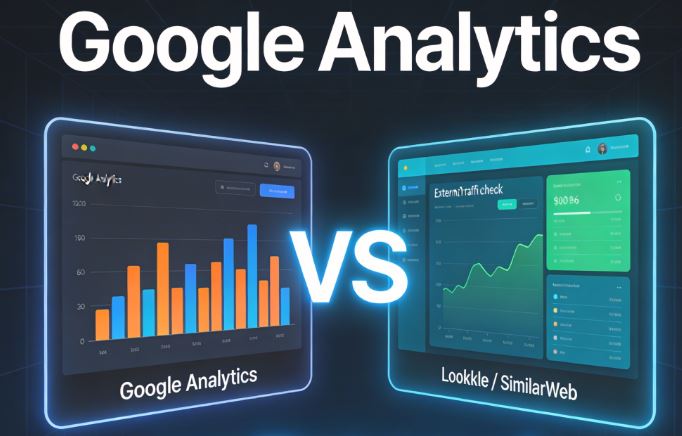
You open Google Analytics and see 8,000 monthly visitors.
You check your site on SimilarWeb and it shows 22,000.
A colleague runs it through Lookkle and gets 10,500.
Who's telling the truth — and why do the numbers never match? This guide explains everything.
🤔 The Core Confusion: Why Two Tools Show Different Numbers
This is one of the most common questions in digital marketing, and the answer lies in how each type of tool collects its data. Google Analytics and external traffic checkers are not competitors doing the same thing differently — they are fundamentally different instruments measuring different things.
Think of it this way:
-
Google Analytics is like a turnstile at your front door — it counts every person who walks in, exactly
-
External traffic checkers are like a traffic researcher standing across the street — they estimate how many people enter based on what they can observe from outside
Both are useful. But they answer different questions.
🔵 What Is Google Analytics (GA4)?
Google Analytics 4 is a first-party analytics tool that you install directly on your own website by adding a tracking tag or using Google Tag Manager. Once installed, every time a real user visits your site, their session is recorded with precision — pages viewed, time spent, buttons clicked, conversions completed, and much more.
How GA4 Collects Data
-
A visitor lands on your website
-
The GA4 JavaScript tag fires in their browser
-
The tag sends an event to Google's servers
-
GA4 records the session, traffic source, device, location, and behavior
-
You see that data in your GA4 dashboard in near real-time
What GA4 Tells You
-
✅ Exact session counts and pageviews for your own site
-
✅ Precise traffic sources (organic, social, direct, paid, referral)
-
✅ User behavior: bounce rate, scroll depth, time on page
-
✅ Conversion tracking and goal completions
-
✅ Device, browser, and geographic breakdown
-
✅ Funnel analysis and audience segmentation
-
✅ Integration with Google Ads for campaign attribution
GA4's Key Limitations
-
❌ Only works for sites you own — you cannot use it to analyze competitors
-
❌ Cookie consent gaps — users who decline cookies or use ad blockers are invisible. Sites can lose 30–50% of their real traffic data due to this
-
❌ Data sampling — for large sites, GA4 applies statistical sampling instead of counting every session, which introduces estimation errors
-
❌ Steep learning curve — GA4's event-based model is complex and confusing for beginners
-
❌ No competitive intelligence — you can only see your own data, never your competitors'
🌐 What Are External Traffic Checkers?
External traffic checkers (also called third-party traffic estimators) are tools that analyze the traffic of any public website — including your competitors — without needing to install any code. Tools like Lookkle, SimilarWeb, Ahrefs, SEMrush, and Ubersuggest fall into this category.
How External Traffic Checkers Estimate Traffic
Since they cannot install tracking code on websites they don't own, these tools use a combination of estimation methods:
| Method | How It Works |
|---|---|
| Clickstream / Panel Data | Aggregate anonymized browsing data from millions of users who have installed browser extensions or apps that share their browsing history |
| SERP Analysis | Crawl Google search results, identify what keywords a site ranks for, estimate search volume × click-through rate per position = estimated traffic |
| ISP Data | Aggregate anonymized data from internet service providers |
| Crawler Data | Web crawlers index pages and estimate traffic based on content signals |
| Direct Measurements | Some tools (like SimilarWeb) allow site owners to connect GA data for "verified" numbers |
The result is always an estimate, not an exact count.
🔵 Spotlight: Lookkle as an External Traffic Checker
Lookkle is a free web traffic analysis platform that combines multiple estimation methodologies to provide competitive intelligence on any public website — without registration for basic reports. Its key differentiator is providing instant results with no login required for initial analysis, plus historical traffic data going back to 2020.
What Lookkle shows you for any website:
-
📊 Total estimated monthly traffic.
-
🔍 Organic Traffic.
-
🌍 Direct Traffic.
-
📈 Social media traffic.
-
🕵️ Competitor discovery (up to 20 similar sites per domain)
🎯 The key use case: You can't see a competitor's Google Analytics. But you CAN run them through Lookkle to understand their traffic trends, top keywords, and traffic sources — giving you actionable competitive intelligence that GA4 simply cannot provide.
⚖️ Head-to-Head Comparison
| Feature | Google Analytics 4 | External Checkers (Lookkle, SimilarWeb, etc.) |
|---|---|---|
| Data type | Exact (first-party) | Estimated (third-party) |
| Accuracy | ★★★★★ (your site) | ★★★☆☆ (varies by site size) |
| Your own site | ✅ Perfect | ✅ Estimated |
| Competitor sites | ❌ Not possible | ✅ Yes |
| Requires installation | ✅ Yes (tracking tag) | ❌ No |
| Cookie/consent impact | ⚠️ Yes (30–50% data loss possible) | ❌ Not affected |
| Historical data | Limited (GA4 from 2020) | ✅ Some tools back to 2020 |
| Keyword breakdown | ❌ (via GSC only) | ✅ Yes |
| Traffic source detail | ✅ Very detailed | ✅ Estimated breakdown |
| User behavior (scrolls, clicks) | ✅ Yes | ❌ No |
| Conversion tracking | ✅ Yes | ❌ No |
| Free tier | ✅ Fully free | ✅ Limited free (Lookkle: 10 free/day no login) |
| Best for | Your own site optimization | Competitor research & niche analysis |
📊 How Accurate Are External Traffic Checkers?
This is where it gets nuanced — and where most people get confused. External traffic estimators are not equally accurate across all websites.
Accuracy by Website Size
A landmark study analyzing 86 websites found that SimilarWeb's estimates were 19.4% lower for total visits and 38.7% lower for unique visitors compared to Google Analytics baseline data. A more recent study of 1,787 e-commerce sites found SimilarWeb reporting 94% more sessions than GA — meaning discrepancies can go in either direction.
The key pattern across all studies: accuracy improves dramatically with site size.
| Site Size | External Checker Accuracy | Recommendation |
|---|---|---|
| Large sites (>100K sessions/month) | ★★★★☆ High | Relatively reliable for absolute numbers |
| Medium sites (10K–100K/month) | ★★★☆☆ Medium | Use for trends, not exact counts |
| Small sites (<10K/month) | ★★☆☆☆ Low | Directional only — trends matter more than numbers |
⚠️ Important nuance: Even when absolute numbers are off, trend data is highly reliable. If an external tool shows a competitor's traffic jumped 50% month-over-month, that directional signal is trustworthy even if the raw number isn't exact.
Why Numbers Differ Between Tools
Even two external tools will show different numbers for the same site because:
-
They use different panel sizes and data sources
-
Their SERP crawl frequency varies
-
Their CTR models for keyword-to-traffic estimation differ
-
Panel demographics may skew toward certain geographies or device types
🔍 Why GA4 Isn't Always More Accurate Than You Think
It seems obvious that GA4, which directly counts your visitors, should always be the gold standard. And for most purposes, it is. But there are scenarios where GA4 undercounts your real traffic:
-
Ad blockers: Users with ad blockers prevent GA4 from firing. In tech-heavy audiences, ad blocker usage can be 30–40%
-
Cookie consent refusal: GDPR cookie banners mean users who click "Reject" are entirely invisible to GA4. Some sites lose 30–50% of their data this way
-
JavaScript disabled: Users with JS off don't trigger the GA4 tag
-
Data sampling: For sites with very high traffic, GA4 samples data for certain reports rather than processing every session
-
Bot traffic: While GA4 filters known bots, it doesn't catch all automated traffic
💡 This means your real traffic could actually be higher than GA4 shows — external tools, which don't rely on browser-side JavaScript execution, can sometimes capture traffic signals GA4 misses.
🛠️ When to Use Each Tool
Use Google Analytics 4 when you need to:
-
Track your own website's performance over time
-
Understand how users behave on your site (which pages they visit, where they drop off)
-
Measure conversions and goal completions
-
Attribute traffic to specific marketing campaigns
-
Analyze audience demographics of your visitors
-
Optimize landing pages based on real user data
Use External Traffic Checkers (Lookkle, SimilarWeb, etc.) when you need to:
-
Analyze competitor websites you don't own
-
Validate a niche before building a site (is there real traffic there?)
-
Benchmark your traffic against industry peers
-
Discover which keywords drive traffic to competitors
-
Identify traffic trends across an entire market or niche
-
Find content gaps by seeing what topics competitors rank for
-
Analyze sites before buying or partnering with them
🔄 The Power Combination: Use Both Together
The smartest digital marketers don't choose between GA4 and external tools — they use them together in a complementary workflow:
📊 GA4 → "What's happening on MY site?"
↓ Shows exact user behavior, conversions, traffic sources
🔵 Lookkle → "What's happening on COMPETITOR sites?"
↓ Estimates traffic, top keywords, traffic sources, trends
📈 Google Search Console → "How does Google SEE my site?"
↓ Shows impressions, clicks, queries, indexing status
🔁 Combined insight → Full picture of your market + your performance
Real-world example workflow:
-
Use GA4 to see your organic traffic dropped 20% last month
-
Use Lookkle to check if a competitor gained traffic in the same period (if yes → they took your rankings)
-
Use Lookkle's Organic Analyzer to see which specific keywords the competitor now ranks for
-
Use Google Search Console to confirm which of your pages lost rankings
-
Update or expand that content to reclaim your positions
🏆 Tool Comparison: The Full Landscape
| Tool | Type | Best For | Free Tier | Accuracy |
|---|---|---|---|---|
| Google Analytics 4 | First-party | Your own site behavior | ✅ Fully free | ★★★★★ (own site) |
| Google Search Console | First-party | Your SEO performance | ✅ Fully free | ★★★★★ (own site) |
| 🔵 Lookkle | Third-party | Competitor analysis, niche research | ✅ Limited | ★★★☆☆ (estimates) |
| SimilarWeb | Third-party | Industry benchmarking | ✅ Limited | ★★★☆☆ (estimates) |
| Ahrefs | Third-party | Organic SEO traffic | ✅ Webmaster tools free | ★★★☆☆ (organic only) |
| SEMrush | Third-party | Full SEO suite | ✅ Very limited | ★★★☆☆ (estimates) |
| Ubersuggest | Third-party | Keyword research | ✅ 3/day free | ★★☆☆☆ (estimates) |
❓ Frequently Asked Questions
Why does SimilarWeb show more traffic than Google Analytics?
SimilarWeb uses panel data and statistical modelling, which can overestimate traffic — especially for smaller sites. A study of 1,787 e-commerce sites found SimilarWeb reporting 94% more sessions than GA on average. For trend analysis, SimilarWeb's directional data is still reliable even when raw numbers diverge.
Can I trust Lookkle data for competitor analysis?
Yes, for directional analysis and trend identification.
Why do Google Analytics and Google Search Console show different numbers?
They measure different things. GSC counts clicks from Google Search only. GA4 counts sessions from all sources. Additionally, GSC measures "clicks" while GA4 measures "sessions" — one user can generate multiple sessions. They will never match exactly.
Is GA4 100% accurate?
No. GA4 can miss 30–50% of real traffic due to cookie consent refusals, ad blockers, and JavaScript blockers. It's the most accurate tool for your own site's data, but it's not a perfect headcount.
Can external tools track traffic in real time?
No. External traffic checkers like Lookkle and SimilarWeb update their data monthly or bi-monthly. Only first-party tools like GA4 provide near-real-time data.
What's the most accurate free tool for checking competitor traffic?
For competitor traffic, Lookkle offers the most accessible free tier (no registration needed for basic reports) with historical data back to 2020. For organic SEO traffic specifically, Ahrefs Webmaster Tools (free for your own site) and Neil Patel's Ubersuggest are also strong options.
✅ Key Takeaways
-
Google Analytics 4 gives you exact data for your own site but cannot analyze competitors
-
External tools like Lookkle estimate traffic for any public website — ideal for competitive research
-
External tools are estimates, not exact counts — accuracy improves with site size
-
Even when numbers differ, trend data from external tools is highly reliable
-
The smartest approach is to use both: GA4 for your own optimization, Lookkle for competitor intelligence
-
GA4 itself can undercount your real traffic by 30–50% due to cookie consent and ad blockers
🛒 Tools Referenced in This Guide
🔵 Lookkle — Free competitor traffic analysis & keyword research:
👉 lookkle.com
📊 Google Analytics 4 — Free first-party analytics for your site:
👉 analytics.google.com
🔍 Google Search Console — Free SEO performance tool:
👉 search.google.com/search-console