Reading Time 9
Number of Words 1806
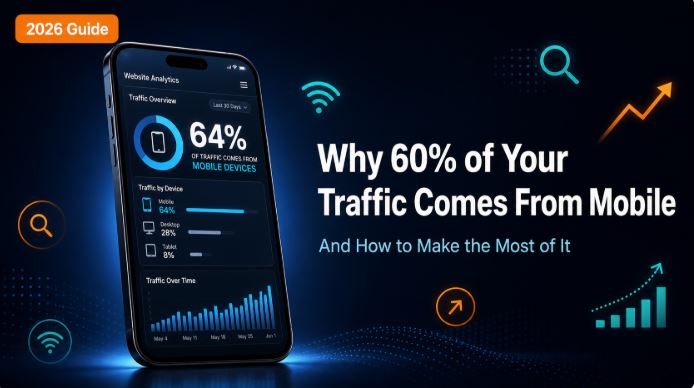
If you check Google Analytics or any web analytics tool, such as Lookkle, and see that between 55% and 70% of your visits come from mobile devices, you're not seeing an anomaly. You're seeing the global norm.
In the second quarter of 2025, smartphones already accounted for 64.1% of global web traffic, marking eight consecutive quarters of uninterrupted growth. In some regions of Asia, that figure reaches 71.3%. And in Europe, the trend is no different: mobile has ceased to be the second most used device and has become the primary point of access to the internet.
The question is no longer "Should I optimize my website for mobile?" The real question is: Are you taking advantage of that traffic or are you missing out?
📈 The Unstoppable Evolution of Mobile Traffic
A decade ago, desktop computers undisputedly dominated internet access. The shift happened gradually but inevitably:
-
2016: Smartphones surpass desktops in global web traffic for the first time
-
2020: 66% of visits to the 1,000 most visited websites in the world came from mobile devices (Semrush data)
-
2022: Mobile devices generate 59% of total web traffic, almost 10% more than in 2021.
-
2025: 64.1% of global web traffic comes from smartphones — an all-time high
This change is not due to a passing fad. It has structural and permanent causes:
-
Cheaper smartphones: Affordable Android devices have put the internet in the hands of millions of people who never had a computer.
-
5G Expansion: High-speed mobile connectivity has arrived before fiber optics in many regions of the world.
-
Generational habits: Today's youth don't use computers for leisure, social media, or information. Everything is done through their phones.
-
Improved mobile design: Websites are now more usable on small screens than they were five years ago, eliminating a historical barrier.
💡 Key fact for your strategy: 61% of visits from search engines to many websites come through the mobile version of Google, and an additional 16% come via Facebook (almost always from mobile as well).
🤔 Why is so much mobile traffic coming to your website specifically?
Beyond the global trend, there are specific reasons why your website has such a high percentage of mobile traffic:
1. 🔎 Google indexes the mobile version first
Since 2019, Google has used Mobile-First Indexing as the universal standard. This means that Google crawls, indexes, and ranks your website based on its mobile version, not the desktop version. If your website loads well and has good content on mobile, you'll appear at the top. Otherwise, you'll lose positions even if it looks perfect on desktop.
2. 📱 Local searches are mostly mobile
Searches like "restaurant nearby", "plumber in [city]", or "store open now" are almost exclusively done on mobile devices. If your business has a local component, this directly explains your traffic data.
3. 📣 Social media traffic is 99% mobile
99% of social media use happens on phones. If you promote content on Instagram, Facebook, TikTok, or any other platform, almost all the traffic you generate will land on your website from a smartphone.
4. 📰 Media outlets and blogs receive more mobile traffic
Content sites, news sites, review sites, and blogs register the highest percentages of mobile traffic of all web categories. If your website is a blog or content portal, it's perfectly normal to be in the 65-75% range.
⚠️ The Problem: Many Sites Are Not Ready Yet
Having high mobile traffic is a huge opportunity. But it can also become a problem if your website isn't ready to handle it well. Warning signs:
-
❌ Your bounce rate on mobile is significantly higher than on desktop
-
❌ Time spent on page is much shorter on mobile
-
❌ Conversions (sales, forms, subscriptions) are almost nonexistent from mobile.
-
❌ Google Search Console shows mobile usability errors
-
❌ Your PageSpeed Insights mobile score is below 70
🛠️ Recommended tool: You can analyze the performance of any URL in seconds, view traffic metrics by device, and detect technical problems that are affecting your mobile ranking.
✅ How to Maximize Your Mobile Traffic: 10 Strategies
⚡ 1. Loading Speed: The #1 Factor
A one-second loading delay reduces conversions by up to 7%. On mobile, users are even more impatient than on desktop. Google directly penalizes slow websites in its rankings through Core Web Vitals.
Specific actions:
-
Compress all images and use WebP format
-
Implements lazy loading (deferred image loading)
-
Use CSS/JS caching and minification (WP Rocket, LiteSpeed Cache)
-
Remove heavy sliders and autoplay videos
-
Target LCP: less than 2.5 seconds on mobile
📐 2. Real Responsive Design (Not Just "Adapted")
There's a difference between a design that "works on mobile" and one that's truly optimized for mobile. A quality responsive design should:
-
Have fonts that are legible without zooming (minimum 16px)
-
Display buttons with sufficient touch surface ( minimum 44x44 px )
-
Remove or rearrange elements that do not add value on a small screen
-
Ensure that the forms are easy to complete with the thumb.
💡 Design tip: Always work with a Mobile First approach : design first for mobile and then adapt to desktop, never the other way around.
🍔 3. Simplified Navigation for Small Screens
Mobile navigation should be intuitive with one hand:
-
Use hamburger menus with the key sections
-
Add a floating contact or WhatsApp button at the bottom
-
Reduce the number of menu levels (maximum 2)
-
Prioritize shortcuts to what matters most: store, services, contact
🔍 4. Mobile SEO: Optimize for Google Mobile-First
Google evaluates your website's mobile version for ranking purposes. Basic checklist:
-
✅ Same content on mobile and desktop (do not hide important content)
-
✅ Optimized meta titles and descriptions (read the same in both versions)
-
✅ Structured data (Schema.org) correctly implemented
-
✅ No text that's too small or interactive elements too close together
-
✅ No aggressive pop-ups covering the main content
-
✅ Hreflang is correct if you have a multilingual version
🤖 5. Optimize for Voice Search and Questions
Mobile searches are more conversational than desktop searches. Phrases like "what's the best cheap mini PC?" or "how to improve my website's SEO" are typical on mobile.
Strategy: Include frequently asked questions in natural language (FAQ section) in your content, short and direct answers at the beginning of each section, and aim for Google featured snippets .
📊 6. Accurately Measure Your Mobile Traffic
You can't improve what you don't measure. Monitor regularly:
-
% of traffic by device (mobile / tablet / desktop)
-
Bounce rate per device — if the mobile device bounces much more, there's a problem
-
Time on page per device
-
Most visited landing pages from mobile
-
Conversions by device
🛠️ Use Lookkle to get detailed SEO metrics for your website and your competitors, identify which pages aren't performing well on mobile, and take action based on real data.
🛒 7. Optimize the Conversion Process for Mobile
If you have a store, subscription service, or contact form, the conversion process must be specifically designed for mobile:
-
Short forms with the minimum required fields
-
One-click payment (Apple Pay, Google Pay, PayPal)
-
Large, visible call-to-action buttons with plenty of space around them
-
Checkout process in a maximum of 3 steps
📹 8. Create Content Designed for Mobile Consumption
Mobile reading behavior differs from desktop reading behavior. Users scroll quickly, scan visually, and read in chunks.
-
Short paragraphs (maximum 3-4 lines)
-
Many subtitles (H2, H3) to facilitate scanning
-
Bulleted lists instead of dense blocks of text
-
Images and videos are integrated to break up the text
-
Strategic bolding to highlight key information
🔔 9. Take advantage of Mobile Push Notifications
If your website or app allows push notifications, use them sparingly but with purpose. They are especially effective for:
-
Notify me of new published content
-
Remembering abandoned shopping carts (e-commerce)
-
Announce limited offers or events
-
Reconnect with inactive users
🗺️ 10. Google Business Profile and Local SEO
If your business is local, mobile traffic and local searches go hand in hand. A complete and optimized Google Business profile can attract visits from people searching on their mobile devices in your area.
-
Updated and high-quality photos
-
Schedules always correct
-
Well-defined categories
-
Respond to all reviews
📊 Mobile vs. Desktop: What Behavior to Expect?
| Metrics | 📱 Mobile | 💻 Desktop |
|---|---|---|
| Global traffic share (2025) | 64% | 36% |
| Average bounce rate | Elderly | Minor |
| Average time on page | Minor | Elderly |
| Average conversion rate | Minor | Elderly |
| Local searches | Dominant | Secondary |
| Use of social media | 99% | 1% |
| Voice search | Frequent | Strange |
💡 Interpretation: A lower mobile conversion rate doesn't mean you should ignore it—it means there's a huge opportunity for improvement. Every percentage point you improve mobile conversion has a massive impact on your business, given the volume of traffic.
🔧 Essential Tools for Auditing Your Website on Mobile
| Tool | What is it for? | Price |
|---|---|---|
| Lookkle | Complete SEO analysis, traffic by device, competitor comparison | Freemium |
| Google Search Console | Mobile usability errors, Core Web Vitals | Free |
| PageSpeed Insights | Speed and Core Web Vitals on mobile/desktop | Free |
| Google Mobile-Friendly Test | Check if your website passes Google's mobile usability test | Free |
| Hotjar / Microsoft Clarity | Heat maps and mobile session recordings | Free / Freemium |
| Semrush / Ahrefs | Mobile keyword analysis, positioning | Paid |
❓ Frequently Asked Questions
Is it normal for my bounce rate to be higher on mobile than on desktop?
Yes, it's perfectly normal. Mobile users are more impatient and more likely to leave if the website loads slowly or doesn't look good. The goal is to reduce that difference, not eliminate it entirely.
Do I need a mobile app, or is a mobile-optimized website enough?
For most businesses, a well-optimized mobile website is sufficient and more cost-effective than maintaining an app. Apps only make sense when users return frequently (banking, social media, everyday tools).
Does tablet traffic count as mobile?
On most analytics platforms, tablets are counted separately from mobile. However, Google treats them similarly for indexing purposes. They generally represent 3-5% of total traffic.
How do I know if my website passes Google's mobile-friendly test?
Go to search.google.com/test/mobile-friendly and enter your URL. In less than 30 seconds, you'll know if Google considers your website mobile-friendly and what issues it detects.
Does mobile traffic affect my Google ranking?
Absolutely. With Mobile-First Indexing, Google ranks your website based on its mobile version. A slow or difficult-to-use website on mobile loses search engine rankings.
🏁 Conclusion: Mobile is not the future, it's the present
The 60-65% mobile traffic you see in your analytics isn't a passing trend: it's the new permanent standard for how people access the internet. Ignoring it or putting it off is no longer an option if you want to compete in organic visibility, user experience, and conversions.
The good news is that most mobile improvements are the same ones that improve your overall SEO, page load speed, and user experience. Improving for mobile is improving your website in every way.
Start with the basics: audit your website today with Lookkle and PageSpeed Insights, identify weaknesses in the mobile experience, and prioritize page load speed and responsive design. With that foundation, every marketing action you take—SEO, social media, email marketing—will have a significantly greater impact.