Reading Time 4
Number of Words 857
Everyone debates which platform is "better" for creators, but almost nobody talks about the raw, unfiltered web traffic numbers.
We analyzed the world's top social media platforms using Lookkle, and the results reveal a gap so massive it will change how you think about social media strategy in 2026.
The Numbers Don't Lie
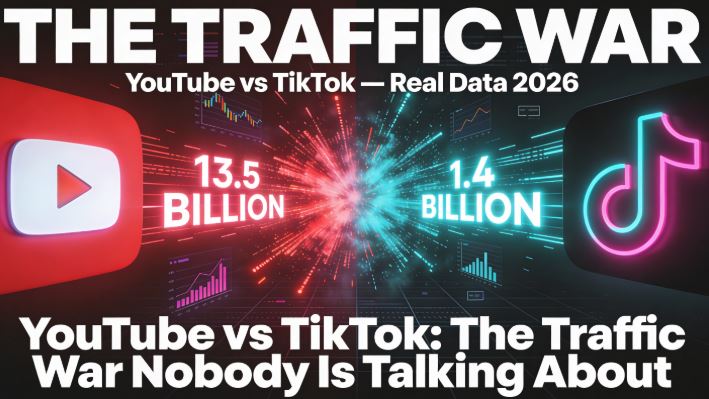
Let's start with the most shocking stat: YouTube receives 13.5 billion visits per month. TikTok? Just 1.4 billion. That's nearly a 10x difference in raw web traffic — yet TikTok dominates the conversation around content creation and virality. So what's really going on?
The answer lies not just in how much traffic each platform gets, but in how that traffic behaves. And when you break it down with real data, the two platforms couldn't be more different.
Head-to-Head: YouTube vs TikTok
| Metric | YouTube | TikTok |
|---|---|---|
| Monthly Web Visits | 13,511,627,644 | 1,413,348,452 |
| Bounce Rate | 37.79% | 57.91% |
| Pages per Visit | 12 | 9 |
| Avg. Time on Site | 00:19:11 | 00:04:56 |
| Traffic from Search | 2,609,218,099 | 507,768,848 |
| Direct Traffic | 10,409,136,793 | 857,562,709 |
| Traffic from Social | 87,329,128 | 12,516,709 |
Source: Real data analyzed with Lookkle
The contrast is brutal. YouTube users stay on the platform for an average of 19 minutes and 11 seconds per visit — TikTok users leave in under 5 minutes. YouTube's bounce rate is a remarkably low 37.79%, meaning most visitors stay and explore. TikTok's is 57.91% — more than half of visitors leave almost immediately.
YouTube Is an SEO Giant. TikTok Is Not (Yet).
One of the most underreported advantages YouTube holds is its dominance in search-driven traffic. YouTube pulls in over 2.6 billion visits from search engines every month, compared to TikTok's 507 million. This is because YouTube videos are indexed by Google, appear in search results, and continue generating traffic for months or even years after publishing.
TikTok, on the other hand, prioritizes fresh, trending content. Its algorithm gives new videos a boost — but older content quickly fades. In 2026, YouTube's SEO longevity is an increasingly valuable asset, with YouTube video publications growing 53% year-over-year and video views up 76% compared to 2025.
The Engagement Paradox
Here's where TikTok fights back. Despite its lower web traffic numbers, TikTok delivers an engagement rate of 2.5–6% per post — far above Instagram and Facebook. Users spend an average of 95 minutes per day on the TikTok app, making it the most addictive platform by daily usage — even if those sessions don't translate into long web visits.
TikTok's algorithm is also uniquely democratic. Every video gets initial test exposure regardless of follower count, because the platform prioritizes content completion rate over subscriber count. In 2026, the virality bar sits at 70% video completion — meaning short, captivating content can explode overnight.
YouTube, meanwhile, rewards consistency and depth. Its weekly publishing frequency is 524% higher than TikTok's among regular creators, debunking the myth that YouTube requires less effort.
Where the Rest of the Social Web Stands
YouTube and TikTok don't exist in a vacuum. Here's how other major platforms compare in the traffic race — all analyzed with Lookkle:
| Platform | Monthly Visits | Avg. Time on Site | Bounce Rate |
|---|---|---|---|
| YouTube | 13.5B | 19:11 | 37.79% |
| 5.4B | 09:55 | 45.79% | |
| 3.2B | 08:13 | 48.41% | |
| X (Twitter) | 1.99B | 12:42 | 46.53% |
| 1.91B | 05:28 | 59.15% | |
| TikTok | 1.41B | 04:56 | 57.91% |
| 911M | 07:20 | 37.38% |
Facebook sits firmly in second place with 5.4 billion monthly visits — and contrary to popular belief, it's far from dead. In fact, Facebook's reach grew 51% and interactions grew 56% year-over-year in 2026.
How to Analyze Any Platform's Traffic with Lookkle
The data in this article was pulled directly using Lookkle — a free web intelligence tool that lets you analyze traffic for any website in the world. Here's how you can replicate this analysis:
🔍 1. Web Traffic Checker
Go to lookkle.com and enter any domain — youtube.com, tiktok.com, or your own site. You'll instantly see monthly visits, bounce rate, pages per session, and average time on site.
📅 2. Historical Traffic Analysis
Track how a platform's traffic has evolved since 2020. Identify when TikTok started gaining ground on YouTube, or how algorithm changes have impacted traffic over time.
🌍 3. Traffic by Source and Country
Break down exactly how much traffic comes from search, direct, social, or referral sources — for any site. This is how we discovered YouTube gets 2.6B search visits vs. TikTok's 507M.
🏆 4. Competitor Benchmarking
Compare up to 20 competitors side by side. If you run a content site, you can benchmark yourself against major social platforms to understand where your audience is spending their time.
📈 5. Real-Time Traffic Estimation
Lookkle's real-time estimator shows how much traffic a page or domain is likely receiving right now — not just historical monthly averages. Perfect for tracking the immediate impact of viral moments or algorithm shifts.
What This Means for Creators and Marketers in 2026
The data points to a clear strategic split:
-
Choose YouTube if you want long-term, compounding, SEO-driven traffic. Videos published today will still generate visits in 2028. YouTube's 19-minute average session time means deeper audience relationships.
-
Choose TikTok if you want fast virality, high daily engagement, and access to nearly 2 billion monthly active users. The platform is unmatched for discovery and trend-driven content.
-
Use both if you're serious about dominating your niche — repurpose long-form YouTube content into TikTok Shorts, and funnel TikTok audiences to your YouTube channel for deeper engagement.
The real winner of the traffic war isn't YouTube or TikTok — it's the creator who understands the data behind each platform and uses it strategically.
Stop Guessing. Start Measuring.
Every number in this article is publicly accessible using Lookkle's free web traffic analyzer. Whether you're a brand deciding where to invest your ad budget, a creator choosing your primary platform, or a marketer building a social media strategy — the data already exists. You just need the right tool to surface it.
The traffic war between YouTube and TikTok is very real. Now you know who's actually winning — and why.