Reading Time 4
Number of Words 845
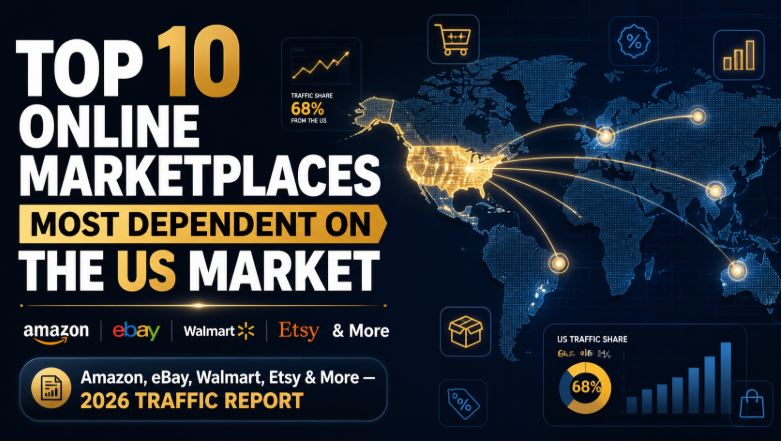
Not all e-commerce giants are equally dependent on the United States. While some marketplaces have achieved a truly global customer base, others build virtually their entire business within US borders.
Analyzing traffic data with Lookkle, we compared the top 10 online marketplaces based on the actual percentage of visits they receive from the US, and the results are more compelling than they seem at first glance: there are platforms where more than 98% of their visitors are American, compared to others with a user base much more spread around the world.
How this ranking was compiled
The data has been extracted and analyzed with Lookkle, specifically filtering the e-commerce and marketplaces category, and ordering the domains according to the percentage of traffic they receive from the United States (not according to the total volume of visits, but according to their actual level of dependence on the local market).
Ranking of dependence on the US market
1. Kohl's.com — 98.99% traffic from the US
The US department store chain tops the ranking with the highest dependence on all the marketplaces analyzed. Barely 1% of its traffic comes from other countries, with Canada (0.11%) as its second largest market, practically irrelevant compared to its local presence.
2. Target.com — 97.74% of traffic from the U.S.
Target confirms the pattern of large brick-and-mortar retail chains with an online presence: its business model, focused on physical stores in the US, is directly reflected in almost exclusively local traffic. India (0.36%) is its second largest market.
3. Wayfair.com — 97.25% of traffic from the USA.
The furniture and home decor specialist maintains an almost total dependence on the US market, with Canada (0.65%) as the most relevant secondary country.
4. Walmart.com — 95.5% of traffic from the U.S.
The world's largest retail giant also overwhelmingly concentrates its online traffic in its home country. Only 4.5% of its visits come from outside the US.
5. Amazon.com — 87.21% of traffic from the US
Despite operating with local domains in dozens of countries (amazon.es, amazon.de, amazon.co.uk...), the main domain amazon.comcontinues to concentrate its traffic heavily in the United States. India accounts for barely 0.91% of its visits.
6. Ebay.com — 81.5% of traffic from the USA.
eBay maintains a high dependence on the US market, with Mexico (1.21%) and Canada (1.08%) as the next most important countries, well below the weight of the US.
7. Etsy.com — 59.1% of traffic from the USA.
The marketplace specializing in handcrafted and vintage products significantly reduces its reliance on other markets compared to the previous six. The United Kingdom (8.64%) is its second most important market, reflecting its strong community of European creators.
8. Wish.com — 25.39% of traffic from the US
Wish marks a clear turning point in the ranking: it is the first platform with a predominantly international traffic base. China (6.96%), Italy (6.63%), and Germany (6.38%) account for a very significant portion of its traffic.
9. Temu.com — 24.44% of traffic from the USA.
Temu confirms its aggressive expansion strategy outside the United States: Germany (5.72%), the United Kingdom (4.97%) and Italy (4.31%) are key markets for this platform of Chinese origin.
10. Alibaba.com — 19.73% of traffic from the US
The Chinese wholesale marketplace closes out the ranking, with the lowest dependence on the United States of any on the list. Its second largest market is, logically, China (10.7%), reflecting its nature as a global B2B platform.
What these data reveal
-
There is a huge gap between "traditional" marketplaces and new generation marketplaces : Kohl's, Target, Wayfair, Walmart and Amazon exceed 87% dependence on the US, while Wish, Temu and Alibaba, with more international origins or strategies, remain below 26%.
-
Marketplaces with a physical presence in the US (Kohl's, Target, Walmart) are the most dependent, since their online traffic is closely linked to customers who also buy in physical stores, which naturally limits their international reach.
-
Etsy occupies an interesting middle ground : its niche model (crafts, vintage, personalized products) has allowed it to build a more international customer base than Amazon or Walmart, without reaching the diversification of Wish, Temu or Alibaba.
-
Alibaba is the opposite case to Kohl's : being a B2B platform focused on international wholesale trade, its traffic is much more globally distributed, with China as its true home market.
Frequently Asked Questions
Why doesn't Amazon have 100% of its traffic in the US if it's an American company?
Because Amazon operates with its own domains in many countries (amazon.es, amazon.de, amazon.co.jp...), which reduces the percentage of international traffic that goes to the main domain .com, although it still receives visits from users in other countries who access it directly.
What does it mean for a marketplace to have low country dependence?
It indicates that its user base is more geographically diversified, which can be an advantage in the face of economic or regulatory changes in a single market, but it also implies managing the complexity of operating in multiple countries simultaneously.
Why do Wish, Temu, and Alibaba have so little dependence on the US?
These three platforms were born or grew with an international expansion strategy from their origin (China), unlike chains like Walmart, Target, or Kohl's, which built their business first in physical US stores before digitizing.