Reading Time 8
Number of Words 1674
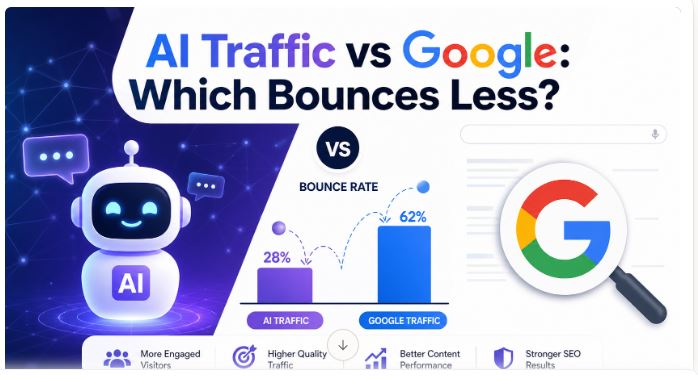
Over the past year and a half, hundreds of thousands of sessions analyzed by firms such as Similarweb, Adobe, Amsive, Seer Interactive, and Exposure Ninja have shown a pattern: traffic coming from ChatGPT, Gemini, Perplexity, or Claude bounces less than classic Google organic traffic .
But the difference isn't uniform; it depends on the type of website, and the very concept of "bounce rate" is becoming obsolete compared to more refined engagement metrics. This article compiles the latest industry data and compares it with a mini-study conducted using Lookkle Web Traffic Checker on four content, affiliate, and e-commerce websites.
The bounce rate is the percentage of visitors who enter a page on your website and leave without performing any further interaction: they do not click on another link, visit a second page, or complete any action (fill out a form, scroll meaningfully, play a video, etc.).
A simple example: if 100 people enter an article on your blog and 45 of them close the tab or go back without touching anything else, your bounce rate for that page is 45%.
What the studies say from 2025-2026
The most cited study in the sector, conducted by researchers from the University of Hamburg and the Frankfurt School of Finance, analyzed 973 e-commerce sites and $20 billion in combined revenue , comparing over 50,000 transactions from ChatGPT with 164 million transactions from traditional channels. Their conclusion regarding engagement is clear: ChatGPT traffic has a lower bounce rate than most channels , although organic and paid Google search traffic remains the best in this metric when measured across the entire set of channels (email, affiliates, social media, etc.).
Adobe reached an even more striking conclusion by analyzing traffic to retail sites: between July 2024 and February 2025, visits from generative AI showed a bounce rate up to 45% lower than traditional traffic, with 12% more page views and 41% longer sessions . The gap continued to widen month after month.
SEOmator, after scanning 48 sites with data from 2026, found that AI-referred visits have a 27% lower bounce rate and longer session durations, while Google Organic converts worse (2.8%) compared to 14.2% for AI searches.
A particularly illustrative example is Averi.ai, which published its real-world analytics for 16 days: Gemini had a 64.7% bounce rate compared to Google Search's 83.2% on the same website and time frame , with 1.76 pages per visit versus Google's 1.35. Their team also warns that GA4 already considers any session without an engagement event in the first 10 seconds a "bounce," so comparing traditional bounce rates between such different channels can lead to erroneous conclusions.
Comparative table by traffic source
The most granular data by AI platform comes from an August 2026 report on 90 days of real sessions, which breaks down bounce rate, visit time, and pages per session channel by channel:
| Fountain | Bounce rate | Average visit duration | Pages per visit | Engagement rate |
|---|---|---|---|---|
| Gemini | 29.47% | 7:16 min | 4.07 | 72.0% |
| ChatGPT | 32.83% | 5:56 min | 3.61 | 69.7% |
| Perplexity | — | — | — | 64.5% |
| Claude | — | — | — | 64.8% |
| Bing Organic | — | 47.9 s | — | 58.4% |
| Google Organic | — | 44.2 s | — | 61.8% |
Overall, AI sources generate 20% to 31% higher engagement than organic Google and Bing, and multiply engagement by up to 14 times compared to social networks like LinkedIn or Reddit.
On the conversion side, however, the roles are reversed according to the sample: Slate reports that ChatGPT's referred traffic converts at 15.9% compared to 1.76% for Google Organic, while an Amsive study of 54 websites found that the conversion difference between LLM (4.87%) and organic (4.60%) is not statistically significant (p=0.794), and that AI traffic still represents less than 1% of total sessions compared to 32% for organic traffic. In other words: a lower bounce rate doesn't always mean better business, especially if AI traffic volume is still marginal.
Why AI traffic bounces less
The most consistent explanation across various analyses is that users arriving via AI have already received prior context in the conversation before clicking: the chatbot has summarized, compared, or pre-qualified the answer, so those entering the website already know what to expect and are more likely to stay and explore further. This also explains why AI sessions generate more page views: users arrive "warmed up" and explore in depth instead of quickly scrolling to see if the page answers their question, as happens with a Google result that may or may not match the search intent.
Another factor is purely technical: AI crawlers generate a huge volume of crawling for each actual visit they produce (Cloudflare Radar calculated that Anthropic crawls 2,442 pages for each visitor it sends back, compared to 5 for Google), indicating that the "AI" traffic that reaches analytics is already heavily filtered and cleaned of bots before being counted as a session.
Real-world examples analyzed with Lookkle
To test the theory with field data, we ran four niche content and affiliate websites through Lookkle's Web Traffic Checker and cross-referenced their organic and AI traffic with the site's aggregate bounce rate:
| Web | Total visits | MoM variation | % Organic | % AI Traffic | Bounce rate | Pages/visit | Time on site |
|---|---|---|---|---|---|---|---|
| brantashop.com | 16,523 | 🔺 27.4% | 47.00% | 0.80% | 5.64% | 1.68 | 00:01:05 |
| mbookmarking.com | 10,490 | 🔺 33.2% | 5.00% | 0.71% | 45.91% | 2.79 | 00:02:16 |
| smartads.in | 4,722 | 🔻 -9.5% | 53.01% | 0.47% | 50.51% | 1.62 | 00:00:29 |
| minipc-review.com | 22,646 | 🔺 48.4% | 72.00% | 0.26% | 50.53% | 1.57 | 00:00:35 |
(Ordered from highest to lowest percentage of AI traffic relative to total visits. Methodological note: only content/ecommerce/affiliate websites with a similar profile have been compared, excluding B2B SaaS tools whose usage pattern is not comparable to this group.)
With this group of four sites, the correlation between AI traffic percentage and aggregate bounce rate is negative and notable (r ≈ -0.72) : the higher the AI traffic share, the lower the overall site bounce rate. A positive correlation also appears with pages per visit (r ≈ 0.47) and, especially, with time on site (r ≈ 0.63). It's a small sample, but the trend aligns with what Adobe and SEOmator report on a larger scale.
The most striking case is brantashop.com , with a bounce rate of just 5.64% and an average session duration of 1 minute and 5 seconds, significantly higher than the rest of the group. It combines the highest share of AI traffic (0.80%) with 47% well-segmented organic traffic, suggesting a product or landing page architecture highly aligned with search intent—the kind that both search engines and AI assistants tend to cite and recommend. mbookmarking.com , with 0.71% AI traffic, is second best in pages per visit (2.79) and time on site (2 minutes and 16 seconds), despite relying on direct traffic in 87% of cases.
At the opposite end of the spectrum, smartads.in and minipc-review.com —the two websites with the lowest AI traffic share (0.47% and 0.26% respectively)—show the highest bounce rates in the group, exceeding 50%. Furthermore, minipc-review.com relies almost exclusively on traditional organic traffic (72% of the total), confirming that its traffic model now depends much more on Google than on the AI assistant ecosystem.
The minipc-review.com case
Within this group, minipc-review.com stands out as the website with the highest monthly growth (+48.4%) and the largest proportion of organic traffic (72%), but also the one that captures the least AI traffic in relative terms (0.26%) and has the second highest bounce rate in the group (50.53%). This suggests a clear opportunity: mini PC comparison content, with technical specifications and tables, is precisely the format that AI search engines prefer to cite. Therefore, optimizing product pages with structured data and direct answers could begin to move that 0.26% share closer to the 0.7-0.8% already achieved by mbookmarking.com or brantashop.com, without sacrificing the organic volume that currently sustains the site's growth.
How to replicate this analysis with Lookkle
The recommended workflow for any site owner would be:
-
Run a Live Web Traffic report on the domain and filter by source to isolate the "AI-generated visits" block from "Search / Organic".
-
Cross-reference that segment with the Traffic by Device and Historical Analytics modules , since AI traffic tends to be concentrated on desktop and product research sessions.
-
Use the Competitor Benchmark to compare the website against direct competitors in the niche and see if they already receive a higher proportion of AI traffic, which usually correlates with more quotable content (lists, specification tables, clear comparisons).
-
Review Organic Keywords Insights to identify which keywords continue to bring in classic search traffic with a high bounce rate and could be rewritten in an "AI Overview friendly" format (direct answer at the top, structured data, tables).
Since the classic bounce rate loses its meaning when GA4 no longer calculates it the same way as Universal Analytics, the practical recommendation is to replace the bounce rate KPI with engagement time per session and pages per visit , exactly the indicators that Lookkle already breaks down by traffic source.
Conclusions for a review and affiliate site
For a hardware comparison project monetized through affiliate marketing, the correct interpretation of this data is not to "chasing AI traffic because it bounces less," but to understand that:
-
AI traffic (ChatGPT, Gemini, Perplexity) is more qualified and bounces less because the user has already been pre-informed by the assistant, something especially favorable for technical comparison content such as mini PC specifications.
-
Our own mini-study with Lookkle, although with a reduced sample of four sites, reinforces that trend: the two sites with the highest share of AI traffic (brantashop.com and mbookmarking.com) have the lowest bounce rate and the highest time on site in the group.
-
Google Organic still contributes the bulk of the volume (up to 72% of sessions on minipc-review.com), so abandoning traditional SEO to pursue still marginal AI traffic would be a prioritization mistake.
-
The winning strategy combines both: optimizing content to be cited by AI (clear specification tables, structured comparisons, verifiable data) while still working on classic SEO that continues to bring the volume that ultimately converts into affiliate clicks.