Reading Time 9
Number of Words 1843
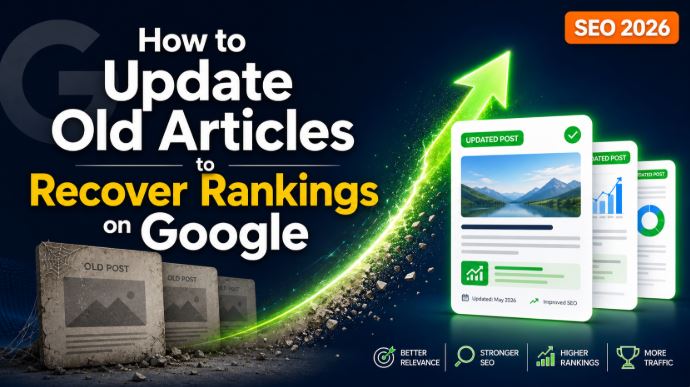
If you have a blog or website with articles that used to generate traffic but now seem invisible in the results, you don't need to start from scratch.
Updating old content is one of the most cost-effective SEO strategies: you invest much less time than writing a new article and the results can be as good—or better—than those of a newly published post.
In this guide we explain exactly how to do it, step by step, with real tools and clear criteria to prioritize what to update first.
Why Do Articles Lose Positions?
Google doesn't rank pages permanently. Its algorithm constantly evaluates which result is most useful for each query, and several factors can cause an article that previously performed well to become irrelevant:
-
The content is outdated: data, statistics, tools, or advice that no longer apply.
-
Search intent has changed: what the user is looking for when typing that keyword today is different from what they were looking for two years ago.
-
Stronger competition emerged: more comprehensive, better structured, or more authoritative articles.
-
Link deterioration: broken internal or external links that weaken the page.
-
Loss of freshness signals: Google rewards recent content in many categories, especially in technology, SEO, finance, and health.
Step 1: Identify Which Items Are Worth Updating
Not all old articles deserve the same effort. The goal is to find those with latent potential: pages that Google already knows and values, but that have lost their effectiveness.
🔍 How to detect them in Google Search Console (GSC)
-
Go to Search Console → Performance → Search Results
-
Filter by the last 6 or 12 months
-
Activate the columns: Clicks, Impressions, CTR, and Average Position
-
Sort by Impressions from highest to lowest
Look for pages that meet one or more of these criteria:
| Sign | What does it indicate? |
|---|---|
| Many impressions, few clicks | The article appears but doesn't encourage clicks (weak title/meta description) |
| Position between 5 and 20 | It's close to the first page — with improvements you can easily jump ahead |
| Progressive decline in clicks in recent months | The article is becoming outdated. |
| High-volume but low-CTR keywords | The search intent is not well covered |
📊 How to detect them in Google Analytics 4 (GA4)
Go to Reports → Acquisition → Traffic Acquisition and filter by organic channel. Compare time periods: pages that received a lot of traffic 12 months ago and have now dropped by more than 30% are your priority candidates.
💡 Prioritization criteria: Start with the articles that were previously among your 10 most visited pages. These have the most "accumulated authority" and respond best to updates.
Step 2: Analyze the Article Before Touching It
Before editing anything, you need to understand why it lost positions. Opening the article and starting to write without prior analysis is the most common mistake.
Pre-checklist ✅
1. Review current search intent.
Search Google in incognito mode for the article's main keyword. Analyze the first 10 results: Are they guides? Lists? Videos? Product pages? If the format of the first results differs from yours, there's your first problem.
2. Analyze the content of your competitors who outperform you.
Use tools like Lookkle or even a manual search to see what they're covering that you're not. Do they have sections you're omitting? More up-to-date data? A better visual structure?
3. Identify the secondary keywords you're not using.
Many articles miss opportunities by not including semantic variations. Use Google Search Console to see what searches your article is currently ranking for and add the relevant keywords you haven't covered.
4. Check the date of the data.
If the article mentions statistics, prices, tools, or regulations from more than 18-24 months ago, it is urgent to update it.
Step 3: The Changes That Really Matter
Here's the key: not everything needs to be rewritten. Efficiency lies in knowing which changes have the greatest SEO impact and which are merely cosmetic.
🔴 High Impact Changes
→ Update the title (H1) and meta title.
If your article has had the same title for 3 years, it's probably not optimized for how people search today. Add the current year if the topic is time-sensitive (e.g., "...in 2026"), or include an intent modifier you were missing ("Complete Guide," "Step-by-Step," "With Real-World Examples").
→ Rewrite the meta description.
This text is what determines whether the user clicks or scrolls down. It should include the main keyword, a clear benefit, and a call to action. Google has confirmed that the meta description doesn't directly affect ranking, but a high CTR does improve your position.
→ Update data, figures, and statistics.
Replace any statistics older than 12-18 months with current data. Find official sources (industry reports, academic studies, data from recognized organizations) and link to them. This improves the article's EEAT (Experience, Expertise, Authoritativeness, Trustworthiness) credibility.
→ Add sections that cover unanswered questions. Check Google's "People also ask"
section for your keyword. If there are related questions your article doesn't answer, add new sections or an FAQ block at the end. This can help you get featured snippets.
→ Improve the structure with H2 and H3 headings.
A well-structured article is easier for users to scan and for Google to interpret. If your article has blocks of text without headings, divide them into clear sections. Use H2 headings for the main blocks and H3 headings for the subtopics within each block.
🟡 Medium Impact Changes
→ Update or add images
. Replace outdated screenshots. Add infographics, tables, or visual comparisons if the theme allows it. Remember to optimize the alt text with the relevant keyword or variations.
→ Include new internal links.
Link the updated article to other recent posts on your site that are relevant. And vice versa: go to those new articles and add a link to the one you just updated. Well-executed internal linking can have a huge impact.
→ Fix or replace broken external links.
A link that leads to a 404 page not only frustrates the user, but also sends a negative signal to Google. Use an extension like Check My Links (Chrome) or tools like Screaming Frog to detect them.
→ Add video if possible.
Embedding a related video (your own or from YouTube) increases the time spent on the page, an indirect quality signal for Google.
🟢 Minor (but cumulative) Impact Changes
-
Add the structured data schema ( Schema markup ) if you don't already have it: Article, FAQ, HowTo
-
Improve page load speed (compress images, clean unnecessary scripts)
-
Add a table of contents with anchor links to long articles
-
Update the publication date or add a visible "last updated" notice
Step 4: The Update Date — When and How to Indicate It?
This point causes a lot of confusion. The answer is: always indicate the last update date if the topic is time-sensitive.
Make it visible, ideally right below the title or at the beginning of the article:
✏️ Last updated: May 2026
Should you change the original publication date? It depends:
-
Yes, if you have substantially rewritten or expanded the article (more than 40-50% of the content)
-
No, if you're only correcting minor errors or adding a paragraph — in that case, just add the "last updated" date.
Changing the publication date without having made any real changes is a practice that Google identifies and penalizes as "freshness spam".
Step 5: Notify Google of the Changes
Once you've saved your changes, don't wait for Google to discover them automatically. Request manual reindexing in Search Console.
-
Go to Google Search Console
-
Paste the URL of the updated article into the top inspection bar
-
Click on "Request indexing"
Google usually processes the request in minutes or a few hours, although changes in ranking can take days or weeks to solidify.
Step 6: Amplify the Updated Article
Treating an updated article as if it were new content in terms of distribution is one of the best practices:
-
📱 Share it on social media as if it were a recent post (you can indicate "Updated for 2026")
-
📧 Include it in your newsletter with a short introduction explaining what you've improved.
-
🔗 Add links from other new articles you publish in the coming months
-
💬 Respond to comments or questions that have been submitted about the article — recent activity is also a sign of freshness
Step 7: Measure the Results
Don't update and forget. Follow up in the 4-8 weeks afterward to assess the impact:
| Metrics | Where to measure it | What to expect |
|---|---|---|
| Average position on Google | Search Console → Performance | Gradual improvement in 2-6 weeks |
| Organic clicks | Search Console → Performance | Increase proportional to the improvement in position |
| CTR | Search Console → Performance | Upload if you improved the title and meta description |
| Time on page | GA4 → Commitment | Upload if you improved the quality of the content |
| Bounce rate | GA4 → Commitment | Lower the list if the article better fulfills the intention |
If after 6-8 weeks you don't see improvement, analyze again: the problem may be domain authority (you need more backlinks) or the competition for that keyword may be too strong for your current site.
How Often Should You Update Your Articles?
There is no single answer, but these are the recommended guidelines depending on the type of content:
| Content type | Recommended frequency |
|---|---|
| SEO, digital marketing, technology | Every 6-12 months |
| News or trends | As the issue evolves |
| Evergreen (tutorials, recipes, timeless guides) | Every 1-2 years |
| Content with statistical data | When new relevant data is published |
| Product reviews | When new versions are released or the price changes |
Common Mistakes You Should Avoid
These are the most common mistakes when updating old content:
❌ Update without prior analysis: Changing things randomly without knowing what caused the drop.
❌ Change the article URL: If the article already has backlinks or a good ranking, changing the URL will ruin it. Always keep the original URL.
❌ Delete content that is still valid: Don't delete sections that are still useful just to "modernize" the article.
❌ Only update the date without changing anything: Google detects this quickly, and it doesn't generate any real benefit.
❌ Don't measure the results: If you don't analyze the impact, you'll never know if the strategy is working on your site.
❌ Ignore search intent: You can have the best article in the world on a topic, but if the format doesn't match what Google thinks the user is searching for, you won't rank.
Recommended Tools for this Strategy
| Tool | What to use it for | Price |
|---|---|---|
| Google Search Console | Detect drops and request reindexing | Free |
| Google Analytics 4 | Analyze user behavior | Free |
| Organic Keywords | Keyword and competitor analysis | Paid (with free trial) |
| SEO Audit | Detect technical errors and broken links | Free |
| Surfer SEO | Compare your content to the top 10 | Paid |
| Check My Links | Detect broken links in seconds | Free |
| PageSpeed | Loading speed | Free |
| Competitor Tool | Get to know up to 20 competitors | Free |
✅ Conclusion: Update Before Creating
Updating old content is not an emergency solution: it's a proactive and cost-effective strategy that should be on the calendar for any website older than 6 months.
The logic is simple: you already have an article that Google knows, that has some authority, and that may even have some backlinks. Improving it costs much less than creating a new one from scratch, and the return can be the same or even greater.
The process in summary:
-
🔍 Audit with GSC and GA4 — identify the pages with the most dormant potential
-
🧠 Analyze before you act — understand why it dropped
-
✏️ Update wisely — prioritize high-impact changes
-
📅 State the update date — clearly and honestly
-
📢 Share the updated article — treat it as new content
-
📊 Measure the results — and adjust if necessary
Apply this strategy systematically, article by article, and in a few weeks you will start to see how pages that seemed dead begin to generate constant organic traffic again.