Reading Time 5
Number of Words 918
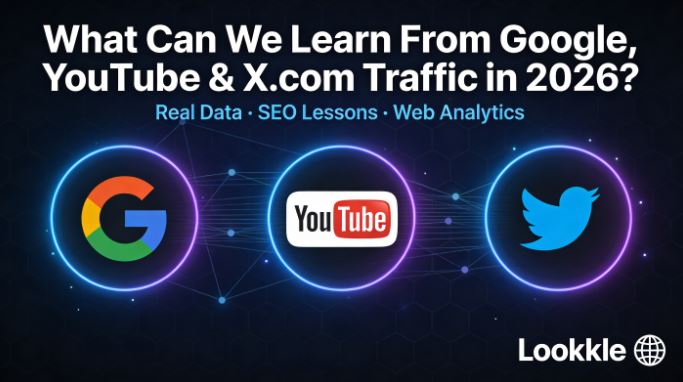
If you're learning SEO, analyzing how internet giants manage their traffic is one of the best exercises you can do. In this article, we explain what the real data for 2026 means and how to apply those lessons to your own website.
What is web traffic and why does it matter?
Before we delve into the data, let's clarify a basic concept: web traffic is the number of visits a site receives in a given period. But not all visits are created equal. They come from different sources: organic search (SEO), direct traffic, social media, or referrals from other sites.
Understanding where the traffic of the world's largest websites comes from helps you prioritize your strategy.
Do you want to check it yourself on any domain?
Use Lookkle's Web Traffic tool to see the traffic sources of any site at a glance.
The data: ranking of the most visited sites in 2026 ( source: lookkle.com )
This is the table with the actual data for the three giants we analyzed today:
| Metric | Google.com | YouTube.com | X.com |
|---|---|---|---|
| Total trafficking | 42.878 million visits | 15.187 million visits | 2.271 million visits |
| Bounce rate | 43,36% | 37,64% | 46,65% |
| Pages per visit | 8 | 12 | 14 |
| Time on site | 10 min 08 sec | 19 min 40 sec | 12 min 25 sec |
| Search traffic | 3.579M | 2.913M | 439M |
| Direct traffic | 36.801M | 11.709M | 1.715M |
| Social trafficking | 326M | 82M | 29M |
What is the bounce rate and what does this data tell us?
Q: What does bounce rate mean for a beginner SEO?
A: The bounce rate indicates the percentage of users who enter a site and leave without further interaction. A high bounce rate (above 60-70%) is usually a bad sign: the user didn't find what they were looking for.
YouTube has the lowest bounce rate of the three: only 37.64%, meaning that almost two out of three users continue browsing after entering. Google's bounce rate is 43.36% and X.com's is 46.65%, both healthy figures for platforms of this type.
💡 Lesson for your website: If your bounce rate exceeds 70%, review whether your content truly addresses the user's search intent. You can audit your website with Lookkle's On-Page SEO tool to detect relevance and usability issues.
Pages per visit: How much does the user browse?
Q: Why does X.com have more pages per visit than Google or YouTube?
A: X.com registers 14 pages per visit, the highest of the three, thanks to its infinite feed format that encourages continuous scrolling. YouTube achieves 12 pages per visit because its video recommendation system guides the user from one piece of content to another. Google, with 8 pages, reflects that users perform multiple searches and use integrated services like Gmail or Maps.
💡 Lesson for your website: Design your content architecture so that the user always has a clear "next step": related articles, well-linked categories, or internal calls to action. Use Lookkle's Competitor Benchmark to see how many pages per visit your direct competitors achieve and set a realistic goal.
Time on site: video always wins
Q: Why does YouTube have the highest time on site?
A: YouTube reaches an average visit time of 19 minutes and 40 seconds, almost double that of Google (10:08) and well above X.com (12:25). Video is the format that consumes the most attention: it is immersive, entertaining, and the YouTube algorithm is designed so that there is always another video waiting.
💡 Lesson for your website: If you want to improve time on site, incorporate video into your articles. An embedded tutorial or video explanation can significantly increase the time a user spends on your page, which Google interprets as a sign of quality.
Traffic sources: the big secret no one tells you
Q: Where does the traffic for Google, YouTube, and X.com actually come from?
A: The most revealing piece of data in the table is this: the three giants depend primarily on direct traffic, not SEO. Google receives 36.801 billion direct visits compared to only 3.579 billion from searches. YouTube has 11.709 billion direct visits vs. 2.913 billion from searches. And X.com, 1.715 billion direct visits vs. 439 million from searches.
Q: What does this mean for a beginner SEO?
A: It means that SEO is essential for being discovered, but branding is what makes users return directly. Direct traffic is the most valuable because it's free, loyal, and doesn't depend on algorithms.
💡 Lesson for your website: Work on SEO to attract new users, but build brand awareness to retain them. Analyze any competitor's traffic sources with Lookkle's Traffic Source Breakdown tool and discover which channel works best for them.
Social traffic: less than it seems
Q: Do social media platforms generate a lot of traffic?
A: Surprisingly, not as much as people think. Google receives only 325 million visits from social media out of a total of 42.878 billion: less than 1%. YouTube has 82 million social media visits out of 15.187 billion (also less than 1%). X.com, logically, receives 29 million social media visits out of 2.271 billion.
💡 Lesson for your website: Social media is useful for visibility and branding, but it's not the primary source of traffic, even for the world's largest websites. Invest in SEO as a sustainable channel and use social media as an amplifier.
Bonus: ChatGPT now surpasses X.com in traffic
One fact you shouldn't ignore: ChatGPT.com registers 2.861 billion visits, already surpassing X.com (2.271 billion) in the global ranking. With a bounce rate of 47.26% and just 4 pages per visit, users go to ChatGPT, ask their question, and leave. This has a direct impact on SEO: users who previously searched on Google now get answers directly from AI.
💡 Lesson for your website: Optimize your content so that it's cited by AI tools (answer questions directly, use clear formats, and provide verifiable data). This is the new SEO everyone's talking about: AEO (Answer Engine Optimization).