Reading Time 9
Number of Words 1997
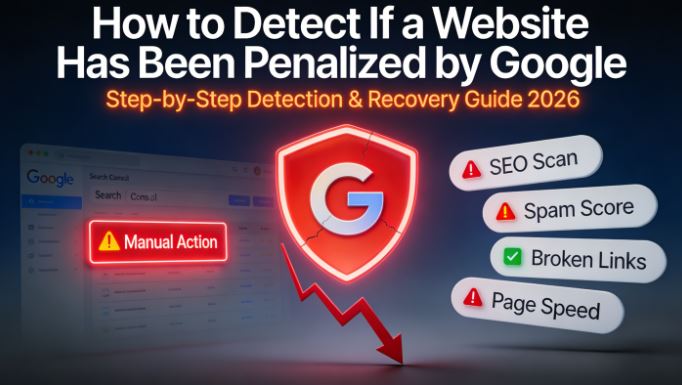
One day your website is ranking on page one. The next, your traffic has collapsed, your keywords have vanished from the SERPs, and your Google Search Console is showing alarming drops in impressions.
If this sounds familiar, you may be dealing with a Google penalty — one of the most serious threats any website owner can face in 2026.
Google issues over 400,000 manual penalties every month. And that doesn't count the far more common — and far harder to detect — algorithmic penalties, which hit silently with no notification whatsoever.
The good news: 30% of penalized websites recover their rankings within a year when they follow the right diagnosis and recovery process.
This guide walks you through everything: how to detect a penalty, what caused it, and exactly how to fix it.
What Exactly Is a Google Penalty?
A Google penalty is a punitive action — either applied manually by a Google reviewer or triggered automatically by Google's algorithms — that causes a website to lose rankings, visibility, or indexation in Google Search results. Penalties are Google's way of enforcing its Search Essentials (formerly Webmaster Guidelines) and ensuring that only high-quality, trustworthy content reaches users.
There are two fundamentally different types of Google penalties, and understanding the difference is critical — because they require completely different detection and recovery approaches.
Manual Penalties vs Algorithmic Penalties
| Manual Penalty | Algorithmic Penalty | |
|---|---|---|
| Applied by | Human Google reviewer | Automated algorithm |
| Notification | ✅ Yes — Google Search Console + email | ❌ No notification at all |
| Where to find it | GSC → Security & Manual Actions | Not visible in GSC |
| Common causes | Unnatural links, spam, hidden text, malware | Thin content, poor UX, link profile, Core Web Vitals |
| Scope | Entire site or specific pages | Usually sitewide |
| Recovery time | 10–30 days after reconsideration | 3–6+ months |
| Recovery method | Fix issue + submit reconsideration request | Fix issues + wait for next algorithm update |
| Severity | Can cause complete deindexation | Usually ranking drops, not full removal |
Manual penalties are applied by Google's web spam team after a human reviewer investigates the site and confirms a violation of Google's guidelines. Algorithmic penalties are silent — triggered automatically when Google's systems detect quality issues — and they are significantly harder to diagnose because no notification is ever sent.
10 Signs Your Website Has Been Penalized
Before running any tools, look for these warning signals:
-
Sudden, sharp traffic drop — a 30–90% drop in organic traffic in a matter of days
-
Keywords disappearing from rankings — pages that ranked on page 1 now don't appear in the top 100
-
Homepage no longer ranks for your brand name — one of the most severe penalty signals
-
Pages deindexed — your pages no longer appear when you search
site:yourdomain.com -
Google Search Console alerts — manual action notifications or security warnings
-
Traffic drop coincides with a known Google update — check if the drop aligns with a documented algorithm update date
-
Significant drop in impressions (not just clicks) in GSC — indicates Google is showing your pages less
-
Crawl errors spike in Google Search Console
-
Spam score increase — your site's spam metrics worsen without explanation
-
Competitors suddenly outrank you on keywords you dominated for months
Step-by-Step: How to Detect a Google Penalty
🔍 Step 1: Check Google Search Console for Manual Actions
The very first step — always — is to open Google Search Console.
-
Log into Google Search Console → select your property
-
Navigate to Security & Manual Actions → Manual Actions
-
If you see "No issues detected" → you have no manual penalty
-
If you see a warning → read it carefully — Google will specify the exact violation (unnatural links, thin content, spam, malware, etc.)
If a manual penalty exists, Google also sends a notification email to all verified GSC users. Check your Gmail for messages from google-search-console-no-reply@google.com.
🔍 Step 2: Analyze Your Traffic Timeline
If Google Search Console shows no manual action, you may be dealing with an algorithmic penalty — which requires traffic analysis to detect.
-
Open Google Analytics 4 → go to Reports → Acquisition → Organic Traffic
-
Set a date range of the last 6–12 months
-
Look for a sudden, sustained drop on a specific date
-
Cross-reference that date with Google's official algorithm update history
If your traffic drop coincides exactly with a documented Google algorithm update (Core Update, Helpful Content Update, Spam Update), you are almost certainly dealing with an algorithmic penalty.
💡 Use Lookkle's Website Traffic Checker to get a quick external view of your site's traffic trends — useful for checking competitor sites or verifying your own traffic data against a third-party source. It shows estimated monthly visits, traffic sources, and visibility trends at a glance.
🔍 Step 3: Check Your Spam Score
One of the most overlooked causes of both manual and algorithmic penalties is a high spam score — driven by toxic backlinks, spammy anchor text, or low-quality link profiles. Google's Penguin algorithm specifically targets manipulative link building, and a contaminated backlink profile can trigger a penalty without any warning.
Signs of a spam-related penalty:
-
Sudden acquisition of hundreds of backlinks from irrelevant or foreign-language domains
-
High percentage of exact-match anchor text backlinks
-
Links from known link farms, PBNs (Private Blog Networks), or casino/pharma spam sites
-
Your disavow file hasn't been updated in over 12 months
🔍 Step 4: Run a Full Technical SEO Audit
Technical issues are a leading cause of algorithmic ranking drops that are often mistaken for penalties. Common technical triggers include:
-
Accidental
noindextags on important pages (pushed via CMS updates) -
Broken canonical tags causing Google to index the wrong URL
-
Slow page speed — Core Web Vitals failures (LCP, CLS, INP)
-
JavaScript rendering issues preventing Google from reading page content
-
Duplicate content across multiple URLs without proper canonicalization
-
robots.txt errors blocking Googlebot from crawling key sections
-
Missing or broken XML sitemap
💡 Use Lookkle's SEO Website Scan to run a complete technical audit in minutes. It checks meta tags, heading structure, canonical tags, robots directives, sitemap status, image alt attributes, and dozens of other on-page signals — giving you a prioritized list of issues to fix immediately.
🔍 Step 5: Test Your Page Speed
Slow loading times are not a direct manual penalty, but they trigger algorithmic drops through poor Core Web Vitals scores — which Google treats as a strong negative ranking signal since the Page Experience update. If your Largest Contentful Paint (LCP) is above 4 seconds or your Cumulative Layout Shift (CLS) exceeds 0.25, you are likely losing rankings algorithmically.
Core Web Vitals thresholds Google uses:
| Metric | Good | Needs Improvement | Poor |
|---|---|---|---|
| LCP (loading) | < 2.5s | 2.5–4.0s | > 4.0s |
| CLS (stability) | < 0.1 | 0.1–0.25 | > 0.25 |
| INP (interactivity) | < 200ms | 200–500ms | > 500ms |
🔍 Step 6: Scan for Broken Links
Broken internal and external links are a technical SEO red flag that signals poor site maintenance to Google. A high number of broken links — especially on key pages — contributes to:
-
Poor crawl efficiency (Googlebot wastes crawl budget on dead URLs)
-
Poor user experience signals (high bounce rates from 404 pages)
-
Loss of link equity from external links pointing to non-existent pages
-
Reduced E-E-A-T perception — a well-maintained site doesn't have broken links
💡 Use Lookkle's Broken Link Scanner to crawl your entire site and identify every broken internal and external link in minutes. Fix 404 errors with 301 redirects to the correct page, and replace broken external links with updated sources — two quick wins that improve both crawlability and user experience.
The Most Common Causes of Google Penalties in 2026
Understanding why penalties happen helps you both diagnose and prevent them:
Content-Related Causes
-
Thin or low-value content — pages with fewer than 300 words, minimal original insight, or purely recycled information
-
AI-generated content farms — mass-produced AI content with no human oversight or original expertise (heavily targeted in the January and February 2026 Core Updates)
-
Keyword stuffing — unnaturally high keyword density that reads as spam
-
Duplicate content — same or near-identical content on multiple URLs without canonicalization
-
Cloaking — showing different content to Googlebot vs. human users
Link-Related Causes
-
Unnatural inbound links — links purchased, exchanged in bulk, or generated through link schemes
-
Toxic backlink profile — high volume of links from spam domains, PBNs, or irrelevant foreign sites
-
Over-optimized anchor text — excessive exact-match anchor text in backlink profiles
Technical Causes
-
Malware or hacked content — Google penalizes sites infected by hackers to protect users
-
Hidden text or links — content visible to Googlebot but not to users
-
Doorway pages — pages created solely to rank for a keyword with no real user value
-
Core Web Vitals failures — persistent LCP, CLS, or INP issues
How to Recover from a Google Penalty
Recovery from a Manual Penalty
-
Identify the violation — read the manual action notification in GSC carefully
-
Fix every instance of the violation across your entire site
-
Disavow toxic links using Google's Disavow Tool if the penalty is link-related
-
Document all changes made — Google reviewers expect evidence of cleanup
-
Submit a Reconsideration Request in GSC → Manual Actions
-
Wait 10–30 days for Google's review team to process your request
-
Monitor GSC and GA4 for ranking and traffic recovery
Recovery from an Algorithmic Penalty
-
Identify the algorithm that caused the drop (Core Update, Helpful Content, Spam Update)
-
Audit your content — remove or substantially improve thin, AI-spammy, or low-quality pages
-
Clean your backlink profile — disavow toxic links proactively
-
Fix all technical SEO issues — Core Web Vitals, broken links, crawl errors
-
Strengthen E-E-A-T signals — author bios, editorial standards, original research
-
Wait for the next algorithm update — algorithmic recoveries are confirmed at the next major update cycle
-
Recovery timeline: 3–6 months minimum for significant algorithmic penalties
Penalty Detection Toolkit: All Tools in One Place
Here is your complete toolkit for detecting and diagnosing a Google penalty:
| Tool | What It Checks | Use It For |
|---|---|---|
| Google Search Console | Manual actions, indexation, crawl errors | First step — always |
| SEO Website Scan | Full on-page SEO audit, technical issues | Comprehensive site health diagnosis |
| Backlink Tool / Spam Checker | Backlink toxicity, spam signals | Detect link-related penalties |
| PageSpeed Insights | Page load speed, Core Web Vitals | Detect algorithmic UX penalties |
| Broken Link Scanner | Internal & external broken links | Fix crawl and UX issues |
| Traffic Checker / Search Console | Traffic trends, visibility | Confirm and measure traffic drops |
| Google Analytics 4 | Traffic timeline, source breakdown | Match drop date to algorithm updates |
| Google's Disavow Tool | Toxic backlink removal | Fix link-related manual penalties |
Penalty Prevention: How to Never Get Penalized Again
The best strategy is to never need recovery in the first place. Follow these best practices:
-
Publish only original, high-quality content with real expertise and first-hand experience
-
Audit your backlink profile quarterly — disavow new toxic links before they trigger a penalty
-
Monitor Core Web Vitals monthly — set up alerts for performance regressions
-
Scan for broken links regularly — maintain a technically healthy site at all times
-
Never buy links or participate in link schemes — Google's Penguin algorithm detects them reliably
-
Keep your CMS and plugins updated — outdated software is a common malware injection vector
-
Use structured data correctly — never implement schema markup that misrepresents your content
-
Monitor your spam score — a rising spam score is an early warning sign before a penalty hits
❓ Frequently Asked Questions
How do I know if my website has been penalized by Google?
The fastest way is to check Google Search Console under Security & Manual Actions. If you see a manual action notification, you have a confirmed penalty. If no manual action is shown but your traffic has dropped significantly, you may have an algorithmic penalty — use Lookkle's Traffic Checker and SEO Scan to investigate.
What is the difference between a manual and algorithmic Google penalty?
A manual penalty is applied by a human Google reviewer and appears as a notification in Google Search Console. An algorithmic penalty is triggered automatically by Google's systems (Penguin, Panda, Helpful Content, etc.) and produces no notification — you only detect it through traffic and ranking analysis.
How long does it take to recover from a Google penalty?
Manual penalty recovery takes 10–30 days after submitting a reconsideration request. Algorithmic penalty recovery is slower — typically 3–6 months depending on severity and the frequency of Google's algorithm update cycles.
Can a high spam score cause a Google penalty?
Yes. A high spam score — driven by toxic backlinks, link schemes, or spammy anchor text — is one of the most common triggers for both manual link penalties and Penguin algorithmic penalties. Use Lookkle's Spam Score Checker to monitor your domain's spam risk regularly. Use Lookkle's backlink tool to detect toxic links pointing to your website
Does slow page speed cause a Google penalty?
Not a direct penalty, but persistent Core Web Vitals failures (LCP > 4s, CLS > 0.25, INP > 500ms) cause significant algorithmic ranking drops through Google's Page Experience signals. Use PageSpeed Insights to identify and fix performance bottlenecks.
Can broken links cause a Google penalty?
Broken links don't directly cause a penalty, but they degrade crawl efficiency, user experience signals, and E-E-A-T perception — all of which contribute to algorithmic ranking losses. Scan and fix broken links monthly with Lookkle's Broken Link Scanner.
Does AI-generated content cause Google penalties in 2026?
AI-assisted content is acceptable. AI-generated content farms — mass-produced articles with no human oversight, no original insight, and weak E-E-A-T signals — were heavily targeted by Google's January and February 2026 Core Updates and can result in significant algorithmic ranking drops.
How do I submit a reconsideration request to Google?
After fixing the violations described in your manual action notification, go to Google Search Console → Security & Manual Actions → Manual Actions → Request Review. Provide detailed documentation of all changes made. Google typically reviews requests within 10–30 days.