Reading Time 4
Number of Words 739
What are Core Web Vitals?
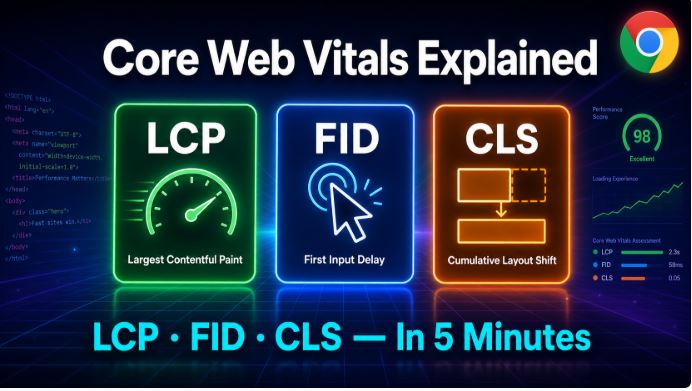
Core Web Vitals (or Essential Web Metrics) are a set of metrics defined by Google to measure key aspects of user experience on a website. They focus on three fundamental areas: page load speed, interactivity, and visual stability. Since Google incorporated them as ranking signals, ignoring them risks losing rankings to competitors with better technical performance.
One fact that sums it all up: a site that goes from "poor" to "good" scores in Core Web Vitals experiences a 24% lower abandonment rate, according to Google data.
The 3 metrics you should know
⚡ LCP — Largest Contentful Paint (Loading Speed)
The LCP measures the time it takes to render the largest visible content element on screen without scrolling: typically the hero image, H1 block, or a video. Essentially, it answers the question: "When does the user see something useful?"
| Result | Worth |
|---|---|
| ✅ Good | ≤ 2.5 seconds |
| ⚠️ Needs improvement | 2.5 – 4 seconds |
| ❌ Poor | > 4 seconds |
Common causes of a high LCP: unoptimized images, blocking CSS and JavaScript, slow hosting, or lack of a CDN.
🖱️ FID — First Input Delay (Interactivity)
The FID measures the time it takes from when a user performs their first action (a click, a tap) until the browser responds. It reflects whether your page "reacts" or freezes while loading heavy scripts in the background.
| Result | Worth |
|---|---|
| ✅ Good | < 100 ms |
| ⚠️ Needs improvement | 100 – 300 ms |
| ❌ Poor | > 300 ms |
⚠️ Important for 2026: Google officially replaced FID with INP (Interaction to Next Paint) as its primary interactivity metric. INP is more demanding: it measures all user interactions, not just the first, and its acceptable threshold is <200 ms.
📐 CLS — Cumulative Layout Shift (Visual Stability)
CLS measures how much content "jumps" or jumps unexpectedly while the page loads. You've probably been there: you went to click a button and, at the last second, an ad pushed the content forward and you clicked on something you didn't mean to. That's a high CLS .
| Result | Worth |
|---|---|
| ✅ Good | < 0.1 |
| ⚠️ Needs improvement | 0.1 – 0.25 |
| ❌ Poor | > 0.25 |
Common causes: images without defined dimensions, ads that suddenly appear, web fonts that cause text reflow.
How to measure your Core Web Vitals
Google provides several official and free tools:
-
Google Search Console → "Core Web Vitals" report: Shows real data from 75% of your users in the last 28 days
-
PageSpeed Insights (pagespeed.web.dev): URL-by-URL analysis with field and lab data
-
Chrome DevTools → Performance/Lighthouse tab
-
Web Vitals Chrome Extension: Real-time metrics while you browse your website
How to improve each metric
Improve LCP
-
Use modern image formats: WebP or AVIF
-
Add it
fetchpriority="high"to your main image so that the browser prioritizes it. -
Activate a CDN (Cloudflare has a free plan and reduces latency by 30–50%)
-
Remove rendering-blocking CSS and JavaScript
-
Use lazy loading only on images outside the viewport, never on the LCP image.
Improve FID/INP
-
Split long JavaScript tasks into smaller blocks using the Long Tasks API
-
Load heavy third-party scripts (chats, analytics, ads) in a deferred manner
-
If you use WordPress, disable plugins that inject JS into pages where they are not needed using tools like Asset CleanUp
-
Review the actual INP data in Search Console to identify which page or interaction is the bottleneck.
Improve the CLS
-
Always define attributes
widthinheightthe HTML of all your images and videos. -
Reserve space for ad slots even if they are empty
-
Use
font-display: swapyour custom fonts (including Google Fonts) to have the text appear first with a system font -
Preload critical web sources with
<link rel="preload">
3-step action plan
-
Audit your website right now: go to pagespeed.web.dev and analyze your homepage; identify which metric is in red.
-
Prioritize by impact: attack the weakest metric first — LCP is usually improved by optimizing the hero image and enabling a free CDN
-
Monitor monthly: Review the Core Web Vitals report in Search Console once a month and document the improvement by correlating it with your bounce rate and conversion rate.
The real impact on your SEO
Core Web Vitals have been an official Google ranking factor since 2021 and have been strengthened with each algorithm update.
In 2026, with INP firmly established as an interactivity metric, the standard is more demanding than ever. It's not just about pleasing Google: a fast, stable, and responsive site converts better, retains more users, and builds more trust.
Improving your Core Web Vitals is, in essence, improving your online business.
💡 Tip: If your site is on WordPress, use a combination of quality managed hosting + a caching plugin (LiteSpeed Cache or WP Rocket) + a free Cloudflare CDN. These three changes, properly configured, can get you into the green in all three metrics in less than an afternoon's work.