Reading Time 5
Number of Words 988
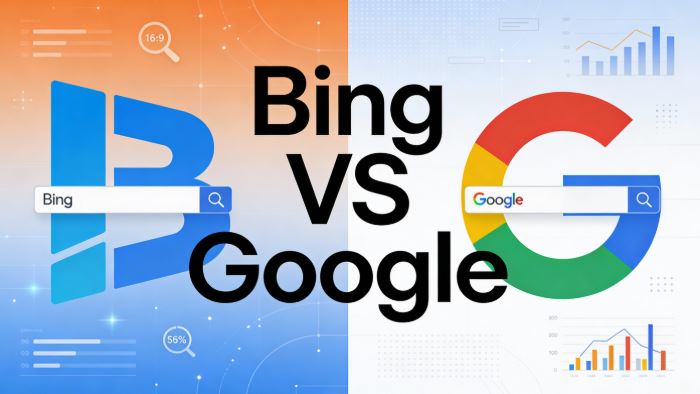
Google continues to dominate the global search engine market with an 89.54% share in 2026, but Bing has experienced steady growth, going from 2.81% in February 2023 to the current 3.98% (reaching 4.03% in December 2025).
Although the gap remains vast, the demographic and behavioral differences between the two audiences reveal unique opportunities for marketers and SEO specialists.
Global and Regional Market Share
Google processes approximately 8.5 billion searches daily compared to Bing's 900 million , a difference of almost 10x. However, in the United States, Bing handles more than 28% of all queries , representing almost a third of American users.
Globally, the outlook as of December 2025 is:
-
Google : 90.83%
-
Bing : 4.03%
-
Yandex : 1.56%
-
Yahoo!: 1.26%
-
DuckDuckGo : 0.78%
-
Baidu : 0.66%
User Demographics: Age
The audiences of both search engines show different age profiles, with Bing attracting considerably older users.
Bing users by age (USA) :
-
18-24 years: 11-18.5%
-
25-34 years: 18-25.9%
-
35-44 years: 18-23.6%
-
45-54 years: 15.6-20%
-
55-64 years: 9.8-17%
-
65+ years: 6.6-16%
Google users by age :
-
18-24 years: 21%
-
25-34 years: 28%
-
35-44 years: 19%
-
45-54 years: 14%
-
55-64 years: 9%
-
65+ years: 6%
Key finding : 33% of Bing users are over 55 years old, compared to approximately 15% on Google. The youngest group (18-24) represents only 11% on Bing versus 21% on Google, demonstrating that Bing is less popular among Gen Z.
User demographics: gender
-
Bing : ~64% men, ~36% women
-
Google : ~58% men, ~42% women
User demographics: income and education
Bing stands out for attracting users with higher purchasing power and a higher level of education.
Bing user revenue (USA) :
-
Less than $25,000: minority
-
$25,000-$39,999: 9%
-
$40,000-$59,999: 16%
-
$60,000-$74,999: 12%
-
$75,000-$99,999: 16%
-
Over $100,000: 38-41%
Approximately half of Bing users are in the top 25% of household income , constituting professionals with disposable income.
Education : 30% of Bing users are university graduates , with an additional 18% holding advanced degrees (master's, doctoral). A total of 34% have completed higher education.
Marital status : 43% of Bing users are married , while 31% are single.
Search behavior and devices
Usage per device :
-
Bing is predominantly a desktop search engine : with ~11-12% share on desktop vs less than 1% on mobile, the vast majority are desktop-only users.
-
In North American corporate and enterprise environments, Bing commands over 33% of searches on managed desktop devices (due to default IT configurations).
-
Bing mobile experienced an 18% year-over-year increase thanks to the launch of the Bing Chat mobile app in early 2024.
-
On tablets, Google maintains a 91.2% market share versus Bing's 6.1% .
Search intent : Bing searches are more brand- and navigation-oriented than Google searches, meaning users are usually closer to making a purchase decision.
Traffic and visitor volume
-
Google receives 85.2-86.3 billion monthly visits with a bounce rate of 28.46%; 27.15% of its users come from the United States.
-
Bing reached more than 1.4 billion unique global visitors in spring 2025, up from 1.3 billion in previous months.
-
After launching its AI update, Bing surpassed 100 million daily active users .
User satisfaction
According to a 2025 Statista survey:
-
72% of Bing users reported being "satisfied or very satisfied" with their results.
-
83% of Google users reported the same level of satisfaction.
Google maintains an 11 percentage point lead in satisfaction.
Index and crawlability
-
Google indexes more than 50 billion web pages daily.
-
Bing indexes around 12 billion pages , focusing more on quality over quantity.
-
The size of Google's search index exceeds 100 million gigabytes.
AI adoption in search
-
Bing's AI-powered answers are used in 34% of all Bing
-
Google SGE (Search Generative Experience) / AI Overviews represent 19% of Google searches in April 2025
-
Google's AI Overviews have scaled to 1.5 billion monthly users in 200 countries, representing 11.6% of search results in the UK and 10.37% in the US.
Popular searches and clicks
-
The most popular Google search term is "YouTube" with 1.2 billion global monthly searches, followed by "Facebook" with 593.5 million.
-
15 % of Google searches use completely new search phrases never seen before.
-
The #1 position in Google's organic results has an average CTR of 27.6% .
-
An estimated 58.5% of Google searches in the US (mobile + desktop) result in zero clicks; in the EU this figure rises to 59.7% .
-
28.5 % of searches on Google in the US lead to clicks on Google-owned platforms (YouTube, Images, Maps, etc.).
Voice Search
-
48 % of consumers use voice search for "general web searches" and 39% use virtual assistants via smart speakers
-
Three of the four main virtual assistants (Apple's Siri, Microsoft's Cortana, and Amazon's Alexa) use Bing to answer queries; only Google Assistant uses Google results.
-
Microsoft's Cortana has superior voice recognition , while Google Assistant offers better contextual understanding .
Advertising: Google Ads vs Microsoft Advertising
Performance and range :
-
Google Ads generates $56.57 billion in search property revenue in Q3 2025 alone (a 14% year-over-year increase).
-
Microsoft reported $70.1 billion in total revenue in FY25 Q3 (up 13%), with search and news advertising revenue increasing 21% (above average).
Cost :
-
The CPC (cost per click) in Microsoft Advertising tends to be lower than in Google Ads in most verticals, although with a smaller audience volume
Network range :
-
Microsoft Ads appear on Bing, Yahoo, AOL, MSN, DuckDuckGo, Microsoft Edge, Outlook, Skype, Windows, Cortana, and Xbox.
Strategic Implications for Marketers
For Google :
-
Younger, more diverse, and mobile-first audience
-
Ideal for e-commerce, food delivery, entertainment, fashion, and tech startups
-
Higher volume but also greater competition and CPC
For Bing :
-
Larger audience, with higher incomes and more desktop-oriented
-
Excellent channel for B2B, home services, luxury markets, financial products and professionals.
-
Less competition, lower CPC, but lower volume
-
Users with higher purchase intent (brand/navigation searches)
Conclusion
Although Google maintains a crushing advantage in global market share (90.83% vs 4.03%), Bing represents a valuable and growing opportunity , especially in the US (28% market share) and for niches targeting mature, highly educated, and high-income audiences
The optimal strategy for maximizing market coverage is to optimize for both search engines : Google for high-volume, young/mobile audiences, and Bing for high-value desktop users with less advertising competition. Ignoring Bing means missing out on nearly a third of US users and losing access to a premium demographic.
Sources : Impression Digital (2025), StatCounter (January 2026), HawkSEM (2025), SQ Magazine (2025), 99firms, NerdyNav, Backlinko, SearchEndurance.