Reading Time 12
Number of Words 2698
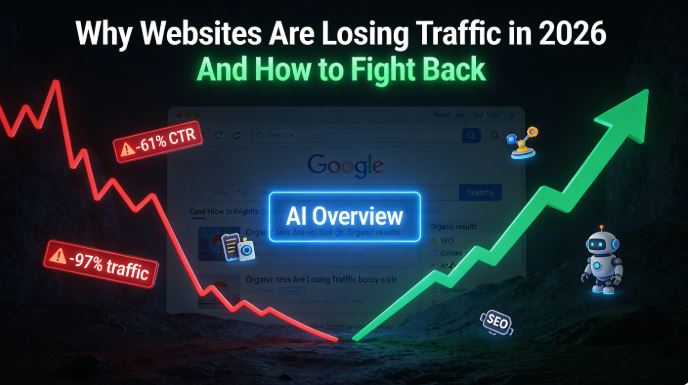
Something dramatic happened to website traffic between 2024 and 2026.
Publishers, bloggers, and businesses that had built years of organic search dominance woke up to Google Search Console graphs pointing sharply downward.
This wasn't a minor fluctuation — it was a structural shift.
Some of the world's top media publications lost up to 97% of their web traffic following Google's rollout of AI Overviews.
According to recent data, 73% of B2B websites experienced significant traffic loss between 2024 and 2025. And Gartner predicts a 50% drop in organic traffic by 2028 — driven almost entirely by AI answering queries before users ever click a link.
This is not a temporary algorithm hiccup. It is a permanent restructuring of how people find information online — and the websites that survive will be the ones that understand what's happening and adapt fast. This guide explains everything: the causes, the data, and the exact strategies that work in 2026.
The Scale of the Problem: By the Numbers
Before diving into solutions, let's look at the hard data so you understand the magnitude of what's happening:
-
60% of Google searches now end with zero clicks — users get their answer directly on the SERP without ever visiting a website
-
61% drop in organic CTR observed on queries where Google AI Overviews appear
-
34.5% decline in CTR for position #1 when an AI Overview is present (Ahrefs, 300,000 keywords)
-
Only 8% of users click on blue links below an AI Overview, vs. 15% when no AI Overview is present
-
97% traffic loss reported by some top publications after AI Overview rollout
-
Organic CTR without AI Overview: 1.6%; with AI Overview: just 0.6% (Seer Interactive)
-
AI traffic is growing 527% year-over-year — but only for sites that know how to capture it
-
Google AI Overviews appear in roughly 30% of all searches — and in 75% of "how-to" queries
💡 Pro tip: Use Lookkle to monitor your keyword rankings, track visibility trends, and get alerts when your positions change — so you catch traffic drops before they become catastrophic.
The 6 Root Causes of Traffic Loss in 2026
1. 🤖 Google AI Overviews — The #1 Traffic Killer
The single biggest driver of organic traffic loss in 2026 is AI-powered search cannibalization. Google's AI Overviews (formerly Search Generative Experience) now synthesize answers from multiple sources and display them at the very top of search results — before any organic listings. When someone searches "how to speed up a mini PC" or "best budget gaming setup," Google's AI generates a complete answer on the spot. The user reads it, gets what they need, and never clicks through to any website.
This hits informational content hardest — "how-to" guides, tutorials, definitions, comparisons, listicles, and FAQs. These were historically the most effective content types for driving SEO traffic. In 2026, they are the most vulnerable.
Real example: A website ranking #1 for "how to clean a mechanical keyboard" — with a well-written, comprehensive guide — may now receive 34.5% fewer clicks than a year ago because Google's AI answers the question in the Overview before the user even sees the organic result.
2. 📅 Google's Accelerated Algorithm Update Cadence
Unlike prior years with isolated major updates, 2025–2026 introduced continuous ranking recalibration. Google's systems are now updated more frequently and more aggressively. The key January 2026 and February 2026 core updates specifically targeted:
-
AI-generated content farms — sites publishing high volumes of AI content with minimal human oversight saw the steepest declines
-
Thin affiliate content — sites rewriting product specs from manufacturer pages without adding original analysis
-
Parasite SEO pages — third-party content on high-authority domains exploiting domain power
-
Poor page experience — slow loading, intrusive interstitials, high Cumulative Layout Shift (CLS)
-
Weak E-E-A-T signals — content lacking Experience, Expertise, Authoritativeness, and Trustworthiness
The February 2026 update also tightened user intent alignment significantly. Pages that only partially match search intent — or that try to serve multiple intents simultaneously — lost ground to pages that precisely deliver exactly what the searcher is looking for.
3. 📉 Content Decay — Your Old Posts Are Dying
Content decay is the slow death of pages that once ranked well but have become outdated, overtaken by fresher competitors, or misaligned with evolving search intent. In 2026, the problem has accelerated because:
-
Google's AI systems weight recency heavily for time-sensitive queries
-
Competitors are refreshing their content more aggressively than ever
-
Statistics from 2022–2023 now signal "stale" content to Google's algorithms
-
AI-generated articles flood niches with fresh content daily, pushing older pages down
Data shows that properly refreshed content recovers 60–80% of lost rankings within 30–45 days — making content updates one of the highest-ROI activities in SEO right now.
4. 🔧 Silent Technical SEO Regressions
Technical issues are the silent traffic killer that many site owners overlook while chasing content strategies. The most common technical regressions causing traffic loss in 2026:
-
Accidental
noindextags pushed during CMS updates or plugin installations -
Broken internal links from URL structure changes
-
JavaScript rendering failures preventing Google from reading content
-
Core Web Vitals failures introduced by new scripts, widgets, or design changes
-
robots.txt changes accidentally blocking AI crawlers (which also reduces AI citation potential)
-
Canonical tag errors from content management system updates
The February 2026 algorithm update specifically amplified the impact of page experience signals — slow-loading pages and poor mobile usability are now causing dramatic ranking drops even for high-quality content.
5. 🏆 Competitive Displacement
Your traffic may not have been taken by Google's AI — it may have been taken by a better-funded or better-optimized competitor. Competitive displacement accelerates when:
-
A competitor publishes a more comprehensive resource and earns more backlinks
-
A competitor creates interactive tools or calculators while your site still has static text
-
A competitor has a domain authority advantage after a sustained link-building campaign
-
Large media brands invest in E-E-A-T signals (author bios, editorial standards, original research) that your site lacks
6. 🔀 Keyword Cannibalization & Thin Content Bloat
Larger sites often suffer from keyword cannibalization, multiple pages competing for the same query, confusing Google about which page to rank. The result: none of them rank well. If Google Search Console shows the same keyword driving impressions to 3+ different URLs, you have a cannibalization problem that is silently suppressing all of them.
The Traffic Landscape Has Changed Permanently
It's important to understand that Google is no longer the only search engine you need to care about. The discovery landscape in 2026 looks very different from 2022:
| Platform | Share of Discovery | Trend |
|---|---|---|
| Google Search | ~60% | 📉 Declining |
| YouTube | ~15% | ➡️ Stable |
| ChatGPT / Claude | ~8% | 📈 Growing fast |
| Perplexity | ~3% | 📈 Growing fast |
| ~5% | ➡️ Stable | |
| TikTok | ~4% | 📈 Growing |
| Direct / Email / Apps | ~5% | ➡️ Stable |
AI traffic from ChatGPT alone is growing 527% year-over-year. ChatGPT drives 77–80% of all AI referral traffic, Perplexity accounts for 15–20%, and Google's Gemini contributes 6–7% and growing. The sites winning in 2026 are those that have diversified their traffic sources and optimized for AI citation, not just Google page rank.
How to Fight Back: 12 Strategies That Work in 2026
✅ Strategy 1: Master GEO — Generative Engine Optimization
Generative Engine Optimization (GEO) is the new discipline of optimizing your content to be cited by AI systems, Google AI Overviews, ChatGPT, Perplexity, Gemini, and Copilot. While traditional SEO optimizes for ranking positions, GEO optimizes for selection probability, the likelihood that an AI system chooses your content as a citation when answering a user's question.
The core GEO tactics for 2026:
-
Answer-first structure (BLUF): Lead every section with the direct answer, then provide context. AI systems extract the clearest, most direct answers.
-
Fact density: Every paragraph should include specific statistics, named sources, and verifiable claims — vague assertions are never cited by AI.
-
Structured sections: Use descriptive H2/H3 headings with in-page anchors so AI can cite specific sections rather than just the page.
-
Comparison tables: AI systems love structured comparisons — "For X use case, use Tool A; for Y use case, use Tool B."
-
FAQ and HowTo schema: Implement structured data that directly feeds AI extraction systems.
-
Fresh timestamps: Add visible "Last Updated" dates and replace statistics older than 18 months.
✅ Strategy 2: Optimize for AI Overviews Directly
Rather than fighting AI Overviews, the winning strategy is to get cited inside them. When your content is cited as a source in a Google AI Overview, you gain brand visibility at the very top of the SERP — even if your click-through rate is lower.
How to increase your AI Overview citation probability:
-
Write clear 40–60 word definition paragraphs that directly answer common queries
-
Structure content with explicit question-and-answer blocks
-
Include original data, statistics, and research that AI systems can't generate themselves
-
Build E-E-A-T signals: author bios with credentials, editorial standards pages, first-hand experience in your content
-
Use FAQ schema — this is one of the most reliable ways to appear in AI Overviews
✅ Strategy 3: Refresh Decaying Content Aggressively
Content refresh is the highest-ROI activity in SEO right now. Every article older than 12–18 months should be audited and updated:
-
Replace all statistics with 2025–2026 equivalents
-
Add a "What Changed in 2026" section to evergreen articles
-
Restructure sections to front-load answers (put the answer in the first sentence)
-
Add new subsections addressing follow-up questions and "People Also Ask" results
-
Add or update FAQ schema markup
-
Update the publication date with "Last Updated: [date]" visibly on the page
✅ Strategy 4: Shift from Traffic to Brand Authority
In the zero-click era, brand recognition has become a ranking signal in itself. The more users search your brand name directly, the more AI systems interpret your site as authoritative. Build brand recognition by:
-
Publishing original research that gets cited by other sites and AI systems
-
Running email newsletters that build a direct audience independent of Google
-
Building social media communities (especially YouTube and LinkedIn) that drive branded searches
-
Pursuing podcast appearances, interviews, and guest posts that spread your brand name across the web
-
Optimizing your Google Knowledge Panel so your entity is well-understood
✅ Strategy 5: Create Content AI Can't Replicate
The content most protected from AI displacement is content that requires genuine human expertise and first-hand experience. Google's 2025–2026 algorithm updates specifically reward:
-
First-hand product testing and reviews with original photos, videos, and measurements
-
Original research and surveys with proprietary data
-
Expert opinions with clear author credentials and experience signals
-
Interactive tools and calculators that provide personalized answers
-
Community and user-generated content that reflects real human experience
-
Local, specific, or niche knowledge that AI systems don't have access to
✅ Strategy 6: Fix Technical SEO Immediately
Run a full technical audit of your site right now. Prioritize:
-
Core Web Vitals: LCP under 2.5s, CLS under 0.1, INP under 200ms — these are now hard ranking factors
-
Mobile usability: Google uses mobile-first indexing; any mobile UX issue directly impacts rankings
-
Crawl budget: Ensure Googlebot can efficiently crawl your most important pages
-
Internal linking: Build strong internal link structures to concentrate authority on your key pages
-
Schema markup: Implement Article, FAQ, HowTo, Product, and Organization schema throughout your site
-
Page speed: A single poorly-optimized script can tank your entire site's performance scores
-
💡 Lookkle monitors your site's technical health automatically, alerting you to crawl errors, broken links, and performance regressions before they impact your rankings.
✅ Strategy 7: Get Your Content Into AI Search Platforms
ChatGPT Search, Perplexity, and Gemini generate trackable referral traffic — and it's growing fast. To maximize your presence in AI search:
-
Track AI referral traffic in Google Analytics 4 by filtering for chatgpt.com, openai.com, perplexity.ai, and gemini.google.com
-
Focus on specific, niche questions with few well-developed answers online — broad queries are too competed
-
Structure content to answer conversational, long-tail queries (6+ words, question modifiers)
-
Ensure your site is not blocking AI crawlers in robots.txt — several major sites accidentally did this
-
Build earned media placements in Tier 1 publications that AI systems trust and frequently cite
✅ Strategy 8: Diversify Traffic Sources Now
The fundamental lesson of 2026 is that dependence on a single traffic source is an existential risk. Build a multi-channel traffic strategy:
-
Email list: The most resilient traffic source — owned, direct, and immune to algorithm changes
-
YouTube: Second-largest search engine in the world, growing in AI integration
-
Social media communities: Facebook Groups, Reddit, LinkedIn newsletters
-
Push notifications: Re-engage existing visitors without depending on search
-
Podcast / audio content: Rapidly growing discovery channel in 2026
-
Partnerships and collaborations: Co-marketing and guest posting for direct referral traffic
-
💡 Lookkle's traffic source analytics show you exactly where your visitors are coming from across all channels — so you can see at a glance how dependent you are on Google and where to invest to diversify effectively.
✅ Strategy 9: Eliminate Keyword Cannibalization
Audit your Google Search Console Performance report filtered by query. Any keyword showing impressions across 3+ different URLs is being cannibalized. Fix it by:
-
Identifying which URL is the "winner" (highest impressions + best position)
-
Merging similar pages into one comprehensive resource
-
Setting up 301 redirects from weaker URLs to the winner
-
Updating internal links to point to the consolidated page
-
Adding cross-links between related (non-competing) pages
✅ Strategy 10: Target Bottom-of-Funnel Keywords
Informational queries ("how to", "what is", "why does") are the most vulnerable to AI Overviews. Commercial and transactional queries are significantly more protected because:
-
Users searching with purchase intent need to visit a site to actually buy
-
Product comparison queries ("Blackview MP100 vs Beelink SER5") require detailed human judgment
-
Local queries ("mini PC repair near me") require real-world action
Rebalance your content strategy toward commercial comparison content, product reviews with affiliate links, pricing pages, and case studies — these drive conversions and are harder for AI to replace.
✅ Strategy 11: Build E-E-A-T Signals Into Every Page
Google's algorithms and AI systems both use E-E-A-T (Experience, Expertise, Authoritativeness, Trustworthiness) signals to evaluate content quality. In 2026, weak E-E-A-T is a leading cause of ranking loss. Build E-E-A-T by:
-
Adding detailed author bios with credentials, social profiles, and areas of expertise
-
Publishing an "About" page and editorial standards / review policy
-
Including disclosure statements for affiliate content
-
Linking to primary sources (studies, official documentation, government data) from your content
-
Earning third-party mentions and citations on reputable domains
-
Showing real product photos and original testing data in reviews
✅ Strategy 12: Use AI as a Tool, Not a Replacement
The February 2026 Google Core Update made a critical distinction: AI-assisted content is fine; AI-generated content farms are penalized. The sites that won in this update used AI to:
-
Speed up research and outline creation
-
Generate first drafts that were then heavily edited and enriched by human expertise
-
Identify content gaps and keyword opportunities
-
Scale content production while maintaining editorial standards
The sites that lost used AI to mass-produce hundreds of thin articles with minimal human oversight, no original insight, and no genuine E-E-A-T signals.
Your 90-Day Recovery Action Plan
If your traffic has dropped, here's a prioritized action plan:
📅 Days 1–14: Diagnose
-
Run a full Google Search Console audit — identify pages with the steepest traffic declines
-
Use Lookkle to check keyword ranking changes and traffic source breakdown
-
Check for technical regressions (Core Web Vitals, crawl errors, accidental noindex)
-
Identify keyword cannibalization issues
-
Set up AI referral traffic tracking in GA4
📅 Days 15–45: Fix & Refresh
-
Fix all technical SEO issues immediately
-
Refresh your top 20 traffic pages with updated statistics, new sections, FAQ schema
-
Consolidate cannibalized content with 301 redirects
-
Add author bios and E-E-A-T signals site-wide
-
Use Lookkle to monitor ranking recovery week-by-week
📅 Days 46–90: Grow
-
Launch a GEO strategy: restructure content for AI citation
-
Begin building an email list and YouTube presence
-
Pursue earned media placements in authoritative publications
-
Shift content production toward commercial, bottom-of-funnel keywords
-
Use Lookkle's analytics to track AI referral traffic growth and optimize based on what's being cited
The Bottom Line
The era of publishing keyword-optimized articles and watching traffic roll in automatically is over. Google has fundamentally changed what search looks like — and AI platforms are eating the clicks that Google doesn't take. But this is not the end of content marketing. It's the end of lazy content marketing.
The websites that thrive in 2026 will be those that create genuinely expert content, optimize for AI citation alongside traditional SEO, build direct audience relationships, and treat brand authority as their most valuable asset. Traffic sources have diversified — and so must your strategy.
The good news? AI traffic is growing 527% year-over-year. There is more opportunity than ever for sites that earn trust and deliver genuine value. The question is whether you'll adapt fast enough to capture it.
❓ Frequently Asked Questions
Why is organic traffic declining in 2026?
The main reason is the massive rollout of Google's AI Overviews, which answers questions directly in search results without the user having to click on any website. 60% of searches now end with zero clicks.
What is GEO and how is it different from SEO?
GEO (Generative Engine Optimization) is the practice of optimizing content to be cited by AI systems like ChatGPT, Perplexity, and Google AI Overviews. While SEO focuses on ranking positions, GEO focuses on getting your content selected as a source in AI-generated answers.
Which content types are most affected by AI Overviews?
Informational content — how-to guides, tutorials, definitions, FAQs, and comparison articles — is most affected. Commercial, transactional, and local content is significantly more protected.
How do I get cited in ChatGPT and Perplexity?
Focus on creating authoritative, well-structured content on specific niche topics with high fact density, clear source citations, and strong E-E-A-T signals. Earn media placements on Tier 1 publications that AI systems trust, and ensure AI crawlers are not blocked in your robots.txt.
How long does it take to recover lost SEO traffic?
With properly refreshed content, studies show 60–80% of lost rankings can be recovered within 30–45 days. Technical fixes show faster recovery. Building brand authority and GEO presence is a longer-term process of 3–6 months.
What tool can I use to monitor my SEO traffic and keyword rankings?
Lookkle is an all-in-one SEO and web analytics platform that tracks your keyword positions, monitors traffic sources, analyzes competitors, and alerts you to technical issues — everything you need to diagnose and recover from traffic drops in 2026.