Reading Time 6
Number of Words 1298
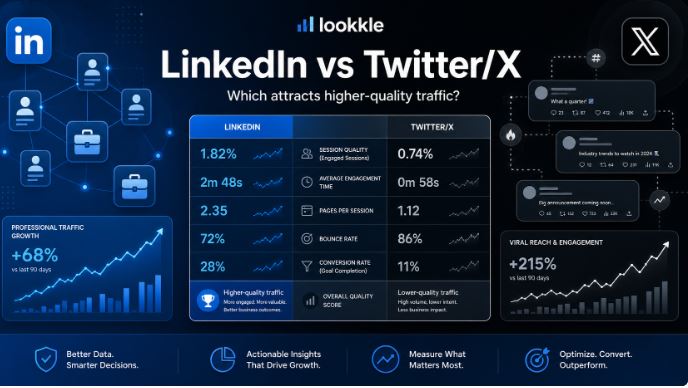
LinkedIn and Twitter/X are two essential platforms for brands, professionals, media, and creators, but they attract audiences with very different behaviors.
According to data analyzed with Lookkle's Web Traffic Checker, X generates much more total traffic and more intense browsing, while LinkedIn stands out for its professional profile, the stability of its channels, and a relevant volume of direct and email traffic.
Methodological note: The data in this article are traffic estimates collected using Lookkle's Web Traffic Checker tool . They are used to analyze trends, acquisition sources, and estimated audience behavior; they do not replace the internal analytics data of each platform.
Quick summary
| Metrics | Twitter/X | Advantage | |
|---|---|---|---|
| Monthly visits | 906.4 million | 2,075.2 million | Twitter/X |
| Monthly growth | +0.1% | +4.7% | Twitter/X |
| Organic traffic | 190.3 million | 311.3 million | Twitter/X |
| Direct traffic | 498.5 million | 1,431.9 million | Twitter/X |
| Traffic from AI | 5.2 million | 11.8 million | Twitter/X |
| Social traffic | 36.3 million | 228.3 million | Twitter/X |
| Referral traffic | 27.2 million | 62.3 million | Twitter/X |
| Traffic from email | 90.6 million | 20.8 million | |
| Pages per visit | 8.58 | 14.33 | Twitter/X |
| Average time on site | 7 min 04 s | 12 min 21 s | Twitter/X |
| Bounce rate | Data not comparable* | 37.91% | — |
*The value shown for LinkedIn under “Bounce Rate” appears to be expressed as a number of users and not as a percentage, so it does not allow a direct comparison with the 37.91% of X.
X gains in volume and activity
Twitter/X registers approximately 2.075 billion monthly visits, more than double that of LinkedIn, with around 906 million. It also shows an estimated monthly growth of 4.7%, compared to LinkedIn's virtually flat growth of 0.1% .
This difference confirms that X functions as a platform for constant conversation, news, current events, communities, trends, and continuous content consumption. Users don't just log in to view a professional profile or reply to a message: they browse threads, posts, profiles, videos, news, and conversations.
Navigation behavior reinforces that idea:
-
In X, the audience consumes an average of 14.33 pages per visit.
-
On LinkedIn, the average is 8.58 pages per visit.
-
The estimated time in X reaches 12 minutes and 21 seconds.
-
On LinkedIn, the estimated time is 7 minutes and 4 seconds.
In terms of volume, recurrence, and depth of navigation, X has a clear advantage.
LinkedIn stands out for its professional focus.
However, more traffic doesn't always equate to more valuable traffic for a company. LinkedIn has a concentrated audience focused on employment, networking, B2B sales, human resources, training, leadership, enterprise software, and professional branding.
Its estimated direct traffic reaches 498.5 million monthly visits, more than half of its total traffic. This suggests a user base with a consistent user base: users who access the site regularly to check messages, posts, job opportunities, contacts, or industry news.
LinkedIn also stands out for its email traffic, with approximately 90.6 million monthly visits. This figure is significantly higher than the estimated 20.8 million email visits for X.
This makes sense from a usage perspective:
-
LinkedIn boosts job alerts and applications.
-
Send notifications for messages, comments, and contacts.
-
Promotes professional newsletters.
-
It reports on news about companies, sectors and profiles.
-
Reactivate users through communications related to their career.
For B2B products, agencies, consultants, professional services, SaaS, HR tools, or training, this audience may have a more valuable commercial intent even if the total traffic is lower.
Traffic sources
Lookkle's data shows a very clear difference in the way both platforms acquire audiences.
| Acquisition channel | Twitter/X | Main reading | |
|---|---|---|---|
| Straight | 498.5 M | 1,431.9 M | Both rely heavily on recurring users |
| Organic | 190.3 M | 311.3 M | X receives more traffic from search engines |
| AI | 5.2 M | 11.8 M | X has a greater estimated presence in references from AI tools |
| Social | 36.3 M | 228.3 M | X receives significantly more traffic from other networks. |
| Referrals | 27.2 M | 62.3 M | X has a wider external network of links |
| 90.6 M | 20.8 M | LinkedIn clearly dominates this channel | |
| Pay | 54.4 M | 0 | LinkedIn shows more traffic attributed to paid campaigns or referrals |
The weight of direct traffic
Both platforms rely primarily on direct traffic, a common characteristic of established digital services with frequent users. X attracts approximately 1.431 billion direct visits, while LinkedIn has around 498 million.
In both cases, direct traffic is a sign of brand recognition and repeat business. However, it should not be interpreted as a pure loyalty metric: estimation tools group as "direct" a portion of traffic whose exact origin cannot be identified.
LinkedIn and the value of email
LinkedIn gets approximately 10% of its monthly visits from email, compared to about 1% in X. This may indicate greater effectiveness of its reactivation communications and a usage model more closely linked to professional processes: job postings, private messages, newsletters, invitations, and contact updates.
For a B2B brand, this difference is relevant. LinkedIn doesn't just function as a publishing channel: it can also be well integrated with an email marketing strategy, authoritative content, and lead nurturing.
X and social distribution
X receives over 228 million visits from social media, compared to approximately 36 million for LinkedIn. This reflects its more open, conversational nature and its connection to other platforms, communities, and media.
For publishing, media, technology, sports, video games, finance, cryptocurrency, or entertainment projects, X can offer greater rapid distribution capabilities. A relevant post can generate conversation, be cited by other accounts, and attract visits in a very short time.
Audience by country
The United States is the main market for both platforms, but the geographical distribution reveals some interesting differences.
| Country | Twitter/X | |
|---|---|---|
| USA | 31.32% | 28.74% |
| India | 9.26% | It does not appear in the top five |
| Japan | It does not appear in the top five | 11.19% |
| United Kingdom | 5.94% | 4.41% |
| Brazil | 4.67% | It does not appear in the top five |
| France | 3.97% | It does not appear in the top five |
| Türkiye | It does not appear in the top five | 3.67% |
| Spain | It does not appear in the top five | 3.53% |
LinkedIn appears to have a particularly strong presence in the United States, India, the United Kingdom, Brazil, and France. This could be of interest to companies with an international strategy for talent, software, business services, or B2B marketing.
X has a particularly strong presence in Japan, as well as in the United States, the United Kingdom, Turkey, and Spain. This pattern could be relevant for creators, media outlets, tech communities, and brands seeking to generate public conversation in markets like Spain or Japan.
Which network attracts higher quality traffic?
The answer depends on how you define “quality”.
If you're looking for reach, conversation, and content consumption
Twitter/X wins.
It has more than double the estimated monthly traffic, higher growth, more pages per visit, and significantly longer browsing time. It also gets more traffic from search engines, social media, AI platforms, and referral sites.
X is especially useful for:
-
Current affairs media and publications.
-
Technology creators.
-
News, opinion or analysis projects.
-
Communities of software, video games, investment or digital culture.
-
Brands that need quick visibility.
-
Companies that can consistently participate in public conversations.
If you are looking for B2B intent, employment or opportunity generation
LinkedIn can bring in traffic of higher commercial value.
Although its total traffic is lower, its users tend to be in a more professional context. Furthermore, the weight of email traffic indicates a more structured relationship with the platform, based on notifications, recruitment processes, contacts, and business content.
LinkedIn is especially suitable for:
-
SaaS companies and productivity tools.
-
Consulting firms, agencies and professional services.
-
Training, employment and human resources.
-
Founders, experts, and personal brands.
-
B2B marketing and lead generation.
-
Content aimed at purchasing managers or executive profiles.
Which platform should a company choose?
You don't have to choose just one. LinkedIn and X can fulfill complementary functions within a digital strategy.
| Aim | Recommended platform |
|---|
| Aim | Recommended platform |
|---|---|
| Build professional authority | |
| Get B2B leads | |
| Promote a professional newsletter | |
| Share quick news and analysis | Twitter/X |
| Participate in trends and conversations | Twitter/X |
| Reaching technological communities | Twitter/X |
| Hire talent | |
| Business networking | |
| Increase brand awareness | Both |
| Distribute editorial content | Twitter/X |
| Promote a SaaS tool | LinkedIn + Twitter/X |
Conclusion
Lookkle's Web Traffic Checker data indicates that Twitter/X clearly outperforms LinkedIn in total traffic, monthly growth, pages per visit, and time spent on the site. It is a more dynamic platform for content distribution, conversation, and recurring consumption.
LinkedIn, on the other hand, exhibits a more professional traffic profile. Its high volume of visits from email and its audience geared towards employment, business, and networking give it a significant advantage for B2B companies, SaaS tools, personal brands, and lead generation.
The best platform isn't necessarily the one with the most visits. It's the one that brings together the right audience for your objective.
👉 Analyze the traffic of any website, its acquisition channels, countries, and estimated behavior with Lookkle Web Traffic Checker.