Reading Time 7
Number of Words 1524
Whether you've been in the world of SEO for a while or have just started working on your Google ranking, sooner or later you'll come across the acronym EEAT.
They are not a passing fad or a minor technicality; they are the central axis on which Google will evaluate the quality of any website in 2026.
In this article we explain what it means, how it works in practice and what specific actions you can take starting today to improve your ranking.
🗓️ Updated: May 2026 | Based on official Google guidelines and the latest algorithm updates.
📌 What does EEAT mean?
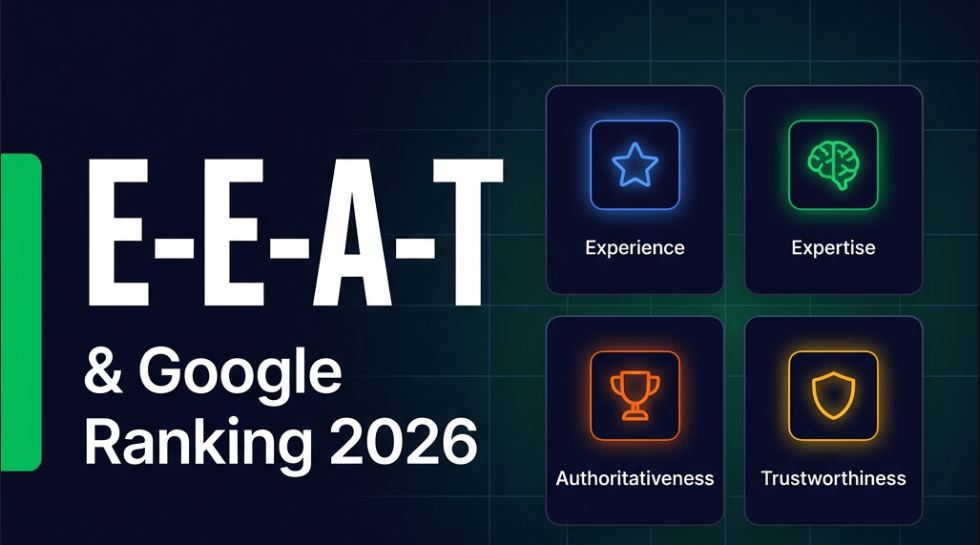
EEAT stands for four key concepts that Google uses to measure the quality and credibility of content:
| Sail | English term | Meaning |
|---|---|---|
| AND | Experience | Experience — Has the author lived or experienced what they describe? |
| AND | Expertise | Knowledge — Do you have training or real mastery of the subject? |
| A | Authoritativeness | Authority — Are you recognized as a leader in your sector? |
| T | Trustworthiness | Reliability — Is the website reliable, secure, and transparent? |
The original term was EAT (without the first "E"). Google added Experience as the first pillar in December 2022, recognizing that there is an important difference between someone who knows about a topic and someone who has experienced it firsthand.
💡 Practical example: A doctor can write about symptoms with technical expertise, but a patient who has overcome that illness provides real-world experience. Google wants to reward both types of content, each in its own context.
🧠 Is EEAT a Direct Positioning Factor?
This is one of the most frequently asked questions—and the answer is nuanced. EEAT isn't a direct ranking factor in the technical sense (there's no numerical EEAT score that Google measures with a specific algorithm). However, Google does use hundreds of signals to assess whether your content adheres to these principles, and those signals do directly affect your ranking.
Simply put: you can't "optimize the EEAT" like you optimize a meta description, but you can build a website that demonstrates expertise, knowledge, authority, and trust—and that translates into better rankings.
In 2026, with the explosion of AI-generated content, the EEAT has become the "humanity filter" that Google uses to separate genuinely useful content from generic filler.
🔎 The 4 Pillars of EEAT Explained
1️⃣ Experience — Real Experience
Google wants to see that the content creator has had direct contact with the topic. It's not enough to summarize what others say—you must demonstrate that you have lived, tested, or experienced it yourself.
How to prove it:
-
Include real photos of products you've tried
-
Share your own mistakes and lessons learned
-
Use first person language when relevant ("in my experience...", "when I tried this product...")
-
Add visible publication and update dates to your articles
2️⃣ Expertise — In-depth Knowledge
Expertise measures the author's level of technical or intellectual mastery of the subject. Google distinguishes between superficial content (which anyone could write in 10 minutes) and in-depth content that demonstrates genuine mastery.
How to prove it:
-
Cite verifiable studies, data, and sources with a link.
-
Create author pages with biography, credentials, and social media links
-
Use correct technical terminology and explain it for the general reader
-
Develop in-depth content (not 300-word articles on complex topics)
3️⃣ Authoritativeness — Site Authority
Authority measures the external recognition of your website and brand within your industry. It's not something built in weeks—it's the cumulative result of months or years of consistent effort.
How to prove it:
-
Get backlinks from relevant and authoritative websites in your niche
-
It is mentioned in media outlets or industry blogs
-
Maintain an active presence on social media and in your industry's communities.
-
Obtain and display verified third-party reviews from Google Business, Trustpilot, etc.
4️⃣ Trustworthiness (The Most Important Pillar)
Trust is the central element of the entire EEAT system. According to Google's own guidelines, trust is the most important pillar —if your website isn't trustworthy, the other elements lose their value.
How to prove it:
-
Use HTTPS (active and visible SSL certificate)
-
Publish Legal Notice, Privacy Policy and Terms of Use pages
-
Include real contact information (email, phone number, address if applicable)
-
Demonstrate clear authorship in each article
-
Correct errors publicly and keep content updated and accurate
📊 EEAT in 2026: Why It's More Important Than Ever
The relevance of EEAT has grown exponentially in the last two years for one specific reason: the rise of AI-generated content. With millions of articles produced automatically every day, Google urgently needs to distinguish genuinely useful content from filler.
As a result, in 2026 Google strengthened its evaluation of real-time credibility signals, including social validation, user feedback, and regular content reviews. Sites with strong EEAT (Environmental Ethics Assessment Tools) are weathering algorithm updates better than those relying solely on technical optimization techniques.
⚠️ The reality for 2026 is straightforward: You can have the best SEO copywriting in the world, but if Google doesn't find social and human evidence to validate your expertise, it will prioritize your competition.
🛠️ 12 Practical Actions to Improve Your EEAT Today
Based on the most recent guidelines, these are the actions with the greatest real impact:
🟢 Experience
-
Add screenshots and real photos to your articles (especially in reviews).
-
Share your own use cases with concrete and measurable results
-
Document your process step by step — the "how I did it" is more valuable than the "how it's done"
🔵 Knowledge
-
Cite authoritative sources with links (studies, official publications, statistics)
-
Create detailed author pages with photo, bio, experience, and links to professional profiles
-
Demonstrate depth without unnecessary jargon — explain the technical concepts you use
🟠 Authority
-
Look for mentions and backlinks in leading media outlets and websites in your industry.
-
Collaborate with other experts — interviews, guest posts, co-authorships
-
Take care of your external presence: social networks, specialized forums, industry directories
🔴 Trust
-
Regularly update older content with visible revision dates.
-
Respond to comments and reviews — active interaction strengthens credibility
-
Show transparency in authorship — if you use AI to create content, review it and add real human perspective
🎯 EEAT and YMYL Content: Maximum Attention
Google applies EEAT with particular intensity to pages labeled YMYL ( Your Money or Your Life). These are pages that could significantly affect the reader's health, finances, or safety.
Examples of YMYL content:
-
💊 Health, medicine and symptoms
-
💰 Finance, investments and cryptocurrencies
-
⚖️ Legal advice
-
🏠 Real estate and insurance
-
🍼 Child rearing and nutrition
If your website touches on any of these topics, EEAT is not optional—it's absolutely essential. Google will scrutinize who authores the content, what credentials they have, and whether the site offers sufficient guarantees of reliability.
🔧 How Lookkle Can Help You Improve Your EEAT
One of the most practical tools for working on your EEAT systematically is Lookkle, which combines SEO analysis with online reputation monitoring, two fundamental pillars of modern EEAT.
With Lookkle you can:
-
📊 Analyze the domain authority of your website and that of your competitors
-
🔗 Monitor external mentions that build your authority (Authoritativeness)
-
📝 Audit content quality and identify pages that need updating
-
🌐 Track your social presence to reinforce trust signals
-
📈 Compare your search engine visibility before and after applying EEAT improvements
💡 Tip: Use Lookkle to identify which pages on your website are underperforming and apply EEAT improvements to those pages first — the impact will be faster and measurable.
🆚 EAT vs EEAT: What's the Real Difference?
| Aspect | EAT (before 2022) | EEAT (since Dec. 2022) |
|---|---|---|
| Acronym | Expertise, Authority, Trust | Experience + Expertise, Authority, Trust |
| Approach | The author's theoretical knowledge | Practical experience + knowledge |
| Valued content | Articles by recognized experts | Testimonials, reviews, lived experiences |
| Application | Principalmente EDGE | All types of content |
| Context | Pre-generative AI era | Post-ChatGPT Era / Massive AI |
The addition of the first "E" for Experience reflects Google's understanding that experiencing something and knowing something are two distinct sources of value — and both deserve to be rewarded in search results.
❓ Frequently Asked Questions about EEAT
Can I improve my EEAT quickly?
Authority and trust are built over time. However, some improvements, such as adding author pages, updating content, adding HTTPS, or including contact information, can have an impact in weeks.
Does AI-generated content penalize EEAT?
Google doesn't penalize AI content per se—it penalizes low-quality content. If AI content is reviewed, enriched with real human expertise, and genuinely helpful, it can have a good EEAT score.
Can a personal blog have a good EEAT (Experience, Emergency, and Advocacy) score?
Yes. The key is for the author to be visible, consistent, and demonstrate real expertise in their niche. A travel blogger with their own photos and authentic stories can outperform a large media outlet with generic content in EEAT scores.
Does EEAT affect local SEO?
Directly, yes. Google Business reviews, NAP consistency (name, address, phone number), and local mentions are key signals of trust and authority for local SEO.
How do I know if my website has good or bad EEAT?
Tools like Lookkle, Semrush, and Ahrefs allow you to analyze domain authority, backlinks, and organic visibility. But the most direct indicator is whether your pages withstand Google's algorithm updates—websites with good EEAT are more stable.
🏁 Conclusion: EEAT is not a trend, it's the future of SEO
EEAT isn't a passing fad from Google—it's the structural answer to the biggest problem in SEO today: the excess of mediocre content. In a digital ecosystem flooded with automatically generated text, Google needs verifiable, human signals to know who to reward.
The good news is that any website can improve its EEAT (End-to-End Customer Experience), regardless of size or budget. It doesn't require expensive tools or obscure technical tricks—it requires consistency, honesty, and genuine user value.
If you start today by implementing the 12 actions in this guide, you'll see measurable differences in your organic ranking within 3-6 months. And if you want to accelerate that process, tools like Lookkle give you the visibility you need to make data-driven decisions.
⚠️ Sources: Google's official guidelines for quality evaluators, NinjaSEO, DinoRANK, ESIC, Mailchimp SEO Blog, ProvenExpert, WiseA.