Reading Time 7
Number of Words 1471
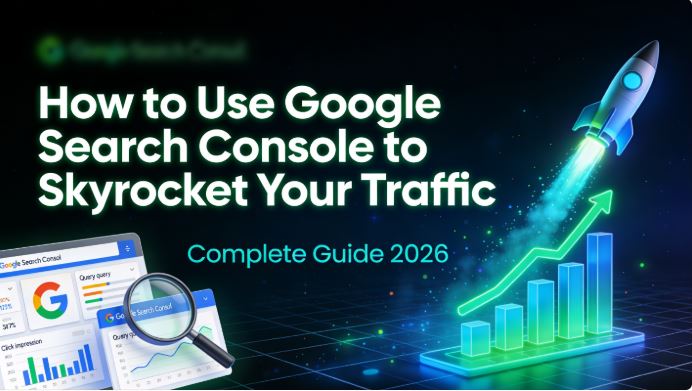
Google Search Console (GSC) is undoubtedly the most powerful and reliable SEO tool available today, and it's completely free. If you're not using it strategically, you're leaving organic traffic on the table every day.
In this comprehensive guide, updated to 2026, you'll learn exactly how to get the most out of Google Search Console to boost your website traffic, detect critical errors, and make data-driven decisions directly from Google.
What is Google Search Console?
Google Search Console is a free tool from Google that allows website owners to monitor and optimize their presence in search engine results. Unlike any third-party tool, the data provided by GSC comes directly from Google, making it incomparably reliable.
With GSC you can find out which keywords bring you traffic, which pages are indexed, if there are technical errors that hinder your ranking, and how to improve the user experience on your site.
How to Configure GSC Step by Step
Before you start analyzing data, you need to verify your property in Search Console:
-
Go to search.google.com/search-console and sign in with your Google or Gmail account.
-
Click on "Add property" and enter your domain URL.
-
Choose your verification method: HTML file, meta tag, Google Analytics, Google Tag Manager, or DNS record.
-
Once verified, submit your sitemap (
yoursite.com/sitemap.xml) from the Indexing > Sitemaps menu. -
Please allow 24 to 72 hours for the data to start appearing.
Submitting your sitemap is key: it allows Google's crawler to analyze your site more thoroughly and efficiently.
The Control Panel: What to See First
Upon entering GSC you will see the Overview, which provides a quick overview of the current status of your site:
-
A performance chart showing the clicks received from Google
-
Alerts if Google detects anything out of the ordinary
-
Quick access to performance, coverage, experience, and improvement reports
-
If you have Search Console Insights enabled, you'll see which content performs best and how users find it.
This section is ideal for detecting sudden traffic drops or seeing if any query is taking off more than expected.
The Performance Report: Your SEO Gold Mine
The Performance Report ( Performance menu > Search Results ) is where the magic happens. Activate the four main metrics for a complete overview:
| Metric | What does it measure? | What is it for? |
|---|---|---|
| Clicks | Visits from Google | View real organic traffic |
| Impressions | How many times do you appear? | Visibility in search engines |
| CTR | % that clicks | Title quality and meta |
| Middle position | Average ranking | Pages to optimize |
How to Read Data Correctly
-
Filter by country: Create a filter for each target market and you'll see specific data about that audience.
-
Filter by device: Use this data to make formatting decisions, such as focusing on mobile designs if the majority of your visits come from smartphones.
-
Filter by date: Use "Last 3 months" to see which terms and topics are popular during that period
Strategy 1: Discover Opportunity Keywords
One of GSC's most powerful actions is finding opportunity keywords: terms for which you are already appearing on Google but for which you do not have optimized content.
How to do it:
-
Go to Performance > Search Results
-
Filter by average position between 11 and 20 (results on page 2)
-
Sort by Impressions from highest to lowest
-
Identify keywords with many impressions but low ranking
These are your hidden gems: pages that Google is already interested in, but with content re-optimization, they can jump to page 1 and multiply their clicks. Always prioritize keywords in positions 5 to 15, as they are easier to improve with content updates.
Strategy 2: Improve the CTR of High-Position Pages
You can have a page in Google's top 3 and still lose traffic if your title and meta description aren't compelling. Identify pages with high rankings but low CTR and optimize their snippets:
-
Rewrite the title including numbers, emotions, or words of power ("guide", "complete", "free", "2026")
-
Improve the meta description to make it a clear and direct value proposition.
-
Make sure the title does not exceed 60 characters and the meta description does not exceed 160.
An improvement in CTR from 2% to 5% on a page with 10,000 monthly impressions is equivalent to 300 extra visits without moving up in rankings.
Strategy 3: Detect and Correct Indexing Errors
If Google can't crawl or index your pages, they don't exist for it. Go to Indexing > Pages for a complete breakdown of your site:
-
Indexed pages: those that Google has in its database
-
Unindexed pages: pages that Google has crawled but chooses not to display
-
Coverage errors: pages with technical problems (404 errors, broken redirects, blocks by robots.txt)
Pay special attention to the "Excluded Pages" section to detect if you have valuable content that Google is ignoring due to avoidable errors.
Index New Pages Instantly
With the URL Inspection tool you can speed up the indexing of new content:
-
Copy the URL of your new page
-
Paste it into the GSC search bar
-
Click on "Request indexing"
-
Google tracks it down in minutes instead of days
This is especially useful when you publish new content and want it to appear on Google as soon as possible.
Strategy 4: Boost your Internal Links
The GSC performance report also helps you identify which pages have low traffic despite having good content: they probably need more internal links.
Recommended process:
-
Find pages with many impressions but few visits
-
Go to Google and search
site:tudominio.com + palabra clave -
Link from related articles with more traffic to that weak page
-
Update the content if it is outdated before adding links
Strategy 5: Analyze Core Web Vitals
In the Experience menu, you'll find the Core Web Vitals report, which measures your site's speed and visual experience. Google uses these metrics as a ranking factor.
-
LCP (Largest Contentful Paint): time until main content loads — must be less than 2.5 seconds
-
INP (Interaction to Next Paint): Interaction response time — must be less than 200ms
-
CLS (Cumulative Layout Shift): visual stability — must be less than 0.1
URLs marked as "Poor" are a priority: fixing them can directly improve your ranking, as Google penalizes slow sites.
Estrategia 6: Monitoriza tus Backlinks
The Links section of GSC shows you the domains that link to your site. Use it to:
-
Identify which of your pages receive the most external backlinks
-
Detect if any incoming link comes from a spam website (and block it)
-
Discover what anchor texts other sites use to link to you and optimize your own
-
Find sites that already link to you to establish collaborative relationships
Complement GSC with Lookkle: The Perfect Combo
Google Search Console gives you data about your own site, but it doesn't tell you how the competition is performing. This is where Lookkle comes in , the web analytics tool that perfectly complements GSC.
What can Lookkle do that GSC can't?
| Function | GSC | Lookkle |
|---|---|---|
| Your website traffic | ✅ Accurate data | ✅ Estimated data |
| Competitor traffic | ❌ | ✅ Up to 25 websites |
| Traffic sources (organic, social, direct, AI) | Partial | ✅ Complete |
| Traffic from AI (ChatGPT, Perplexity) | ❌ | ✅ Exclusive 2026 |
| Audience demographics | ❌ | ✅ Age, gender, income |
| Analysis by device and browser | Basic | ✅ Detailed |
| Benchmarking competitivo | ❌ | ✅ |
| Traffic history (up to 36 months) | 16 months | ✅ Up to 36 months |
Lookkle is especially valuable in 2026 because it includes traffic metrics from AI sources such as ChatGPT, Perplexity, or DeepSeek, an increasingly relevant source of visits that GSC does not measure.
GSC + Lookkle Workflow
Follow this process to maximize your organic traffic:
-
With GSC: Identify your keyword opportunities (positions 11-20 with many impressions)
-
With Lookkle: Analyze which of your competitors' pages rank for those same keywords
-
Action: Create or improve content, surpassing in depth and quality what already ranks.
-
With Lookkle: Check competitors' traffic sources to discover channels you're not using
-
With GSC: Monitor the rise in rankings and clicks week by week after publishing
You can analyze up to 20 competitor sites simultaneously with Lookkle to get a complete overview of your niche at a glance.
GSC Review Calendar: Weekly SEO Routine
For Search Console to truly work, you need to review it regularly:
| Frequency | What to review |
|---|---|
| Diary | GSC alerts and notifications |
| Weekly | Performance (clicks, impressions, CTR, position) |
| Fortnightly | Indexing errors and page coverage |
| Monthly | Core Web Vitals, backlinks, keywords de oportunidad |
| Quarterly | Competitive benchmarking with Lookkle + content strategy |
Common Mistakes That Slow Down Your Traffic
Avoid these common mistakes that we constantly detect at GSC:
-
Do not submit the updated sitemap after publishing new pages.
-
Ignore excluded pages: often they contain valuable content blocked by mistake
-
Not filtering by device: if 70% of your traffic is mobile but your website is not optimized for mobile, you are losing rankings
-
Obsessing over clicks without looking at impressions: impressions reveal the true potential for visibility
-
Not reviewing manual actions: if Google has penalized you, you'll only know in this section
Conclusion: Immediate Action
With Google Search Console, you have free access to your website's most valuable data directly from Google. The difference between sites that grow and those that stagnate isn't budget, but rather the frequency and depth with which they analyze their data and act upon it.
Your plan for this week:
-
Verify your website on GSC if you haven't already.
-
Submit your updated sitemap
-
Identify 5 keywords of opportunity (positions 11-20 with the most impressions)
-
Analyze your top 3 competitors with Lookkle
-
Optimize the titles and meta tags of pages with a CTR below 3%.
Organic traffic doesn't skyrocket overnight, but with the combination of GSC + Lookkle you'll have a real competitive advantage and solid data to make every decision.