Reading Time 5
Number of Words 932
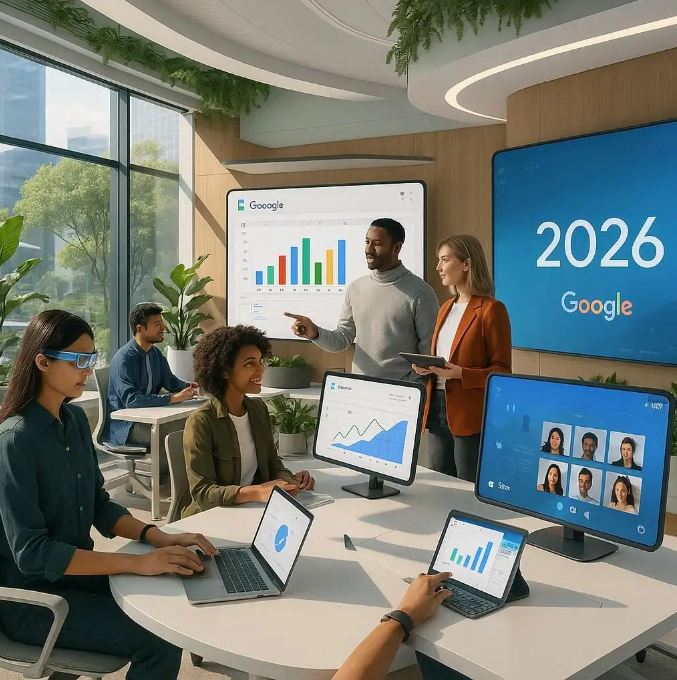
Over the past two years, Google has transformed more than at any other point in its history. What started as a traditional list-based search engine has evolved into an AI-driven discovery platform — one that interprets meaning, anticipates intent, and delivers answers before a user even clicks.
For digital marketers, publishers, and SEO professionals, this evolution represents both a challenge and a revolution.
This is Google in 2026 — and here’s what’s changed, why it matters, and how to adapt.
1. From Search Engine to “Answer Engine”
Google’s shift toward artificial intelligence has redefined the concept of “search.”
With the introduction of AI Overview (formerly SGE – Search Generative Experience), Google now summarizes information directly on the results page using its Gemini AI models.
Instead of ten blue links, users increasingly see:
-
AI summaries combining insights from multiple websites,
-
Interactive follow-up questions,
-
Visual elements such as images, product cards, and videos.
This evolution has one clear implication: less traffic leaves Google.
Users often find what they need within the AI answer itself — creating the phenomenon known as “zero-click search.”
What This Means for SEO
Traditional ranking positions are no longer the only metric that matters.
You now need to optimize to be referenced inside AI summaries — becoming a source of truth rather than just a top-ranked link.
Pages that are well-structured, authoritative, and written in natural language are more likely to be cited by Google’s AI as credible sources.
2. Intent Optimization: Beyond Keywords
The foundation of Google’s ranking system has always been relevance.
But in 2026, semantic search and user intent dominate the algorithm.
Modern SEO isn’t about repeating keywords — it’s about understanding why a user searches.
Google’s language models evaluate:
-
Contextual meaning instead of literal words,
-
Content depth (topic coverage and completeness),
-
Related entities and structured data,
-
Behavioral signals like time on page, scroll depth, and interaction.
Example
If a user searches for “best laptops for designers,” Google expects an in-depth, structured guide that:
-
Defines what designers actually need (GPU, color accuracy, RAM),
-
Compares models with real data,
-
Provides clear conclusions.
Content that satisfies this search intent fully will rank — even if it doesn’t include the exact keyword in every paragraph.
3. Visual and Multimodal Search
Search is no longer just text-based.
Google’s ecosystem now integrates Lens, voice, and video search, allowing users to explore visually or conversationally.
-
With Google Lens, users can photograph an object to get instant product results.
-
Through voice search, natural conversation replaces keywords (“What’s the best café near me that’s open now?”).
-
Short video responses appear directly in results, especially for tutorials and product guides.
The SEO Impact
To stay visible, websites must become multimodal-friendly:
-
Use descriptive alt text and captions for images,
-
Add schema for videos, recipes, and products,
-
Ensure fast media loading and responsive design,
-
Publish visual and audio versions of key content.
The more formats your information appears in, the higher the chance Google includes it across these new search modes.
4. The Decline of the Click: Zero-Click Search Reality
In 2026, up to 60% of all searches (according to multiple industry estimates) result in no website click.
AI summaries, knowledge panels, and instant answers satisfy the query before the user ever leaves the SERP.
This doesn’t mean SEO is dead — it means it’s changing.
Success is now measured by:
-
Visibility within AI results,
-
Brand mentions inside summaries,
-
Featured snippets,
-
Entity recognition (Google understanding your brand as an authority).
Strategic Response
-
Include concise, quotable sentences that AI can extract.
-
Add FAQ sections with natural phrasing.
-
Focus on entity SEO — connect your brand name, authors, and expertise through consistent schema and internal linking.
Being used by Google’s AI is the new form of ranking.
5. Google’s Algorithm Is Now Always Updating
Gone are the days of big, scheduled “core updates.”
In 2026, Google’s algorithm runs on continuous machine learning updates, adapting in real time based on user behavior and feedback loops.
Each query can produce slightly different results depending on:
-
Region, device, search history,
-
Engagement metrics,
-
Personalization preferences.
This makes adaptability essential for SEO. Static strategies that once worked for years may now become obsolete in months.
Action Steps
-
Audit your content quarterly.
-
Track SERP features, not just rankings.
-
Monitor engagement metrics (scroll depth, bounce rate, dwell time).
-
Keep your schema and metadata updated.
6. The Rise of E-E-A-T and Human Value
As AI-generated content floods the web, Google doubles down on E-E-A-T — Experience, Expertise, Authoritativeness, and Trust.
To maintain credibility:
-
Content must be authored by real experts, not anonymous AI.
-
Sites should display clear author bios, credentials, and editorial standards.
-
Original research, case studies, and firsthand insights perform better than generic rewrites.
Pro Insight
Google’s algorithms can detect patterns of synthetic or low-value AI content. Blending automation with human editorial oversight is the safest long-term strategy.
7. Technical Foundations Remain Non-Negotiable
Even as AI dominates search, technical SEO remains the backbone of visibility.
Google still rewards sites that load fast, are mobile-first, secure, and structured.
Key technical priorities for 2026:
-
Core Web Vitals: maintain sub-2.5s LCP and minimal CLS.
-
HTTPS encryption: mandatory for trust signals.
-
Schema markup: required for rich results and AI citation.
-
Crawl efficiency: reduce JS bloat and optimize rendering.
Technical excellence makes your content accessible — and trainable — for AI systems.
8. The Competitive and Regulatory Landscape
Google’s AI dominance is now under global scrutiny.
Regulators in the EU, U.K., and U.S. are investigating how it handles data, ranking bias, and publisher visibility.
Simultaneously, alternative discovery platforms are emerging:
-
Perplexity.ai — conversational search powered by citations,
-
ChatGPT Search — context-aware queries integrated with browsing,
-
Apple Search — potential new competitor for iOS users.
Why This Matters
Marketers should diversify visibility across multiple ecosystems.
SEO in 2026 isn’t “Google-only” anymore — it’s search ecosystem optimization.
9. The New SEO Mindset for 2026 and Beyond
SEO is no longer a battle for positions — it’s a strategy for presence.
To succeed:
-
Create human-centered content that teaches, helps, or entertains.
-
Structure your data for machines (AI) and clarity for humans.
-
Optimize for multiple search formats — text, image, voice, and video.
-
Invest in brand authority — expertise and authenticity now drive trust.
-
Measure visibility holistically — AI citations, engagement, conversions.