Reading Time 5
Number of Words 1114
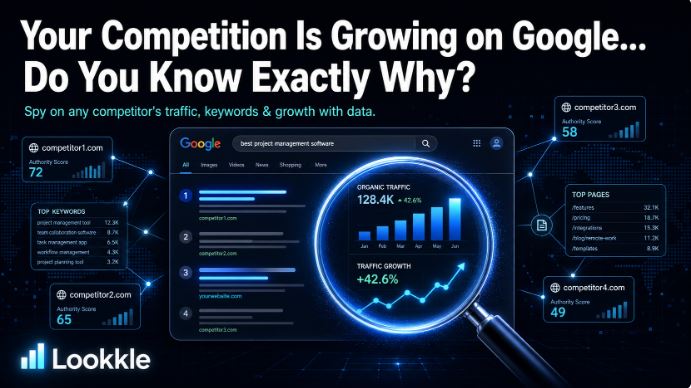
SEO has entered its most profound transformation in history. It's no longer enough to optimize keywords and acquire backlinks. Today, the landscape has two dimensions:
-
Traditional SEO: continue to rank on Google through content, authority and technique.
-
GEO (Generative Engine Optimization): Optimize to be cited by artificial intelligence engines such as ChatGPT, Gemini, Perplexity and Google AI Overviews.
GEO introduces a radical change: content no longer competes solely for rankings but begins to compete for semantic authority. AI systems don't recommend what best repeats a keyword, but rather what explains clearly, provides context, demonstrates expertise, and addresses a genuine user's intent.
The conclusion is straightforward: if your competition is growing on Google in 2026, they probably already have more comprehensive, better-structured, and more cited content than you. The good news is that you can find out exactly what they're doing.
Why Guessing Doesn't Work Anymore
Every day you publish content without knowing what your competitors are doing, you're making marketing decisions blindly. Google doesn't rank sites in isolation: it constantly compares your page to all those competing for the same keyword, which means your SEO performance is always relative, never absolute. Learn more...
Ask yourself these three questions:
-
Do you know which article brings the most organic traffic to your direct competitor?
-
Do you know if your competition has been growing or declining in recent months?
-
Do you know which keywords you're ranking for that you haven't even considered?
If you can't answer these three questions, you're competing blindfolded. Learn more...
What Data Do You Really Need to Outperform Your Competition
To win in SEO in 2026, you need access to five types of competitive intelligence:
-
Estimated monthly traffic — how many visits your competitor receives and whether it's growing or declining
-
Keywords that it ranks for — those that generate the most organic traffic
-
Traffic sources — whether it comes from Google, social media, referrals, or direct traffic
-
Historical domain evolution — its trend over the past 12 months, the most reliable indicator of whether Google rewards or penalizes a site
-
User behavior — bounce rate, time on page, and navigation depth
Spy on Your Competition with Real Data
Lookkle.com is a web analytics tool that allows you to analyze and compare up to 20 competitor websites simultaneously, displaying their key traffic metrics without requiring prior registration. It doesn't require installing anything on the competitor's website—all analysis is based on 100% legal and ethical public data.
What can you see about any competing domain?
| Fact | What it reveals |
|---|---|
| Estimated monthly visits | Total size of your presence on Google |
| Traffic trend (12 months) | Whether they are growing or declining |
| Traffic sources | Organic, social, referred, direct |
| Bounce rate and time on page | Whether its content is engaging or not |
| Geographic data | Markets where they dominate that you can take advantage of |
| Domain keywords | Your organic positioning terms |
| Preview and date of each page | When did they publish and how long did it take to rank? |
What sets Lookkle apart from the rest is that it's the only tool that allows you to analyze 20 competitors at once without registration and see the exact creation date of each competitor's page, something that no other free tool offers, using the competitor analysis tool.
Lookkle vs. the big platforms
| Tool | Free | No registration | 20 competitors at a time | Basic price |
|---|---|---|---|---|
| Lookkle | ✅ Yes | ✅ Yes | ✅ Yes | $19.95/month |
| SimilarWeb | ⚠️ Limited | ❌ No | ⚠️ No | Starting at $125/month |
| Ahrefs | ⚠️ Limited | ❌ No | ⚠️ No | Starting at $129/month |
| Semrush | ❌ No | ❌ No | ⚠️ No | Starting at $130/month |
How to Use Lookkle to Discover Why Your Competition Is Growing
Step 1 — Identify your true SEO rivals
Your SEO competitors aren't necessarily your business competitors—they're the sites that rank for the same keywords as you. Manually search for your main keywords on Google and note who consistently appears in the top 10.
Step 2 — Analyze its traffic and evolution
Enter any URL into Lookkle's Analyzer and get estimated visits, historical trends, and traffic sources in seconds. The goal is to detect if they are growing and, if so, on which channels.
Step 3 — Detect keyword gaps
Use Lookkle's keyword tool to identify the terms your competitors are ranking for that you're not covering. Classify these gaps into four types:
-
🟥 Missing keywords — they rank well, you don't show up → create new content
-
🟧 Weak keywords — you're on page 2-3, they're on page 1 → update existing content
-
🟨 Untapped — no one is positioning well → blue ocean opportunity
-
🟩 Your strengths — words where only you position yourself → protect and reinforce them
Step 4 — Analyze technical SEO and content quality
Use Lookkle's URL Analyzer to instantly audit any competitor's page: H1/H2/H3 heading structure, meta tags, content density, mobile signals, and number of links. Run the same analysis on your pages and compare directly. Lookkle
Step 5 — Act, don't just observe
Repeat the analysis monthly to detect strategy changes, seasonal trends, and new market opportunities. A monthly competitive analysis cycle with Lookkle can become a decisive advantage in positioning over time. lookkle+1
The 7 SEO Trends for 2026 You Should Have on Your Radar
While you're spying on your competition, make sure your strategy also takes into account these factors that define positioning this year:
-
GEO on SEO — Optimize to be cited by AI, not just to rank in lists of 10 links.
-
EEAT 2.0 — Real experience, verifiable authorship and cited sources; AI generates millions of similar texts, Google rewards human authenticity.
-
Structured content — Clear headings, lists, tables, FAQs; that's what LLMs need to recommend you.
-
In-depth subject authority — Better one comprehensive subject group than many superficial articles.
-
Core Web Vitals — LCP less than 2.5 seconds, INP less than 200 ms, CLS less than 0.1; still a positioning filter.
-
Conversational and voice search — Natural language, answers to "People Also Ask" questions, especially in local SEO.
-
Video first — The text market is oversaturated; short video is the engine of discovery in 2026.
The Principle That Changes Everything
"In 2026, the challenge is no longer to rank a URL. The challenge is to become a reference source."
The most advanced companies no longer measure just visits, but also presence, authority, brand visibility, and the ability to influence the decision-making process. Lookkle gives you the raw materials for that competitive intelligence: estimated traffic, active keywords, and real-time performance data for any domain.
The difference between a site that grows and one that stagnates is rarely due to luck — it's due to who best understands the competitive landscape and acts most quickly.
Start Now: Your First 5 Minutes with Lookkle
| Action | Tool | Link |
|---|---|---|
| 🔍 Analyze traffic from any competitor | Competitor Analysis | lookkle.com |
| 🔑 Detect keyword gaps | Keyword Research | lookkle.com |
| 🏗️ Audit on-page SEO of any URL | URL Analyzer | lookkle.com |
| 📊 Compare up to 20 domains at once | Multi-competitor view | lookkle.com |