Reading Time 6
Number of Words 1143
If you've ever logged into Google Analytics and seen words like organic, direct, or paid search without really understanding what they mean, you're not alone.
Understanding where your website traffic comes from is one of the first steps in making smart decisions about your digital presence.
In this article we explain it to you without technical jargon and with real-world examples.
What is web traffic and why does it matter?
Web traffic is simply the number of users who visit your site within a specific timeframe. But not all visitors arrive in the same way. Knowing where your visits come from is just as important as knowing how many you have, because each source has different behavior, cost, and conversion potential.
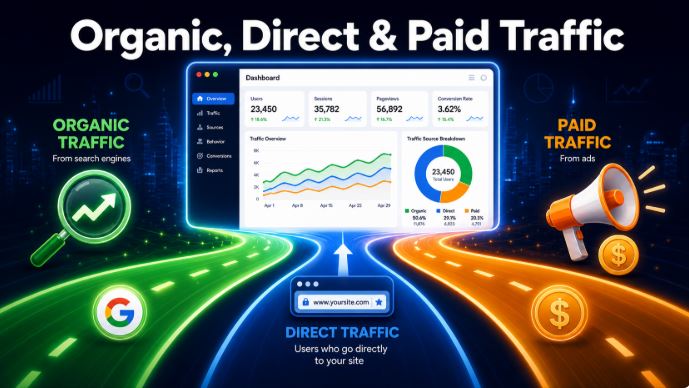
Imagine your website is a physical store. Some customers arrive because they found your storefront through a Google search, others because they already knew your address and came directly, and still others because they saw an advertisement on the street. These three paths are precisely the three types of traffic we're going to explain.
Organic traffic: the kind that builds over the long term
Organic traffic is the traffic that comes to your website through unpaid search engine results like Google or Bing. The user types a query, Google displays the results, and the user clicks on your page without you having paid for that click.
This is the most valuable type of traffic in the long run because, once you rank well, visits keep coming in at no extra cost. However, it requires time and a solid SEO (Search Engine Optimization) strategy : creating quality content, optimizing your website technically, and getting other sites to link to yours.
Characteristics of organic traffic:
-
It's free in terms of cost per click
-
It takes weeks or months to show results
-
It builds trust: users know it's not an advertisement
-
It is a direct reflection of the quality and relevance of your content
-
Once established, it works for you 24 hours a day.
💡 How much organic traffic does your website really have? Many website owners are unaware of their true percentage of organic visits. With Lookkle 's traffic analysis tool , you can discover not only how many organic visits you receive, but also estimate your competitors', identify which keywords are working for them, and uncover content opportunities you're not yet taking advantage of.
Direct traffic: the thermometer of your brand
Direct traffic is traffic that arrives when a user types your website's URL directly into their browser or has it saved as a bookmark. It can also include visits from links in messaging apps like WhatsApp or Telegram, and from emails where the origin isn't properly recorded.
In Google Analytics, direct traffic is defined as traffic that arrives without an identifiable source or referral data. This sometimes results in traffic being "contaminated" with visits that should be classified in another category, but it remains a very clear indicator of brand awareness.
What does direct traffic tell us?
-
A high proportion indicates that your audience already knows and trusts you.
-
It is a sign of a well-established and memorable brand
-
This may include traffic from mislabeled email campaigns
-
A sharp drop may indicate a loss of relevance or direct competition
💡 Are you losing direct traffic without realizing it? If your direct traffic volume drops from month to month and you don't know why, it's time to investigate. Lookkle lets you compare the traffic evolution of any domain month by month, detect unusual trends, and compare your performance against your direct competitors—all without needing access to their analytics accounts.
Paid traffic: immediate results with investment
Paid traffic is traffic that comes through advertising: Google Ads, Meta Ads (Facebook and Instagram), LinkedIn Ads, display ads, retargeting, etc. Unlike organic traffic, each click has a direct cost, and when you stop investing, the traffic stops immediately.
Its biggest advantage is immediacy: you can launch a campaign today and start receiving visits within hours. It's ideal for product launches, seasonal promotions, or when you need quick results while building your long-term organic presence.
Advantages of paid traffic:
-
Visible results from day one
-
Highly precise segmentation (age, location, interests, purchase intent)
-
Full control of the budget and the message
-
Ideal for testing value propositions before committing to SEO
-
It perfectly complements the organic strategy.
Disadvantages of paid traffic:
-
Constant cost per click; disappears if you stop investing
-
Does it require technical knowledge or a budget for an agency?
-
Users are increasingly reluctant to click on ads
💡 Do you know how much paid traffic your competitors are generating? Before investing in campaigns, it's essential to understand the landscape. With Lookkle, you can analyze the traffic mix of any public domain and estimate whether your competitors are focusing more on SEO or paid advertising. This information can save you thousands of euros in poor decisions.
Comparative table: organic vs. direct vs. paid
| Feature | Organic | Straight | Paid |
|---|---|---|---|
| Cost per visit | None | None | Yes (CPC/CPM) |
| Speed of results | Slow (months) | Immediate | Immediate |
| Sustainability | High | High | It depends on the budget. |
| Control | Half | Low | High |
| Indicator of | SEO Quality | Brand recognition | Advertising investment |
| Key tool | SEO, content | Branding, email | Google Ads, Meta Ads |
What type of traffic should I prioritize?
The honest answer is: all three, in a balanced and progressive way. In the early stages of a project, paid traffic can give you initial traction while you build organic authority. As you mature, organic traffic becomes your most valuable asset, and direct traffic grows naturally as a reflection of your reputation.
A sound strategy in 2026 combines:
-
SEO and content to generate sustainable organic traffic
-
Branding and email marketing to strengthen direct traffic
-
Targeted paid campaigns for launches, trials, and seasonal periods
The most common mistake is completely ignoring one of the three sources. Many businesses invest everything in advertising, and when their budget runs out, their website disappears. Others rely solely on SEO and take years to see results without any revenue in between.
How to measure and compare your traffic (and that of your competitors)
Knowing your own statistics is the starting point, but the real strategic leap comes when you can compare yourself to the market. Are your competitors growing faster than you? What traffic sources are they leveraging that you're not? Which organic keywords should you be focusing on?
This is where Lookkle makes the difference. Unlike other tools, Lookkle allows you to:
-
Analyze the estimated traffic of any domain, including yours and your competitors'.
-
Visually identify the dominant traffic sources (organic, direct, referral, social).
-
Detect growth or decline trends in real time
-
Compare multiple domains in parallel to gain a comprehensive view of the sector
-
Make decisions based on data, not assumptions.
If you manage a website, online store, blog, or any digital presence, you can't afford to make decisions blindly. Try Lookkle for free and discover in minutes what's happening with your traffic and your competitors'.
Quick conclusion
Understanding the difference between organic, direct, and paid traffic isn't just marketing theory; it's the foundation upon which any profitable digital strategy is built. Each type has its own timing, purpose, and method of measurement. The sooner you master these three sources, the sooner you can take real control of your online growth.