Reading Time 9
Number of Words 1955
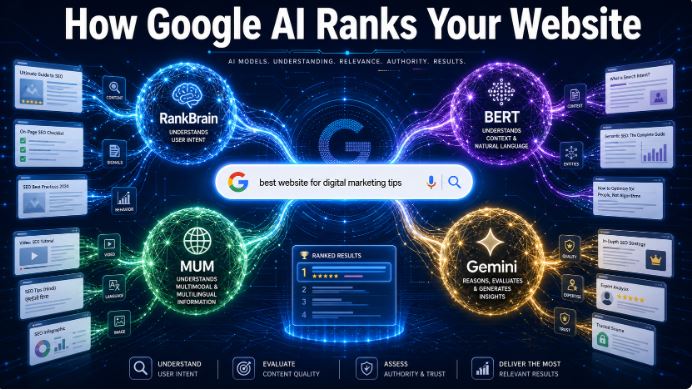
Google has been using artificial intelligence for over a decade to decide what content deserves to be at the top of search results.
In 2026, that commitment has multiplied: there is no longer a single algorithm, but an ecosystem of AI systems working in parallel to read, interpret and answer questions with unprecedented sophistication.
The key question is no longer "how does Google's algorithm work?" but "how do the systems that decide what to rank think?"
The 4 AI Systems That Move Google's Ranking
Google doesn't use a single artificial intelligence model for ranking. It uses several specialized systems that work in layers, each solving a specific problem.
RankBrain: The First Great Leap (2015)
Active since 2015, RankBrain was the first machine learning system officially integrated into Google's algorithm. Its main function is to interpret searches that Google has never seen before, especially complex long-tail queries or unusual phrases.
What RankBrain does is translate words and phrases into mathematical vectors: numerical representations where similar concepts are grouped in the same vector space. So, if someone types "what movie to watch if I liked Inception but without action," RankBrain can interpret that they are looking for something conceptually dense, narratively complex, and with plot twists, even if no one has ever typed that exact query before. Its impact is especially noticeable in the ranking of results when the search intent is ambiguous.
BERT: When Google Learned to Read in Context (2019)
BERT ( Bidirectional Encoder Representations from Transformers ) was the true turning point in Google's natural language understanding. Unlike previous models that read text from left to right, BERT analyzes all the words in a sentence simultaneously and in relation to each other.
This represented a radical change. Previously, if someone searched for "non-drowsy pain pills," Google could ignore the "non-" and show results for pills that do cause drowsiness. BERT understands that the preposition "non-" completely changes the intent. Today, BERT operates in the ranking and retrieval of documents: first, it filters which ones are relevant, and then it orders them by relevance.
MUM: The Multimodal AI that Thinks in 75 Languages (2021)
MUM ( Multitask Unified Model ) represents a significant leap forward compared to BERT: according to Google, it is 1,000 times more powerful in processing capacity. Its fundamental difference is that it understands not only text, but also images, videos, and content in more than 75 languages simultaneously.
MUM is designed to solve complex searches that require synthesizing information from multiple sources and formats. For example, if a user uploads a photo of a pair of shoes and asks, "Can I use these for hiking in the Alps?", MUM can cross-reference the image with textual information about the type of sole, the requirements of alpine terrain, and recommendations in different languages to provide a comprehensive answer.
Gemini (SGE): The AI that Responds Without You Clicking
Gemini is the newest system and, for many SEO professionals, the most disruptive. It's the engine behind AI Overviews (formerly called SGE or Search Generative Experience) that appear at the top of Google search results. In May 2016, Google announced at its I/O conference that AI Overviews already appear in 48% of queries, and that 93% of sessions in AI Mode end without a click on traditional results.
Gemini does not have its own crawl index: it uses Google's search index and its existing quality systems to locate the most relevant and up-to-date pages, synthesize them, and present a direct response to the user.
Query Fan-Out: How Google "Thinks" Before Answering You
One of the most important concepts of 2026, and one that few professionals are yet familiar with, is query fan-out. When a user enters a query in AI Mode, Google doesn't run that search just once. It breaks it down into up to 16 parallel sub-searches on subtopics, related entities, and semantic variations, extracts snippets from multiple sources, and synthesizes a single answer.
This was confirmed by Google's own search director, Prabhakar Raghavan, in a 2026 interview. What this means for SEO is crucial: it's no longer enough to rank for an exact keyword. Your content can be selected as the source of an AI answer even if you're not number one for that query, as long as you accurately cover one of the sub-queries that Google generates in parallel.
From SEO to GEO: The New Positioning Paradigm
The concept that is redefining digital marketing in 2026 is GEO (Generative Engine Optimization): the discipline of optimizing your content not only to rank in link lists, but to be understood, selected and cited by AI generative engines.
While traditional SEO focused on keywords, meta tags, and backlinks, GEO prioritizes:
-
Deep semantic relevance: Cover the topic from all angles, not just the main keyword
-
Data structure for LLMs: Implement Schema markup (FAQPage, HowTo, Article, Person) so that AI can understand the content
-
Direct answers: An introductory block of fewer than 150 words that immediately resolves the search intent
-
Scannable format: Clear headings, lists, tables, and short paragraphs that models can easily extract.
-
Brand mentions without a link: In 2026, Google will value contextual brand mentions even if they are not accompanied by a hyperlink.
Google's official guide, published in May 2026, was unequivocal: specific "GEO tricks" don't work. What does work is good old-fashioned, high-quality SEO, but applied with the new mindset that the ultimate goal is to be cited by AI, not just to appear in the top ten results.
EEAT: The Trust Filter That Controls Everything
If there's one framework that defines SEO in the age of AI, it's EEAT: Experience, Expertise, Authoritativeness , and Trustworthiness. It's not a direct, measurable ranking factor, but by 2026 it will function as the trust filter that determines whether your content is "training data quality" for Google's ranking systems.
The "E" for Experience was added in 2022 and is the most important signal in 2026: Google is looking for real evidence that the writer has lived what they describe. The data confirms this beyond a doubt: sites that publish their own research, original data, or unique perspectives have gained an average of 22% in visibility, while pages that simply repackage existing content with AI have lost 71% of their traffic. The conclusion is clear: generic, mass-produced AI-generated content is being penalized; useful content with genuine authorship is being rewarded.
The EEAT signals that Google detects
These are the specific signals that the algorithms evaluate to determine your EEAT level:
-
Named author: Bylines with author's name, surname, and verifiable credentials
-
Citation pattern: Your domain cited by authoritative external sources
-
Frequency of brand mentions: How many times your brand is mentioned in other web contexts
-
Accuracy track record: Your website has a history of not publishing incorrect information.
-
Behavioral signals: Time on page, bounce rate, and scroll depth as indirect indicators of usefulness
Google No Longer Reads Keywords, It Reads Intents
This phrase summarizes the most profound change in modern SEO. Google doesn't have a list of "rules" to apply mechanically; it has AI systems that try to understand what a user really wants to accomplish when they type a query.
Search intent is classified into four types, and each requires a completely different type of content:
| Type of intention | What the user is looking for | Ideal format |
|---|---|---|
| Informational | To learn or understand something | Educational article, guide, FAQ |
| Navigational | Go to a specific site | Optimized brand page |
| Transactional | Buy or hire | Product sheet, landing page |
| Market research | Compare before you decide | Comparison, review, price table |
Content that serves the wrong purpose will never rank well, regardless of how many keywords it includes. This is why technical SEO is still necessary but no longer sufficient: Google's February 2016 core update explicitly targeted low-quality, mass-produced AI-generated content and rewarded sites that demonstrate genuine subject authority.
How to Measure Your Visibility in the Age of AI
Adapting to this new reality requires accurate data. You can't optimize for Google's AI systems if you don't know what's really happening with your website traffic: which pages are losing clicks due to AI Overviews, which competitors are being cited instead of you, or which keywords are gaining impressions but losing CTR.
Lookkle allows you to analyze the real traffic of any domain, giving you a practical advantage in this new context:
-
Detects CTR drops consistent with the presence of AI Overviews in your target terms
-
Analyze your competitors' traffic to discover which pages are being cited as sources by AI
-
Monitor the evolution of organic traffic before and after changes in your content strategy
-
Identify keyword opportunities with real volume where the competition has not yet optimized for intent.
-
Evaluate the comparative authority of your domain against the leaders in your industry.
Combining competitive analysis with Lookkle and a well-executed GEO strategy allows you to pinpoint exactly where Google's AI is citing your competition and replace it with more useful, structured content that has a higher EEAT signal.
Practical Strategy: Optimize to Be Cited by Google in 2026
Summarizing all of the above into an actionable plan:
1. Audit your content with real intent.
Review the pages with the most impressions but low CTR in Google Search Console. These are the candidates for being "absorbed" by AI Overviews without generating clicks.
2. Rewrite the beginning of each article.
The first 100-150 words should directly answer the main question. Google and AI models extract answers from the beginning of the content.
3. Add your own data and experience.
Include sourced statistics, your own case studies, real-world results, or perspectives that only you can provide. This is what sets your content apart from that generated by AI.
4. Implement full Schema markup
FAQPage on all pages with frequently asked questions, Article with authorship, HowTo in step-by-step guides, and LocalBusiness if you have a physical presence.
5. Build topic authority, not isolated content.
Create content clusters where a pillar page covers the main topic and several satellite pages cover related subtopics. This is what query fan-out rewards: multiple pages from the same domain covering various angles of the same query.
6. Optimize the technical experience.
Loading speed, mobile compatibility, and Core Web Vitals remain the minimum requirements. Without them, no content strategy will work.
7. Measure, adjust, and repeat with Lookkle.
Use Lookkle's traffic and competition data every 4-8 weeks to identify which changes are working and which keywords your content is gaining traction on in AI citations.
Frequently Asked Questions (FAQ)
Do RankBrain, BERT, and MUM work separately?
No. They work in synergy: RankBrain interprets the overall intent, BERT analyzes the grammatical context of the query, MUM processes multiple formats and sources, and Gemini synthesizes the final response.
Does it make sense to continue doing traditional SEO in 2026?
Yes, but only as a foundation. Technical SEO—speed, architecture, quality backlinks—is still necessary. The difference is that now the goal also includes being cited by AI, not just appearing in the top ten organic results.
Can my website appear in AI Overviews if I'm not in the top 3?
Yes. Google's query fan-out generates up to 16 parallel sub-searches and selects snippets from multiple sources. You can be cited if your page specifically addresses one of those subtopics, even if you're not the top overall ranking.
Is AI-generated content being penalized by Google?
Massively generated content without genuine human oversight has been penalized since the February 2026 core update. AI-assisted content that is reviewed, enriched with original data, and published with genuine authorship is not penalized; in fact, it is penalized.
How can I tell if I'm losing visibility because of AI Overviews?
The clearest symptom is that impressions remain the same or increase in Google Search Console, but the click-through rate (CTR) drops significantly. This indicates that Google is showing your ad (possibly as the source of an AI Overview), but the user doesn't need to click because they already have the answer.