Reading Time 9
Number of Words 1848
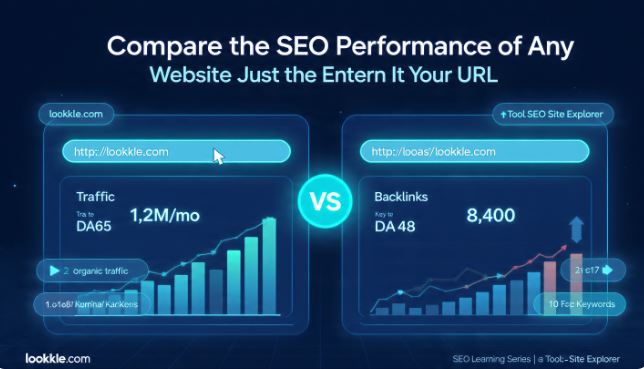
Have you ever wondered how much traffic a website in your industry receives without having to ask anyone?
By 2026, you won't need to be a technical expert or have access to anyone's Google Analytics. With the right tools, comparing the SEO performance of any website will be as simple as entering a URL and clicking a button.
🔍 What does it mean to analyze the SEO performance of a website?
A website's SEO performance is the set of factors that determine its visibility in search engines, the amount of organic traffic it receives, where those visitors come from, and how they behave once on the site. It's not just about Google ranking: it includes engagement metrics, diversification of traffic sources, domain authority, and content quality.
Analyzing this performance—whether of your own site or a competitor's—allows you to:
-
Identify which keywords generate the most traffic for your competitor that you are not targeting.
-
See if your site is losing or gaining positions month by month
-
Identify which traffic sources the competition uses (organic, direct, social media, AI)
-
Validate whether an SEO strategy is working before investing more time or money.
-
Discover technical errors that hinder the site's growth
📊 The most important SEO metrics when comparing websites
When you enter a URL into an analytics tool, these are the numbers you should look at most closely:
🌐 Estimated organic traffic
The monthly volume of visits coming from search engines like Google or Bing is the main indicator of a website's SEO health. A website with growing organic traffic is doing things right; one with sustained declines has a problem to solve.
📈 Global and country-specific positioning
It's not enough to know if a website has traffic: you need to know where that traffic is coming from geographically. A site might have a lot of traffic from India or Latin America but very little presence in Spain. This metric helps you understand whether your competitors' strategy is localized or global.
🔑 Keywords that generate the most traffic
The keywords for which a website appears in Google determine what type of user arrives and with what intent. Knowing your competitors' keywords is one of the most valuable exercises in any SEO strategy: it shows you exactly where the gaps are that you can exploit.
🔀 Diversification of traffic sources
Does the website rely exclusively on Google? Does it get traffic from social media, email, external referrals, or AI platforms? A site heavily dependent on a single source is more vulnerable to algorithm changes.
⏱️ Time spent on site and bounce rate
The time users spend on the site and the bounce rate are signals of content quality and user experience, two factors that Google increasingly considers. A low bounce rate indicates that the content is relevant and the experience is good.
🤖 Traffic from AI platforms
In 2026, an emerging and increasingly relevant metric is traffic from platforms like ChatGPT, Perplexity, Gemini, and Claude. These AIs recommend websites to their users, and this referral traffic is now measurable. Knowing whether your competitors are receiving visits from AI—and you aren't—can make all the difference in your content strategy.
🛠️ How to compare the SEO of any website with Lookkle
Lookkle is a web traffic and SEO analysis platform that allows you to study the performance of any public website simply by entering its URL, without needing access to your Google Analytics or any internal dashboard. It's especially useful for competitive analysis, market research, niche validation, and self-auditing, with a free plan of up to 4 analyses per day without registration.
Step 1 — Analyze the estimated traffic of any URL
👉 Website Traffic Checker — Lookkle
Enter the URL you want to analyze and you'll get the following in seconds:
-
Estimated monthly visits
-
Breakdown of sources: organic, direct, referral, social media, AI traffic
-
Bounce rate and average session time
-
Geographic distribution by country
-
Month-by-month traffic evolution history
-
Estimation of traffic value and monetization channels
With this information you can directly compare any website with yours and detect in which months and sources your competitor has grown.
Step 2 — Check the SEO ranking by keywords
👉 Ranking Checker by Keyword — Lookkle
This tool shows the keywords that position a domain on Google, their search volume, the evolution of the ranking over time, and the difficulty of each keyword.
If your competitor ranks in the top 3 for a keyword with 10,000 monthly searches and you're not even targeting it, you've just found the perfect target for your next piece of content.
Step 3 — Perform an SEO audit of the site
Enter any URL and you'll get a complete analysis of:
-
Meta tags: title, meta description, H1–H3
-
robots.txt status and sitemap
-
HTML errors, broken links, images without alt text
-
Mobile performance
-
Loading speed and Core Web Vitals
-
Overall SEO score with improvement recommendations
Applying this audit to your own site gives you a list of concrete tasks. Applying it to a competitor's site reveals their weaknesses.
Step 4 — Research competitor keywords
👉 Keyword Research Tool — Lookkle
With this tool you can:
-
See which long-tail keywords generate real traffic in your niche
-
Compare search volume with ranking difficulty
-
Identify growing keywords that are not yet saturated
-
Finding semantic variations and related questions
-
Filter by country to tailor the strategy to the target market
🆚 Case study: how to compare two websites in 5 minutes
Imagine you have a technology blog and you want to know if you're competing effectively against a site in the same niche. This would be the exact workflow:
-
You enter its URL into Lookkle Traffic Checker → you discover that it receives 45,000 monthly visits, of which 72% is organic traffic.
-
You enter your own URL → your site has 12,000 visits with 60% organic traffic.
-
You compare the keywords → the competitor ranks for 380 active keywords; you for 110.
-
You check the SEO audit of both → their site has a better heading structure and more backlinks, but their loading speed is lower than yours.
-
Result: You have a technical advantage but a content deficit. You create a plan to target the 50 most accessible keywords that he's working on and you're not.
All that analysis, with real data, in less than 10 minutes.
📈 Why is comparative SEO analysis key in 2026?
SEO no longer works in a vacuum. What determines whether you appear in the top positions on Google is not just how well you do things, but how you do them compared to other sites competing for the same keywords.
Some facts that define the current context:
-
The top 1% of websites account for over 90% of total organic traffic
-
Pages in position 1 on Google have an average click-through rate of 27.6%; those in position 10, barely 2.4%.
-
Traffic from AI platforms has grown 400% since 2025 and now accounts for 2% of global web traffic
-
Websites that combine regular competitive analysis with content strategy grow significantly faster in organic traffic than those that do not.
🔒 Is it legal to analyze the SEO of another website?
Yes, absolutely. Analyzing publicly available website visibility data—estimated traffic, search engine rankings, visible on-page structure—is a perfectly legal and widely used practice in digital marketing, SEO audits, and competitive strategy. Tools like Lookkle, Semrush, Ahrefs, and SimilarWeb routinely operate in this area and never access private internal data of the analyzed site.
✅ What can you do with the information obtained
Once you have comparative SEO data for your competitors, the most effective actions are:
-
Create content about the keywords they rank for that you don't. That's what has the most direct impact on traffic in the medium term.
-
Fix the technical errors that the audit detects on your site. These are opportunities for immediate improvement with relatively quick results.
-
Replicate the structure of your best-performing pages. If a page with a certain heading architecture is in the top 3, there's something about that structure that Google values.
-
Diversify your traffic sources. If your competitor is receiving traffic from AI platforms and you aren't, it's time to optimize your content to be cited by ChatGPT, Perplexity, or Gemini.
-
Monitor monthly trends. SEO is a long-term endeavor. Reviewing comparative metrics every 30 days allows you to detect changes sooner.
💬 What SEO professionals do differently
Experienced SEOs have one thing in common: they don't work with assumptions, they work with data. Before writing an article, they check if that topic already has a strong competitor. Before changing a page's structure, they analyze what the page ranking above it on Google is doing. Before investing in link building, they see how many backlinks the competition has.
That habit of constant comparative analysis is what separates a website that grows steadily from one that works hard without seeing results. And with tools like Lookkle, that type of analysis no longer requires an agency budget or advanced technical knowledge.
❓ Frequently Asked Questions (FAQ)
Can I analyze any website, even without having access to it?
Yes. Lookkle analyzes public visibility and SEO performance data for any domain without requiring login credentials or owner permissions.
Are the estimated traffic figures accurate?
They are estimates based on rankings, search volumes, and behavioral patterns. They are not the exact data from Google Analytics, but they are accurate enough for benchmarking and strategic decision-making.
How often should I analyze my competition?
At least once a month. If you're in a highly competitive niche or actively making changes to your site, a bi-weekly review will give you more agility to react.
Can I use Lookkle for free?
Yes. Lookkle offers a free plan with up to 4 daily analyses without requiring registration. For higher-volume professional use, subscription plans start at $19.95/month, and a Pro plan is available for $49.95 with 105 uses per tool.
Does Lookkle detect AI traffic from platforms like ChatGPT or Perplexity?
Yes. Lookkle includes traffic analysis from AI platforms, differentiating by source: ChatGPT, Gemini, Perplexity, Claude, and others. It's one of the few tools that already integrates this emerging metric in 2026.
Can it also be used to analyze my own website?
Absolutely. Analyzing your own site with external tools gives you an objective perspective that you don't always see from within, and allows you to compare yourself directly with your competition under the same conditions.
🔗 Lookkle tools for comparative SEO analysis
| Tool | What is it for? | Link |
|---|---|---|
| Website Traffic Checker | Estimate monthly traffic, sources, and behavior of any URL | Go to the tool |
| Ranking Checker by Keyword | It shows the keywords that rank a website and in what position. | Go to the tool |
| Website SEO Scan | Complete SEO technical audit of any domain | Go to the tool |
| Keyword Research Tool | Research keywords with volume, difficulty, and trend | Go to the tool |
🏁 Conclusion
Knowing where the competition is isn't spying: it's business intelligence. Every URL you analyze is a lesson in what works in your niche, which keywords have real demand, and which mistakes to avoid. And doing so systematically, with data updated monthly, is what transforms an SEO strategy into measurable results.
You can start today: enter any URL into Lookkle and in less than two minutes you'll have more information about that website than most of its owners have about themselves.
👉 Get started for free at lookkle.com — no registration, no credit card, using real data from any website in less than 2 minutes.