Reading Time 8
Number of Words 1586
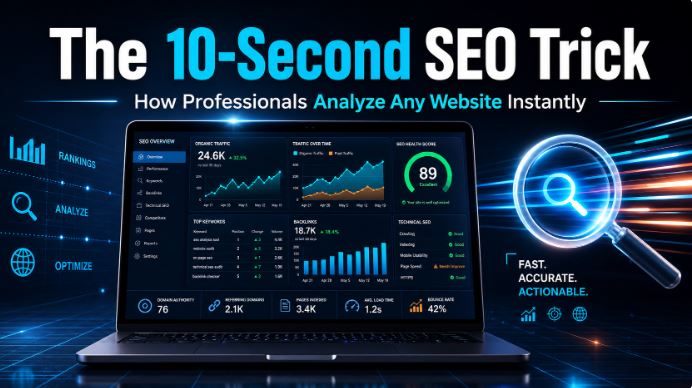
🎯 What Do You Know About a Website in the First 10 Seconds?
There is one skill that separates a novice SEO consultant from an experienced one: the ability to take a complete look at any website in a matter of seconds, before opening a single paid tool, before running a crawl, before even reading a line of the source code.
It's not magic. It's a method. And in this article, we're going to reveal exactly how they do it, step by step.
🧠 Why Do Pros Analyze Websites "Cold" So Quickly?
An SEO professional analyzes dozens of websites a week: their clients' competitors, new niches, link-building opportunities, sites looking to buy… They can't spend hours on each one. That's why they've developed a rapid inspection protocol that allows them to get an accurate first impression in a very short time.
The key is knowing what to look at first and with which tool. It's not about speed: it's about priorities.
💡 "The first 10 seconds of analysis tell you 80% of what you need to know about a website's SEO status." — Methodology used in top-level SEO agencies.
🚀 The 60-Second Protocol: Step by Step
👁️ Step 1 — The Visual Gaze (2 seconds)
Before opening any tool, professionals open the website in their browser and instinctively observe:
-
Does it charge quickly or is there a noticeable delay?
-
Is the design modern and professional, or is it outdated?
-
Is there any visible content or is it mostly advertising?
-
Is the URL clean or full of strange parameters?
These micro-indicators already provide clues about whether the site invests in user experience (UX), which is a ranking factor confirmed by Google.
🔎 Step 2 — The site: Google Operator (3 seconds)
The oldest and most powerful SEO trick is also the most underutilized. Open Google and type:
site:domain.com
In 1 second you get:
-
📄 Indexed pages: How many pages does Google have in its index?
-
🗂️ Site structure: Which sections carry the most weight
-
📝 Quality of titles and meta descriptions: Are they optimized or generic?
-
⚠️ Duplicate content or junk pages: If strange or repeated URLs appear
What does this tell you in seconds? If a website has 500 published pages but Google only indexes 80, there's an indexing problem or thin content. An immediate red flag.
Combine it with:
site:domain.com "keyword"
To see if they have content on a specific topic.
📊 Step 3 — Web Traffic Analysis (5 seconds)
This is where the professionals really accelerate. While the operator site: gives you qualitative data, Lookkle gives you quantitative data: actual traffic, sources, keywords, and user behavior.
👉 Analyze any website for free on Lookkle →
Just enter the domain and in seconds you get:
📈 Real-Time and Historical Web Traffic:
Lookkle shows the evolution of traffic from 2023 to the present. At a glance, you can see if the website is growing, stagnating, or in freefall. A sustained downward trend = a sign of penalties or outdated content.
🌍 Traffic by Country and Device
: Where are visitors coming from? Desktop or mobile? This data is key to understanding the site's true target market. A website with 90% mobile traffic that isn't mobile-optimized has a critical problem.
- Analyze Web Traffic by Country and Device → (Registration Required)
🔑 Lookkle Organic Keywords
shows you which search terms generate real traffic to your website, with volume and trend data. In 5 seconds, you'll know which content strategy is working (or failing).
🔗 Traffic Sources
: Does your traffic come from organic search, social media, direct traffic, referrals, or advertising? A healthy website diversifies its sources. One that relies 95% on Google is vulnerable to any algorithm update.
🤖 AI vs. Human Traffic Detection
: An exclusive advanced feature, Lookkle identifies which traffic comes from AI bots or automation versus real users. Essential in 2025-2026, when synthetic traffic is booming.
- Analyze AI vs. Human Traffic → (Registration Required)
⚡ Benchmark with Competitors
: Analyze two or more domains in seconds to see who wins in SEO, traffic, and engagement. ( Registration Required )
🛠️ The Complete Quick Analysis Checklist
Once you have the initial overview using the steps above, professionals complete the analysis with these additional points, which take no more than 2-3 minutes:
🏗️ On-Page Structure (30 seconds)
-
View source code (Ctrl+U): Does it have the correct meta title, meta description, and H1?
-
Homepage URL: Is it HTTPS? Is it www or non-www? Does it redirect correctly?
-
Page load speed: Use Google PageSpeed Insights (free) — direct penalty if it exceeds 3 seconds
Analyze the On-Page Structure →
🔗 Backlinks Profile (1 minute)
The volume and quality of backlinks is one of the most decisive factors in SEO. With Lookkle, you can see referring domains and their quality. A website with few quality backlinks compared to a competitor with thousands faces a gap that's difficult to close in the short term.
Analyze the Backlink Profile →
🗺️ Basic Traceability (30 seconds)
-
Type
domain.com/robots.txtinto your browser — are important pages being blocked by Google? → Learn More -
Write
domain.com/sitemap.xml— Do they have an up-to-date and well-structured sitemap? → Learn More
📋 Table: Which Tool to Use for Each Data Point
| Information You Need | Tool | Time |
|---|---|---|
| Estimated traffic and sources | Lookkle | ⚡ 5 sec |
| Indexed pages | site: on Google |
⚡ 3 sec |
| Organic keywords | Lookkle Keyword Research | ⚡ 5 sec |
| Loading speed | Google PageSpeed Insights | 🕐 20 sec |
| Backlinks and referring domains | Lookkle Backlink Tracking | ⚡ 10 sec |
| Meta title / description / H1 | Lookkle SEO Scan | 🕐 15 sec |
| robots.txt and sitemap | Direct URL in the browser | ⚡ 5 sec |
| Historical traffic since 2023 | Lookkle Historical Analytics | ⚡ 5 sec |
| Geographical competence | Lookkle Traffic | ⚡ 5 sec |
| Complete on-page audit | Lookkle On-Page SEO Audit | 🕐 30 sec |
🔍 Case Study: Analyzing a Competitor in Real Time
Imagine you're an SEO consultant and your client wants to target the "mini PC review" niche . Your main competitor is minipc-review.com...
This would be your exact process:
-
site:minipc-review.com→ Over 100 indexed pages. Good presence. -
Lookkle → 5641 monthly visits, 24% from the UK, 41.8% organic traffic, rapid rise in the last 3 months.
-
Keywords on Lookkle → Their top 3 keywords: "firebat am02", "minisforum vs beelink", "acemagic retro x5".
-
Backlinks on Lookkle → 129 referring domains, various media outlets and photography blogs.
-
View source code → Title well optimized, clear H1, somewhat generic meta description (opportunity).
-
robots.txt → No relevant restrictions. Sitemap updated.
Results in under 5 minutes: You'll know the traffic volume, its seasonality, its best keywords, the strength of its backlink profile, and its on-page weaknesses. Enough to build a complete competitive strategy.
🆚 Lookkle vs. Other Quick Analysis Tools
| Tool | Free | Speed | Historic Traffic | Keywords | Competitors | Price |
|---|---|---|---|---|---|---|
| Lookkle | ✅ (4 reports/day) | ⚡⚡⚡ | ✅ Since 2023 | ✅ Complete | ✅ Benchmark | Starting at $0 |
| SimilarWeb | ✅ Limited | ⚡⚡ | ⚠️ Only 3 months | ⚠️ Limited | ✅ | Expensive |
| SEMrush | ❌ | ⚡⚡ | ✅ | ✅ | ✅ | Very expensive |
| Ahrefs | ❌ | ⚡⚡ | ✅ | ✅ | ✅ | Very expensive |
| WooRank | ✅ Limited | ⚡ | ❌ | ⚠️ Basic | ❌ | Half |
| Google Search Console | ✅ | ⚡⚡ | ✅ | ✅ | ❌ Only your website | $0 |
💡 Lookkle stands out for offering historical traffic data since 2020, competitor analysis, AI traffic detection, and keyword research all in one platform with a functional free plan — something that tools like SEMrush or Ahrefs reserve for paid plans that exceed €100/month.
⚡ The 5 Mistakes Beginners Make When Analyzing a Website
Professionals also know what not to do:
-
Don't rely solely on total traffic — A website with 500,000 visits but a 90% bounce rate is worthless. Always look at the full context.
-
Ignoring historical traffic — A website with 50,000 current visits might seem interesting... until you see on Lookkle that it had 200,000 visits two years ago. A sign of serious decline.
-
Failing to differentiate between organic and paid traffic — A website with 80% paid traffic doesn't have strong SEO, it has an advertising budget.
-
Skipping device analysis — If 70% of traffic is mobile and the website is not optimized for smartphones, it's a direct attack opportunity.
-
Ignoring seasonal trends — Some niches have very pronounced peaks (Christmas, summer, back to school). Without historical data, you'll misinterpret current traffic data.
💡 Pro Tips: Take Analysis to the Next Level
Once you've mastered the 60-second analysis, these additional shortcuts will take you to the next level:
-
🔍 Google Cache: Type
cache:dominio.comto see when Googlebot last crawled that page. If it's weeks late, there are crawl budget issues. -
📱 Mobile compatibility test:
search.google.com/test/mobile-friendly— Direct ranking factor since 2019. -
🔐 HTTPS verification and SSL certificate: A broken padlock or expired certificate negatively impacts your visual reputation and ranking.
-
📊 Lookkle Growth Signals: Identify domains with growing traffic in specific niches — perfect for detecting new competitors before they become a threat.
-
🌐 Lookkle Traffic by Country: If your client operates in several countries, this module tells you which ones their competitor has a real presence in and which ones have gaps to exploit.
🔧 Your Optimized SEO Workflow
To implement all of this systematically, we recommend this workflow:
- Open the website → Visual impression (2 sec)
- site:domain.com on Google → Indexing and structure (3 sec)
- Lookkle → Traffic + Keywords + Sources + History (10-15 sec)
- View source code → Basic on-page (15 sec)
- /robots.txt and /sitemap.xml → Traceability (10 sec)
- PageSpeed Insights → Speed (20 sec)
Total: less than 60 seconds for a complete diagnosis.
🎯 Conclusion: Speed of Analysis is a Competitive Advantage
In SEO, whoever has the information first, wins first. Professionals in the field don't have superpowers; they simply have better tools and more efficient protocols than everyone else.
The 60-second trick is not a shortcut to avoid work — it's the foundation that allows you to make informed decisions in seconds, prioritize your time, and focus resources where they really matter.
Lookkle is the centerpiece of this protocol: historical traffic since 2023, organic keyword analysis, traffic sources, AI bot detection, competitor benchmarking, and on-page auditing, all in one platform accessible from the free plan.