Reading Time 6
Number of Words 1186
What happens when you finally launch your app? If you have any experience, the dev agency sends you a congratulations email with a couple of celebratory emojis. Then, somewhere around week three, the Slack channel with the dev team goes silent.
That silence usually means the people who built your product are already onboarding their next client, and your app has to fend for itself.
But what many people don’t know is that launching the app is just half the job. The other half comes a year later when users decide they’ve outgrown your product and you need to keep up with their advancing needs. Unfortunately, by this time, it’s almost always too late to start building again.
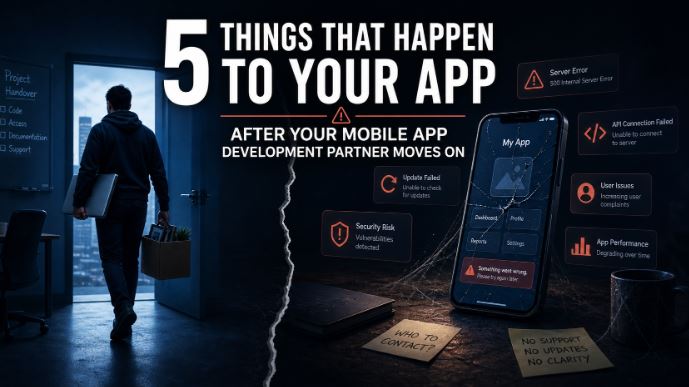
In this guide, we present 5 patterns that emerge when a hired mobile app development services agency completes your project and steps aside, along with the consequences that follow. We’ll also show you how to avoid each scenario, ensuring you build mobile apps that stand the test of time and technology.
1. Your App Store Visibility Drops, and It Reflects in Your Acquisition Bill
App store algorithms continuously recalculate rankings based on signals such as update frequency, crash rates, how fresh your reviews are, and whether anyone replies to them. They do this to surface the best-performing apps at any given moment, rather than those that do well only at launch.
In fact, according to Google, responding to negative reviews can increase your ratings by an average of +0.7, because the store nudges the user back to reconsider. On top of that, about 79% of users check ratings before downloading any app, so when no one replies to reviews, installation rates drop significantly.
And all this doesn’t just happen at once. Instead, the decay is gradual and sneaky because your app will get a handful of one-star reviews in one month and slowly add up through the next few weeks without anyone noticing. By the time someone finally thinks to open the analytics dashboard, the app has already lost visibility.
What’s worse is that every organic installation you lose must be replaced by a paid one. In short, you’ll have to start renting traffic through paid marketing campaigns, which can cost you thousands of dollars a quarter just to buy back demand that maintenance would’ve kept for free.
2. Your Users Outgrow the App, and Retention Pays the Price
Almost every app was built for a specific type of user facing a specific problem. However, real human beings naturally evolve, get promoted, or get bored, and suddenly your app stops being useful to them if it stays exactly the same.
Take a fitness app launched in early 2024 for solo gym-goers, for example. By mid-2025, those same users will want App Watch sync, shared plans, and a social feed (needs that were nowhere in the original scope). The product could be working perfectly, but its audience has already outgrown it because technology waits for no one.
When your development company disappears at launch, nobody’s left to translate that changing preference into a roadmap. On the other hand, iOS and Android will continue to release new permission models and notification rules despite your app being frozen, and your competitors will adapt, widening the gap between you two.
Moreover, statistics claim that about 5-7 out of 100 people who download an app today will still be opening it 30 days from now, which means over 90% of installs are gone within a month, even for healthy apps. So if you don’t actively improve your app, your users will disappear almost immediately.
3. The Cross-Platform Gaps Quietly Turn Into Revenue Gaps
Ever heard or uttered the phrase “I'll fold the laundry as soon as the show ends?” You probably won’t, and it will sit on the chair for another week.
The same thing often happens with mobile app development because companies will launch an app with issues just because they're under pressure to meet deadlines and promise to fix any inconsistencies afterward. But maintenance rarely happens.
Android and iOS look very similar on the outside, with similar apps, home screens, settings menus, and push notifications. However, the two systems speak entirely different coding languages and handle background tasks differently, so an alert system that works flawlessly on an iPhone might fail brutally on an Android phone.
Without a team closely monitoring both systems, you won’t notice any bugs until angry user reviews start piling up.
In fact, bugs affect businesses more because Android owns 70% to 72% of the global market. If you have an international audience, be certain that an unaddressed Android bug will ruin the experience of most of your users.
iOS, on the other hand, captures the majority of actual consumer spending, so if you neglect the platform, you leave massive amounts of money on the table.
4. Your Best Features Become Your Biggest Problems
The unique features that made your app feel special at launch are often the hardest to fix later, once the original dev team moves on.
When developers rush to finish custom features like payment setups or unique welcome screens, they rarely write down instructions or provide full details of the code they used. That makes it difficult for any new team taking over to pick up from where the original creators left. Instead, they waste hours digging through code to see how it works and find the missing pieces, which is time-consuming and expensive.
According to Stripe’s developer research, teams spend 23-42% of their time dealing with technical debt instead of building new features. Similarly, McKinsey estimates that upkeep costs increase by over 50%.
Therefore, if half of your team is stuck trying to keep the app running, your progress slows down, which means the very tools that gave you a head start can easily become your greatest weakness.
5. Compliance and Security Fails While No One Is Watching
Of the five patterns in this article, compliance and security are the sneakiest and most expensive features in regulated spaces because they keep changing even after launch.
For example, phone systems are always updating their rules, payment laws keep changing, and app stores tend to reject old code, making it easier for hackers to commit cyber crimes and steal user data.
Now, fixing such security gaps is always cheaper than trying to recover after a security breach because a cyber attack in finance and healthcare apps can mean massive legal fines, emergency audits, and destroyed customer trust. In the end, you’ll spend more money on fixing a problem than you would on preventing it.
So, ongoing maintenance past the launch phase is more convenient because it’s usually the first thing a company forgets to do once the original developers leave.
Pick the Right Partner From the Very Beginning
Mobile app development doesn’t have a finish line because laws keep changing, users keep evolving, and technology continues to advance. Therefore, the right mobile app development services will remain for store performance, retention, platform parity, readable code, security, and expansion because these are the things that make or break your application.
So next time you plan to develop an app, make sure the partner you choose sticks by you to deal with these patterns before they emerge, instead of one that thinks your contract ends immediately the app goes live.