Reading Time 7
Number of Words 1559
Creating a blog in 2026 is more accessible than ever, but also more competitive.
With millions of blogs on the internet, you need a solid strategy and the right tools to stand out.
This guide will take you step by step through the entire process, from conceptualization to monetization.
Why Create a Blog in 2026?
Despite the rise of social media and video content, blogs remain a powerful tool for building authority, generating passive income, and connecting with a specific audience.
Blogs give you total control over your content, something that social media platforms do not offer.
Step 1: Define Your Niche and Audience
Before you write a single word, you need clarity about your purpose.
Choose a specific niche: Instead of "travel," consider "sustainable travel for young families" or "budget backpacking in South America." Specificity helps you stand out and attract engaged readers.
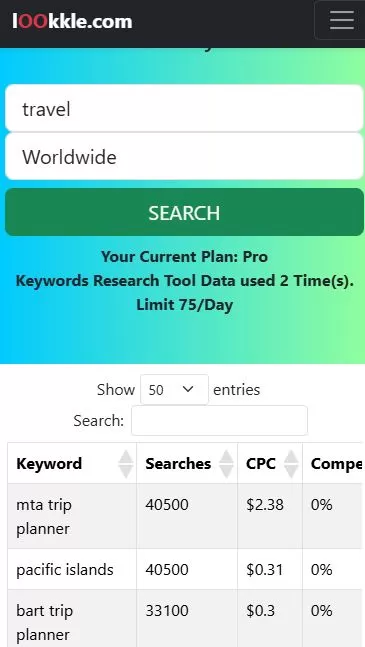
If your topic is travel, analyze "travel" in Lookkle's Keyword Research tool to discover which niche within travel has the least competition and offers the most traffic.
In this case, a good niche could be "travel Pacific islands".
Research your audience: Ask yourself who will read your blog, what problems they have, what questions they ask on Google, and what type of content they consume.
Tools like Google Trends, AnswerThePublic, and Reddit communities can provide valuable insights. Google Trends allows you to evaluate trends over time for chosen topics or evolving keywords.
Evaluate the competition: Search for other blogs in your niche on Google and analyze what they're doing well and where there are opportunities. Analyze web traffic on Lookkle and discover which pages are performing best. Don't be discouraged by competition; it means there's demand.
Step 2: Choose a Name and Domain
Your blog name is your digital identity, so take your time.
Characteristics of a good name: It should be memorable, easy to pronounce, related to your niche, and available as a .com domain. Avoid names that are too long or complicated.
Purchase your domain: Use registrars like GoDaddy, Namecheap, or Google Domains. A .com domain costs between $10 and $15 per year. Consider also purchasing variations (.net, .blog) to protect your brand.
Pro tip: Avoid numbers, hyphens, and confusing abbreviations. Think long-term: Will this name still make sense in 5 years?
Step 3: Select a Blogging Platform
In 2026, you have several options, each with advantages and disadvantages.
WordPress.org (recommended): This is the most popular and powerful option. It offers complete control, thousands of plugins and themes, and excellent SEO. It requires your own hosting, but the investment is worthwhile. Platforms like Bluehost, SiteGround, and Hostinger offer plans from $3-10 per month with WordPress pre-installed.
GoDaddy and other hosting options allow you to easily install WordPress , so once you purchase your domain name and hosting (all in one package), you install WordPress and access the control panel immediately. Then you just have to choose a theme for your new blog. There are also many free WordPress themes available.
WordPress.com: The hosted version of WordPress. You can create your first blog on WordPress.com to familiarize yourself with the platform. Your blog will look like "tub-blog.wordpress.com". This will be simpler but offer less control. It's good for absolute beginners who don't want to deal with technical aspects.
Wix or Squarespace: Drag-and-drop platforms perfect for visual design without code. Limited in advanced customization and SEO compared to WordPress.
Medium or Substack: Excellent for writers who want to focus solely on content. Medium has a built-in audience; Substack is ideal for newsletters. There's less control over design and monetization. These are hugely popular subdomains, requiring no coding; simply create your account and you'll have your first free blog.
Step 4: Configure Hosting and Install WordPress
If you chose WordPress.org (the best option for serious bloggers), you need hosting.
Choose a hosting provider (GoDaddy, Hostinger, Lookkle ): Shared hosting is sufficient for beginners. As you grow, consider a VPS or managed hosting. Look for providers that offer free SSL, automatic backups, good technical support, and at least 99.9% uptime.
One-click installation: Most modern hosting providers offer one-click WordPress installation from their control panel. The process takes literally minutes.
Initial WordPress setup: Once installed, access the administration panel (domain.com/wp-admin), configure the basic settings (site title, time zone, permalink structure), install a clean and professional theme (a default theme is always included), and add essential plugins such as Yoast SEO, a caching plugin, and a security plugin.
Step 5: Design Your Blog in WordPress
The design should be attractive but, more importantly, functional and fast.
Choose a theme: By 2026, themes need to be responsive (optimized for mobile devices), load quickly, and be accessible. Free themes like Astra, GeneratePress, or Kadence are excellent starting points. If you have a budget, premium themes from ThemeForest or StudioPress offer more options.
Personalize without overdoing it: Keep the design clean. Readers come for the content, not elaborate visuals. Make sure the typography is legible, the colors contrast, and the navigation is intuitive.
Essential elements: Your blog should have a clear homepage, an "About" page that tells your story, a contact page, and well-organized navigation menus.
Step 6: Create Quality Content
Content is the heart of your blog. Without valuable content, nothing else matters.
Plan your content: Create an editorial calendar with post ideas for at least 3 months. Mix different types of content: comprehensive guides, lists, tutorials, case studies, personal opinions, and up-to-date content on trends.
Optimize for SEO: In 2026, SEO remains crucial. Research keywords with tools like Ahrefs, SEMrush, or the free Ubersuggest. Include keywords naturally in titles, headings, the first 100 words, and image alt text. But write for humans first, not for algorithms.
Quality over quantity: One comprehensive and valuable 2,000-word post each week is better than three mediocre posts. Focus on solving real problems for your audience.
Format for readability: Use short paragraphs, descriptive subheadings, lists, bold text to highlight key points, relevant images, and generous white space.
Step 7: Promote Your Blog
Creating great content isn't enough; you need people to find it.
Long-term SEO: Organic traffic from Google is the most valuable. Be patient; SEO results take 3-6 months to appear.
Social media: Share each post on platforms where your audience spends time. You don't need to be on all of them; focus on 2-3 that work for your niche. Pinterest is excellent for lifestyle, food, and DIY blogs. LinkedIn works for professional and B2B content.
Email marketing: Start building an email list from day one. Offer a lead magnet (free ebook, checklist, mini-course) in exchange for subscriptions. Platforms like Mailchimp, ConvertKit, or MailerLite have free plans to get you started.
Guest posting: Write guest articles for established blogs in your niche. This gives you exposure to new audiences and valuable backlinks for SEO.
Collaborations: Connect with other bloggers, create joint content, participate in podcasts or interviews.
Step 8: Monetize Your Blog
Once you have consistent traffic (generally 10,000+ monthly visits), you can start monetizing.
Google AdSense: The simplest way. Google automatically places ads on your site and pays you for clicks and impressions. It's not the most lucrative, but it's passive.
Affiliate marketing: Promote products or services you use and love, and earn commissions on sales. Programs like Admitad , Amazon Associates, ShareASale, and CJ Affiliate are popular. Always disclose your affiliate links.
Digital products: Create and sell ebooks, online courses, templates, photographs, or any digital product related to your niche.
Services: Offer consulting, coaching, freelance writing, or services related to your expertise.
Sponsored content: Brands pay for posts that mention their products. Stay authentic; only work with brands you genuinely recommend.
Memberships or subscriptions: Offers exclusive premium content for members who pay a monthly fee.
Step 9: Analyze and Improve
Successful blogging requires constant, data-driven iteration.
Google Analytics: Install it from the start. It shows you which posts are performing well, where your traffic is coming from, how long readers stay, and what devices they use.
Google Search Console: Monitor how your site appears in Google searches, which keywords bring you traffic, and if there are any technical problems.
Experiment: Try different types of content, post lengths, titles, formats, and posting times. Learn what works and replicate those efforts.
Common Mistakes to Avoid
Giving up too soon: Most blogs don't see significant results until after 6-12 months of consistent work.
Neglecting mobile: Over 60% of web traffic comes from mobile devices. Your blog must look and function perfectly on smartphones.
Ignoring site speed: A slow site frustrates visitors and hurts your SEO. Use caching plugins, optimize images, and choose reliable hosting.
Don't neglect building an email list: Social media platforms can change their algorithms or disappear. Your email list is yours forever.
Copying content: Never copy from other blogs. Google penalizes duplicate content and you lose credibility.
Tips for Long-Term Success
Consistency: Publish regularly, even if it's just once a week. Consistency builds audience and improves SEO.
Authenticity: Your unique voice is your greatest asset. Don't try to sound like other bloggers; be yourself.
Continuously learn: Blogging, SEO, and digital marketing are constantly evolving. Invest in your education through courses, podcasts, and blogs about blogging.
Build community: Respond to comments, interact on social media, get to know your readers. Genuine relationships create loyal readers.
Patience and perseverance: Successful blogging is a marathon, not a sprint. Keep expectations realistic and enjoy the process.