Reading Time 8
Number of Words 1634
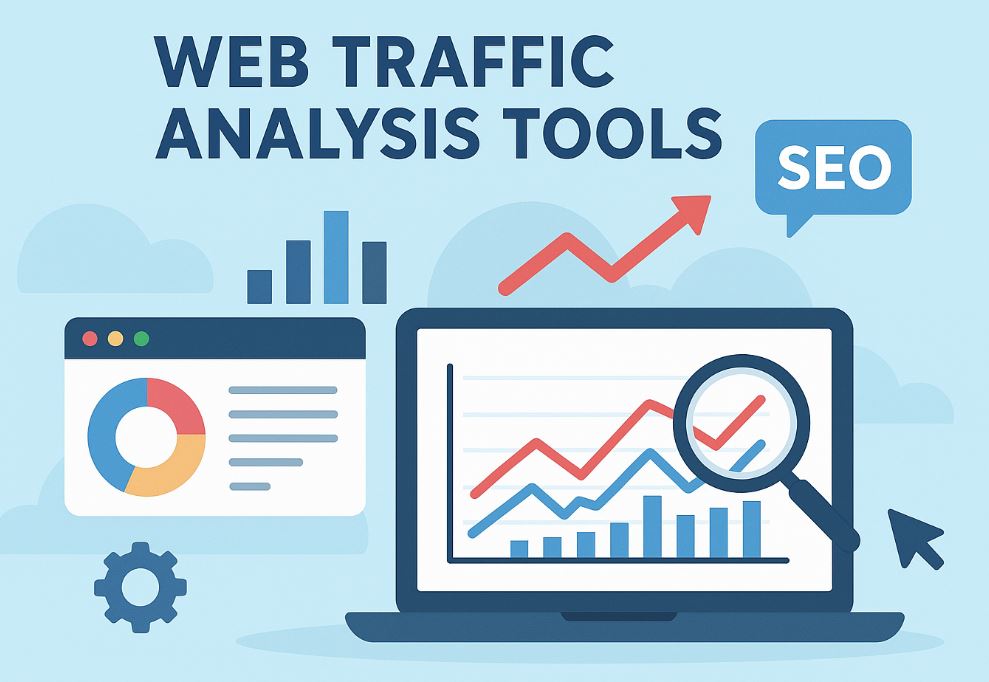
Web traffic analysis is the process of understanding how visitors arrive at a website, what they do when they are there, and how they behave.
There are a number of online tools that allow the analysis of traffic on any website and are essential for any online marketing strategy, which can help any online business move forward.
This article will explore:
-
What are Web Traffic Analysis Tools
-
Why they are critical to your digital strategy
-
The best tools on the market (free and paid)
-
How to interpret web traffic data
-
Real-world use cases
📊 What are Web Traffic Analysis Tools ?
Web Traffic Analysis Tools are software platforms designed to collect, process, visualize, and analyze website visitor data.
These tools transform raw data such as visits, page views, traffic sources, and user behavior into actionable information that can be used to:
-
Improve the user experience
-
Optimize your marketing campaigns
-
Making strategic decisions based on data
-
Measuring the return on investment (ROI)
They include both internal (first-party) analytics tools, which track the actual traffic of your own site, and external estimation tools, which analyze or estimate the traffic of any domain.
🧮 First Key Concepts
Before looking at specific tools, it is important to understand some essential terms:
| Metric | Meaning |
|---|---|
| Visits (Sessions) | Total number of visits to your site |
| Unique Visitors | Individuals who access within a given period |
| Page views | Total number of pages loaded |
| Bounce rate | Percentage of visits that leave without interacting |
| Traffic sources | Sources such as search engines, social networks, AI, etc. |
These terms are essential for correctly reading the traffic reports generated by these tools.
📈 Why are Web Traffic Analysis Tools Important ?
A good website traffic analysis is the foundation of any growth strategy. Here are some key reasons:
🎯 Identify What Works and What Doesn't
With web analytics you can find out:
-
Whether advertising campaigns actually attract visitors.
-
Which pages convert better or worse.
-
Which traffic channels (SEO, social media, email, direct) are most effective?
This allows for more precise allocation of budget and effort.
📉 Understanding User Behavior
These tools help to understand:
-
At what point do users leave your site?
-
How long do they stay on key pages?
-
How they navigate through your content.
With this information you can improve your UX and user experience.
📊 Benchmarking and Competition
Many tools not only analyze your site, but also the estimated or actual traffic of your competitors, allowing you to:
-
To understand the relative performance of your site.
-
Identify market opportunities.
-
Adjust your strategy with competitive data.
🛠️ Main Web Traffic Analysis Tools
Here we review the most useful web traffic analysis tools, both for your own data and for competitive data.
🚀 1. Google Analytics (GA4) — Best for Precise, Proprietary Data
Google Analytics 4 (GA4) is the most well-known and widely used web analytics tool in the world.
✔ Why use it
-
Measures real traffic accurately.
-
It allows for complete analysis of user behavior.
-
It offers detailed reports by channel, device, and audience.
✔ What is it for?
-
User and session tracking
-
Conversion analytics and funnels
-
Reports by marketing campaigns
🔹 GA4 requires installing a small code on your website to collect data (tracking).
👉 Ideal if you want accurate information about your own website.
🔍 2. Lookkle Web Traffic Tool — Competitive Analysis and Traffic Metrics
One of the recommended web traffic analysis tools for checking estimated traffic for any domain is the Lookkle tool .
📌 What it offers
-
Estimated monthly visits to any site.
-
Metrics such as bounce rate and session duration.
-
Distribution by traffic sources and countries.
-
Analysis of organic traffic such as Google and total traffic.
-
Additional features such as traffic history, traffic from social networks, and Artificial Intelligence like chatGPT.
💡 Why it's useful
-
It allows you to compare your site with competitors.
-
Excellent for market research or benchmarking.
-
It provides a quick view without requiring the installation of code on your site.
👉 This tool complements Google Analytics because it gives you an external view , not just an internal one.
3. SimilarWeb — Comprehensive Market Analysis
SimilarWeb is a particularly useful tool for competitive use.
✔ Sample:
-
Estimated volume of visits
-
Traffic sources
-
Ranking by country and category
-
User behavior
✔ Ideal for:
-
Benchmarking competitivo
-
Strategic market analysis
A notable advantage is its ability to separate traffic channels (organic, social, referral, and others), allowing you to see which strategies work best in your industry.
4. SEMrush Traffic Analytics — Detailed View by Channel
SEMrush is another web traffic analysis tool preferred by SEO and marketing professionals.
✔ Provides:
-
Estimated traffic by source
-
Data by country
-
Audience data and overlap with other sites
✔ Includes:
-
Keyword analysis
-
Perfil de backlinks
-
Technical audits
SEMrush combines traffic with comprehensive SEO, making it ideal for all-in-one strategies.
🔎 5. Ahrefs Traffic Checker — Focus on Organic Traffic
Ahrefs is best known for SEO, but its traffic module is also useful for understanding visitor estimates:
✔ Stomach:
-
Estimated organic traffic
-
Keywords that generate traffic
-
Growth trends
It's ideal if your main goal is to optimize traffic from search engines. 👉 lookkle.com
🆓 6. Matomo — Open Source Alternative
Matomo (formerly Piwik) is an analysis tool that you can install on your servers.
✔ Advantages:
-
Total data control
-
It complies with privacy laws such as GDPR
-
Robust real-time analytics capabilities
Matomo is excellent if you value data ownership and don't want to rely on third parties.
📈 7. StatCounter and Other Free Tools
Tools like StatCounter or lightweight integrated solutions work well for small sites or personal projects, offering basic traffic metrics.
📌 How to Interpret Web Traffic Data?
Once you have data from your web traffic analysis tools , the next step is to interpret it correctly :
🧠 1. Traffic Sources
Evaluate which channels bring you the most visits:
-
Organic (Google)
-
Straight
-
Social (X, Instagram and others)
-
Referrals (AI and others)
-
Paid (Google Ads,...)
This helps you decide where to invest more or less effort.
📉 2. Trends Over Time
It's not just the number of visits that matters, but how they change month to month. Steady growth indicates a good strategy; drops can signal user experience issues or algorithm changes.
🕵️♀️ 3. User Behavior
View metrics such as time on page, pages per session, and bounce rate to understand if visitors find relevant and useful content.
📌 Use Case for an E-commerce Site
A medium-sized e-commerce site that sells technology products (gadgets, mobile accessories and consumer electronics) operates in several international markets.
The marketing team wants:
-
Increase organic sales
-
Optimize paid campaigns
-
Understanding traffic behavior
-
Analyze the competition without access to their internal data
To achieve this, they use web traffic analysis tools , combining internal analytics with Lookkle Web Traffic Tool to gain an external and competitive view.
🧠 Main Challenge
E-commerce faces several common problems:
-
He doesn't know if his traffic is competitive compared to other online stores in the sector.
-
It does not know which channels generate higher quality traffic
-
It cannot easily estimate the real impact of SEO or seasonal campaigns
-
It lacks a quick tool for analyzing competing domains
This is where Lookkle comes in as a complementary web traffic analysis tool .
🛠️ Solution: Use Lookkle as a Web Traffic Analysis Tool
The team decides to integrate Lookkle Web Traffic Tool into their analytics stack.
🔗 Tool used:
👉 lOOkkle
Lookkle allows you to analyze estimated traffic from any domain , without needing to install scripts or have internal access to the site.
🔍 Step 1: Analysis of Your Own E-commerce Traffic
The team introduces its own domain into Lookkle to gain an objective, external perspective .
Metrics Analyzed:
-
📈 Estimated monthly visits
-
🌍 Geographical distribution of traffic
-
🔎 Percentage of organic traffic
-
📉 Estimated bounce rate
-
⏱️ Average session duration
Result:
The analysis reveals that:
-
62% of the traffic is organic
-
Mobile traffic accounts for more than 70%
-
The bounce rate is high in certain key countries.
💡 Key insight: The traffic exists, but not all of it is well optimized for mobile conversion.
🧪 Step 2: Analysis of Direct Competitors
The next step is to use Lookkle as a competitive benchmarking tool .
Action:
The team is adding the following domains to Lookkle:
-
3 major direct competitors
-
2 specialized marketplaces
Data Obtained:
-
Monthly traffic volume per competitor
-
Main acquisition channels
-
Countries with the highest concentration of visits
-
Historical evolution of traffic
Important Discovery:
A competitor with fewer products has:
-
More organic traffic
-
Better retention
-
Steady growth over the last 6 months
💡 Key insight: The competitor is ranking better for category pages and long-tail keywords.
📊 Step 3: Traffic Channel Evaluation
Using Lookkle, the E-commerce analyzes traffic distribution by channel :
-
Organic traffic (SEO)
-
Direct traffic
-
Social trafficking
-
Reference traffic
Result:
-
SEO dominates traffic, but social media traffic is almost nonexistent.
-
Some competitors get up to 18% of their traffic from social media.
💡 Key insight: There is a clear opportunity for growth with social campaigns and viral content.
📅 Step 4: Historical Analysis and Seasonality
The team uses Lookkle's traffic history to:
-
Detect traffic spikes (Black Friday, Christmas, Prime Days)
-
Compare past campaigns
-
Anticipate peak seasons
Find:
-
Traffic increases by up to 45% in November
-
Some competitors start SEO campaigns 3 months in advance
💡 Key insight: E-commerce businesses must advance their seasonal content and SEO strategy.
🧩 Step 5: Integration with Other Tools
Lookkle is used in conjunction with:
-
Google Analytics → Internal Real Data
-
Google Search Console → SEO Performance
-
Ads Tools → Cost per acquisition
Roll the Lookkle:
✔ Validate whether internal growth is competitive
✔ Measure real impact against the market
✔ Detect threats or abnormal growth in competitors
📈 Results Obtained
After 3 months of using Lookkle as a web traffic analysis tool:
✅ +27% organic traffic
✅ Improved mobile optimization
✅ New category pages based on competitive analysis
✅ Reduced bounce rate in key markets
✅ Better seasonal campaign planning
📈 Marketing Agencies
Agencies use these tools to monitor campaigns, justify investments, and report results to clients.
🤝 Benchmarking Competitivo
Comparing your metrics with those of your rivals allows you to discover gaps and opportunities.
🧩 Lookkle and Your Web Traffic Analysis Strategy
Lookkle Web Traffic Tool is a lightweight yet powerful addition to your web traffic analysis tools stack .
💡 How to use it
-
View traffic estimates for any domain.
This helps you compare with competitors and evaluate trends. -
Get traffic breakdown by source and key metrics.
You can see what percentage of your traffic comes from organic search, social media, or direct. Learn more: lookkle.com -
Visualizing historical traffic data
is useful for measuring seasonality or specific campaigns. Learn more: lookkle.com
👉 Using Lookkle in conjunction with tools like Google Analytics gives you a complete perspective : accurate proprietary data + external estimates for benchmarking. Learn more: lookkle.com