Reading Time 10
Number of Words 2233
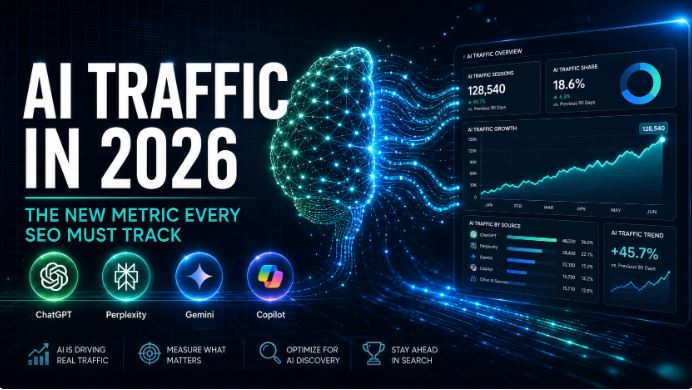
If you've been in SEO for a while, you already know that the rules have changed.
In 2026 we are not talking about an algorithm adjustment: we are talking about a structural transformation of web traffic.
Visitors who previously came from Google can now come from ChatGPT, Perplexity, Gemini, or Copilot. And most importantly: those visitors are worth more.
This article explains what AI traffic is, why it has become the metric that no SEO can ignore in 2026, and how to start measuring it today, with tools available to any webmaster.
📈 The Numbers That Change Everything
The data that summarizes the new reality is compelling: traffic from language modelers (LLMs) grew by 527% year-on-year, going from approximately 17,000 to 107,000 sessions when comparing January-May 2024 with the same period in 2025.
It's not a fringe trend. It's a sign of a changing era.
Other key facts that every SEO should keep in mind in 2026:
-
🤖 ChatGPT has 700 million weekly active users and is the fourth most visited site in the world, with more than 5 billion monthly visits.
-
🔍 Google AI Overviews now reaches 2 billion monthly users in more than 200 countries.
-
📉 Approximately 60% of searches on traditional search engines no longer generate any clicks — the response is consumed directly in the SERP.
-
🧑💻 Nearly 35% of Generation Z uses AI chatbots as their primary source of information, more than any other age group.
-
📊 AI traffic could surpass traditional search traffic before 2028.
🤔 What exactly is AI traffic?
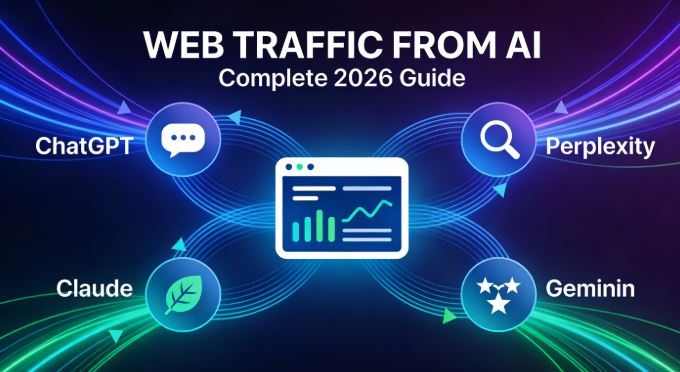
AI traffic (also called AI referral traffic ) refers to visits to your website that come directly from generative artificial intelligence platforms: ChatGPT, Perplexity AI, Google Gemini, Microsoft Copilot, Claude, or other similar tools.
Unlike traditional organic traffic — where the user performs a search, sees a list of results, and clicks —, traffic from AI works like this:
-
The user asks a conversational question to an AI.
-
AI generates a synthesized response.
-
If your content is considered a reliable source, the AI will cite your website with a link.
-
If the user wants to learn more, they click on your link.
The key lies in step 3: getting cited. And to get cited, simply ranking on Google isn't enough. You have to optimize for a different logic.
💎 Why This Traffic Is Worth More Than Traditional Organic Traffic
Here's the fact that should convince any skeptic: the average visitor who arrives from an AI-powered search is worth 4.4 times more than a traditional organic search visitor in terms of conversion.
This is no coincidence. Users arriving from AI platforms have a much more defined intention: they've asked a specific question, received an answer, and if they click on your link, it's because they want to delve deeper into something specific. Furthermore:
-
AI-referred visits have a 27% lower bounce rate than non-AI-referred traffic.
-
They are 38% longer in duration.
-
They involve viewing more pages per session.
-
ChatGPT users click on an average of 1.4 external links per visit, compared to 0.6 for Google.
In summary: less volume (for now), but much higher quality.
📉 The Other Side of the Coin: Organic CTR Falls
While AI-generated traffic is growing, traditional organic traffic is experiencing its greatest pressure ever. Gartner projected in 2024 that organic search engine traffic would fall by 25% by the end of 2026 due to AI chatbots. Actual data is confirming that projection:
| Indicator | Trend 2024–2026 |
|---|---|
| CTR organic medium | ↓ between 18% and 35% |
| Queries resolved directly in SERP | ↑ sustained |
| Use of AI Overviews | ↑ accelerated |
| Traffic from AI platforms | ↑ 527% year-on-year |
| Organic web traffic (media and content) | ↓ Projection >40% before 2028 |
The phenomenon even has its own name: "zero-click AI search" —searches where the user gets their answer without leaving the AI platform. Click-through rates (CTRs) plummet for these queries: when an AI summary appears on Google, only 8% of users click on the organic results below. Without that summary, that percentage nearly doubles to 15%.
🧭 From SEO to GEO: The New Discipline
The industry's response to change has a name: GEO (Generative Engine Optimization), also known as LLMO (Large Language Model Optimization).
The fundamental difference with classic SEO is not technical, it's conceptual:
| Classic SEO | GEO (2026) |
|---|---|
| Objective: ranking position | Objective: to be cited by AI |
| Key metric: organic traffic | Key metric: visibility in LLMs |
| Main signal: backlinks | Main signal: brand quotes |
| Keyword optimization | Optimization for subject authority |
| Content for CTR | Content intended to be a source of reference |
AI doesn't select the best-written content in terms of style. It selects the one that:
-
Define concepts clearly and precisely.
-
Provide verifiable and quotable data
-
It has a logical and coherent structure.
-
Demonstrates real-world experience in the subject matter
-
It reduces ambiguity in its statements
💡 Practical key: AI summarizes the obvious, but cites what it cannot invent. Proprietary data, unique analyses, and exclusive methodologies are exactly what language models cite most frequently.
🔍 What Type of Content Appears in AI Responses
Not all content is equally likely to be cited. Semrush data reveals interesting patterns about what ChatGPT cites:
-
50% of the cited links point to business and service websites.
-
9.5% correspond to news and media sites.
-
8.3% to blogs and content sites.
-
7.6% to e-commerce sites.
Furthermore, 88% of searches that trigger AI Overviews on Google are informational —educational content, guides, comparisons, definitions. Only 1.76% are transactional. This has a direct implication: if your content educates and answers real questions, you are much more likely to be cited than if you are only trying to sell.
📊 How to Measure AI-Powered Traffic on Your Website
This is where the right tool comes in. To monitor AI traffic, you need to identify sessions originating from platforms like ChatGPT, Perplexity, Gemini, or Copilot in your analytics.
In Google Analytics 4 (GA4)
You can filter referral traffic from these domains:
-
chatgpt.com -
perplexity.ai -
gemini.google.com -
copilot.microsoft.com -
claude.ai
Steps:
-
Go to Reports > Acquisition > Traffic Acquisition
-
Filter by Source/Medium
-
Search for the AI domains mentioned above
-
Create a custom segment to compare this traffic with traditional organic traffic.
In Google Search Console
Google Search Console doesn't distinguish between traffic from AI (that traffic doesn't go through Google Search), but it does let you see if your pages are cited in AI Overviews. Look at the click-through rate (CTR) of the pages where you expect to appear: a sharp drop in CTR with stable impressions might indicate that there's an AI Overview answering that query without the user needing to click.
Specialized Tools
The most advanced web analytics platforms already integrate specific AI Traffic Tracking modules to measure this new source of visits:
-
🟦 Lookkle — A web traffic analysis tool that already includes traffic measurement from AI platforms (ChatGPT, Perplexity, Gemini, Copilot, and others). It allows you to analyze AI traffic for your own domain and your competitors'. One of the few accessible tools that offers this metric directly and without complex configuration.
-
🟠 Semrush AI Visibility Toolkit — Track how often and in what context your brand appears on ChatGPT, Claude, Perplexity, and Gemini. Geared towards brands with high tooling budgets.
-
🔵 Ahrefs Brand Radar — Visibility monitoring in LLMs and content gap analysis based on natural language processing.
-
🟢 SE Ranking — AI search visibility tracking with organic traffic impact prediction.
💡 Recommendation: If you manage a web project and want to start measuring traffic using AI without a complex learning curve, Lookkle is the most direct and accessible starting point. Seeing how this metric evolves week by week is the first step toward making strategic decisions based on real data.
🛠️ How to Optimize Your Content to Be Cited by AI
1. 🎯 Answer specific questions with real depth
AI prioritizes content that answers specific questions clearly, with verifiable data, dates, and figures. Avoid lengthy introductions and get to the point in the first sentence.
2. 📐 Logical and scannable structure
Use H2/H3 headings, comparison tables, numbered lists, and clear definitions. Language models process content with explicit semantic structure best.
3. 🔬 Include your own or unique data
Original analyses, case studies, proprietary metrics, or exclusive methodologies are exactly what AIs cite because they cannot generate them on their own.
4. 🏛️ Build subject authority with content clusters
Don't publish isolated articles. Create content clusters around the core issues of your audience. AI evaluates the subject authority of the entire domain, not just a single article.
5. 🔗 Monitor citations, not just backlinks
Brand mentions on AI platforms are displacing backlinks as the primary authority signal. Use brand monitoring tools to detect when and how language models mention you.
6. ⚡ Speed and structured data (Schema.org)
A technically sound website with schema markup makes it easier for crawlers and LLMs to correctly interpret your content. Especially useful are: FAQPage, HowTo, Article, Review and Organization.
🌡️ What Content Is at Risk and What Is Gaining
Not all content poses the same risk to AI. This is the reality in 2026:
❌ Content at risk of disappearing:
-
Superficial posts of the type "what is X?"
-
Rewriting content from others without added value
-
Generic guides without their own data
-
SEO content inflated for word count
-
Lists of advice without context or evidence
✅ Content that is gaining ground:
-
Technical analysis with metrics and benchmarks
-
Comparisons with verified data
-
Own methodological frameworks
-
Expert opinions with solid argumentation
-
Structured FAQs with precise answers
-
Case studies with real results
🆚 Traditional SEO vs. AI Traffic Strategy in 2026
| Action | Traditional SEO | AI Strategy |
|---|---|---|
| Main KPI | SERP Position | Visibility in LLMs / citations |
| Content type | Articles optimized for keywords | Authoritative and quotable content |
| Link building | Third-party backlinks | Brand mentions + citations in IA responses |
| Analytics | Organic sessions | AI sessions + conversion rate |
| Structure | Isolated posts | Topic thematic clusters |
| Impact speed | 3-6 months | 4-8 weeks for first appointments |
🔮 What to Expect in the Next 12-24 Months
Projections point to an acceleration of the phenomenon, not its stabilization:
-
By 2028, organic traffic from search engines to content websites could fall by more than 40%, according to the Reuters Institute.
-
Gartner projects that by 2028, organic search traffic for brands will decrease by 50% or more as consumers adopt AI-powered search engines.
-
Google's AI Mode already has 100 million users in the US and India and is expanding to more markets. If it becomes the default experience, the transition will accelerate.
-
35 % of Generation Z already use AI chatbots as their primary source, anticipating the behavior of the average user in the next 5 years.
✅ List of Immediate Actions for Your Website
If you manage a content website, online store, technology blog, or any project that depends on organic traffic, these are the priority actions today:
-
Configure a segment in GA4 to monitor sessions from
chatgpt.com,perplexity.ai,gemini.google.comandcopilot.microsoft.com. -
Audit which of your pages are already cited in AI responses — you can do this manually by asking questions related to your niche on ChatGPT and Perplexity.
-
Review your older content: transform generic posts into resources with your own data, comparison tables, and FAQ structures.
-
Implement or improve Schema Markup on your key pages (
Article,FAQ,Review). -
Create content that is difficult to summarize: technical guides, comparisons with real data, exclusive analyses that AI cannot generate on its own.
-
Monitor your brand's citations with tools like Semrush, Ahrefs Brand Radar, or SE Ranking.
-
Optimize the conversion of pages that already receive traffic: AI visitors convert 4.4x more, take full advantage of them.
❓ Frequently Asked Questions about Traffic from AI
Does AI-generated traffic appear in Google Analytics?
Yes, as referral traffic, provided the user accesses your website by clicking on the link provided by the AI. Filter by the domains of each platform (chatgpt.com, perplexity.ai, etc.) in the Acquisition report.
Can I ask AIs to cite my website?
Not directly. AIs cite sources based on their perceived authority, content quality, and their presence in the training data. What you can do is optimize your content to be more "citable" by following GEO's guidelines.
Is AI-generated traffic enough to replace organic traffic?
Not yet in volume, but certainly in quality. The right approach in 2026 is to complement your traditional SEO strategy with AI optimization, not replace one with the other.
Does traffic from AI affect Google ranking?
Not directly. However, if your content is frequently cited by AI platforms, that reflects high subject authority, which also tends to correlate with better organic ranking.
Which AI platforms generate the most referral traffic?
In 2025-2026, ChatGPT leads by a wide margin, followed by Perplexity AI, Copilot, and Gemini. Perplexity stands out for its high rate of direct link citations.
🏁 Conclusion
Traffic from AI in 2026 is not an emerging trend or a statistical curiosity: it's the new reality of web traffic. A 527% year-over-year growth, visitors worth 4.4 times more in terms of conversion, and platforms with hundreds of millions of daily users leave no room for doubt.
SEOs that only monitor Google rankings are looking in the wrong direction. The question you should be asking yourself today isn't "What position do I rank for this keyword?" but rather "Does AI cite me when someone searches for my industry?"
Monitoring traffic from AI, optimizing content to be cited, and building real subject authority are the three actions that separate digital projects that will grow in 2026 from those that will continue to lose visibility without understanding why.