Reading Time 11
Number of Words 2460
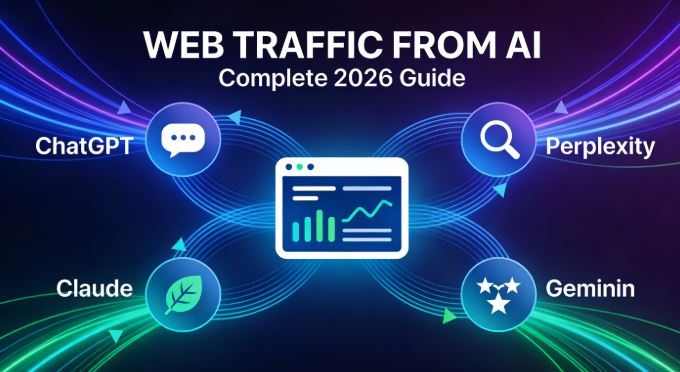
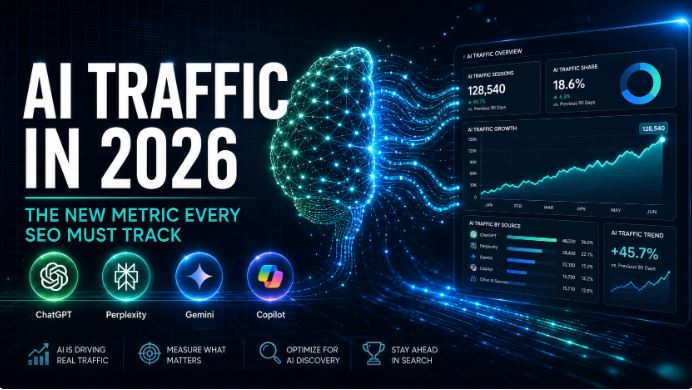
Visits from artificial intelligence platforms have become a new category of web traffic that is transforming the digital landscape.
By 2026, AI bots will account for 2% of all web traffic (1 in 50 visits), a 400% increase from the first quarter of 2025. This shift is redefining how websites attract visitors and how success metrics should be measured.
What are AI-generated Web Visits?
AI-generated visits are website accesses that originate when users interact with artificial intelligence platforms such as ChatGPT, Perplexity, Claude, or Gemini, and these tools provide links to web content as part of their responses. Unlike traditional search traffic, these visits come from conversational recommendations generated by language models.
There are two main types of AI traffic:
-
Training bots: They crawl content to build and improve AI models
-
Retrieval bots: They obtain real-time information such as product prices, movie times, and breaking news to augment AI responses.
Referral traffic from AI experienced explosive growth of 527% in 2025, with users spending an average of 9-10 minutes per session on referred sites. ChatGPT dominates with 40-60% of all AI referral traffic across all industries, while Perplexity accounts for approximately 15% globally, and Claude holds less than 0.001% but boasts the highest session value at $4.56.
The Best Tools for Analyzing AI Traffic
1. Lookkle - Advanced AI Traffic Analysis
Lookkle positions itself as the leading tool for analyzing web traffic from artificial intelligence platforms. Its web traffic analysis system allows users to identify and differentiate visits originating from each AI platform specifically, including:
-
ChatGPT: Detects traffic from openai.com and chatgpt.com
-
Gemini: Identifies visits from gemini.google.com
-
Claude: Tracks access from claude.ai and anthropic.com
-
Perplexity: Analyze traffic from perplexity.ai
-
Microsoft Copilot: Logs visits from copilot.microsoft.com
-
Other platforms: Identifies traffic from DeepSeek, You.com, Brave Search, and more
The platform offers detailed visualizations that allow website owners to understand which AI platforms are sending traffic, which pages are being cited most, and how these visitors behave compared to traditional traffic. This is essential for optimizing content specifically to be cited by language models and maximizing visibility in the emerging conversational search ecosystem.
2. Microsoft Clarity - AI Bot Visibility
In January 2026, Microsoft Clarity launched a dedicated feature called "AI Bot Activity" that provides precise server-side visibility into how AI crawlers and bots access your site. This free tool lets you see exactly which bots are visiting your site, how often, and what content they are indexing.
3. Semrush AI Traffic Dashboard
Semrush offers a dedicated AI traffic dashboard that allows you to analyze AI referral traffic to your domain and competitor domains. The tool shows how traffic flows from different LLMs (Large Language Models) and allows you to compare your performance with that of your rivals.
Key features:
-
Analysis of up to 5 domains simultaneously
-
Traffic breakdown by AI platform
-
Competitive comparison
-
Identification of most cited pages
4. Ahrefs AI Content Helper
Although not a dedicated AI-powered visibility tracker, Ahrefs added an AI Content Helper that supports the creation of AI-aligned content. Users have reported average traffic increases of 72% after aligning content with Ahrefs' recommendations.
Features:
-
Chat-style interactions in over 174 languages
-
Content optimization suggestions
-
Emphasis on thematic coverage and authority
5. Scrunch AI and Otterly AI
These specialized platforms offer targeted visibility tracking for AI search. Scrunch AI provides tracking across more than 7 AI platforms, including DeepSeek and Mistral, with flexible tracking intervals (hourly, daily, or weekly).
Technical specifications:
-
AI Search Engine Simulation
-
Citation analysis
-
Sentiment monitoring
-
Trend summaries
-
24/7 support
6. Google Analytics 4 (GA4) with Custom Settings
GA4 can track AI traffic using custom configurations and regex filters. While it requires manual setup, it's a free option that many sites already have implemented.
How to configure GA4 to track AI:
-
Access GA4 and go to Reports > Explorations
-
Create a new freeform exploration
-
Add a filter with these parameters:
-
Dimension: Session source/medium
-
Match type: regex matches
-
Value
.*chatgpt\.com|openai\.com|perplexity\.ai|claude\.ai|gemini\.google\.com|copilot\.microsoft\.com.*:
-
This configuration captures traffic from major AI platforms.
AI Platforms That Send More Traffic
ChatGPT: The Dominant Leader
ChatGPT is responsible for approximately 80% of all AI-driven clicks, sending users to websites where they stay for about 10 minutes per session. Its reach and engagement make it the central hub for AI search.
Since the launch of "ChatGPT with Search" on October 31, 2024, the platform can search the web in real time, improving its responses with up-to-date and accurate information while linking to external sources.
ChatGPT traffic characteristics:
-
It represents 40-60% of total AI referral traffic.
-
The links include UTM parameters in "citations" but not always in "search results"
-
The traffic appears as
chatgpt.comin Session Source -
Moderate session value but high volume
Perplexity: Growth in Specific Niches
Perplexity has carved out a loyal audience in the United States, where it drives nearly 20% of AI traffic (15% globally). Users spend around 9 minutes per visit on referred sites, proving to be a solid source of qualified traffic.
Strengths of Perplexity:
-
It dominates in the Finance (0.073%) and Legal (0.041%) sectors.
-
Session value of $3.12 per visit
-
It consistently passes visible referents (perplexity.ai).
-
It favors fresh and updated content.
Google Gemini: The Giant in Development
Gemini accounts for 5.37% of total AI traffic but is growing rapidly thanks to its integration with the Google ecosystem. Its presence in the technology and education sectors is notable, with an 8-15% market share.
Characteristics:
-
Session value of $1.98
-
Deep integration with Google services
-
Focus on technical and educational sectors
Claude (Anthropic): High Quality, Low Volume
Claude has the lowest traffic share (<0.001%) but the highest session value of all AI platforms: $4.56 per visit. This presents a massive opportunity for early adopters who optimize specifically for Claude's citation patterns.
Advantages of Claude:
-
Prioritize technical precision
-
Ideal for developer documentation and code examples.
-
Consider ethical factors in the content.
-
Greater purchasing power of users
Microsoft Copilot: Business Approach
Copilot accounts for 10-20% of AI traffic, with a strong presence in the legal and financial sectors. Its session value is $2.89.
How to Optimize Your Site for AI Traffic
Establish a Solid SEO Foundation
77% of AI optimization stems from a solid foundation of traditional SEO. Sites with established domain authority, quality content, and a strong technical structure have a significant advantage.
Implement Structured Data
Add schema markup and data tables to your content. Sites that implemented these improvements saw increases of 0.2% to 1.8% in AI traffic within 30 days.
Create Entity-Rich Content
Implement entity mapping to help AI models understand the context and relationships in your content. Legal resources that implemented this strategy saw increases of 0.4% to 2.3% in AI traffic.
Keep Content Updated
Fresh content is especially important for Perplexity and other platforms that prioritize current information. Financial portals with daily updates saw improvements in AI traffic ranging from 0.3% to 2.1%.
Optimize Header Hierarchy
Use a clear heading structure (H1, H2, H3) to make it easier for AI models to extract relevant information. Technical documentation with a structured hierarchy improved AI traffic from 0.1% to 1.5%.
Platform-Specific Strategies
Each platform has unique preferences:
-
ChatGPT: Encourages depth and comprehensive content
-
Perplexity: It wants freshness and constant updates
-
Claude: Prioritizes technical precision and ethical considerations
-
Gemini: Seeks subject authority and educational context
Key Metrics of AI Traffic
Rebound Rate
AI-referred visits have a 27% lower bounce rate than non-AI traffic to retail sites. Shoppers arriving via AI platforms show greater intent and engagement.
Time on Site
Visitors from AI spend an average of 9-10 minutes per session, significantly more than the average traditional organic traffic.
Conversion Rate
Shoppers who see verified content (such as reviews) recommended by AI convert 161% more than those who don't. Even 10 reviews on a product can generate a 53% increase in conversion.
Price per Session
The price per session varies significantly by platform:
| Platform | Price per Session | Traffic Participation |
|---|---|---|
| Claude | $4.56 | <0.001% |
| Perplexity | $3.12 | 10-15% |
| Copilot | $2.89 | 10-20% |
| Gemini | $1.98 | 5-8% |
| ChatGPT | Variable | 40-60% |
The Impact of AI Traffic in 2026
Bots Surpass Human Trafficking
For the first time in a decade, automated bot traffic surpassed human activity, making up 51% of all web traffic in 2024, and increasing to 52% in 2026. This shift is largely attributed to the rise of AI and large language models (LLMs).
Increase in Malicious Bots
Malicious bots now account for 37% of all internet traffic, a significant increase from 32% in 2023. The rise of accessible AI tools has significantly lowered the barrier to entry for cyber attackers.
Changes in Content Monetization
Companies like Cloudflare and TollBit are developing systems to monetize bot access, transforming how publishers protect and monetize their content. The ecosystem is evolving toward "permissioned commerce" models where sites can control and monetize AI access.
Challenges of AI Traffic Tracking
Inconsistent Attribution
Not all AI platforms consistently pass referrer information. ChatGPT, for example, often appears as "Direct" traffic unless specific UTM parameters are used.
UTM Parameters Variables
ChatGPT includes UTM parameters in "citations" but not always in "search results". The logic it uses to decide when to include UTMs is complex and not entirely predictable.
GA4 Limitations
Some users report that GA4 logs traffic from ChatGPT but not from Claude or Perplexity, even when those visits appear in Debug View. This may be due to tracking configurations or how these tools handle traffic information.
Differentiation between Types of Bots
It is crucial to distinguish between training bots (which crawl to build models), retrieval bots (which obtain information in real time), and real user traffic that arrives via AI recommendations.
Real Success Stories
Sites that Implemented AI Optimization
Several sites that implemented AI optimization strategies saw significant results within 30 days:
| Site Type | Before | After 30 Days | Key Change |
|---|---|---|---|
| SaaS Blog | 0.2% AI traffic | 1.8% AI traffic | He added data tables and schema |
| Legal Recourse | 0.4% AI traffic | 2.3% AI traffic | He implemented entity mapping |
| Finance Portal | 0.3% AI traffic | 2.1% AI traffic | Daily content updates |
| Tech Documentation | 0.1% AI traffic | 1.5% AI traffic | Structured hierarchy of headings |
Hybrid Bot Management Strategy
One site implemented a balanced strategy:
-
It enabled training trackers (GPTBot, ClaudeBot) for AI visibility
-
It limited the search crawler rate to 100 requests/hour
-
He implemented citation tracking to see where the content appeared.
Result: Maintained AI visibility while reducing bandwidth costs by 15%.
Frequently Asked Questions
How can I start tracking AI traffic on my website?
The quickest way is to set up a custom filter in Google Analytics 4 using regular expressions to capture traffic from the main AI platforms: chatgpt.com, perplexity.ai, claude.ai, gemini.google.com, and copilot.microsoft.com. For more advanced analytics and platform-specific differentiation, consider specialized tools like Lookkle that automate this process and provide detailed visualizations.
Which AI platform sends the most valuable traffic?
Claude sends the most valuable traffic at $4.56 per session, followed by Perplexity at $3.12. However, ChatGPT sends the highest volume (40-60% of the total), so the total value may be higher despite the lower value per individual session. The "best" platform depends on your industry and content type.
How long does it take to see results from AI optimization?
Most sites see initial improvements within 14-30 days, with significant traffic increases after 60 days of consistent optimization. Early adopters who optimize early capture 60% more AI citations than late adopters.
Should I optimize differently for each AI platform?
Yes, although there is overlap, each platform has unique preferences. ChatGPT favors depth, Perplexity wants freshness, Claude prioritizes technical accuracy, and Gemini seeks subject authority. An effective strategy begins with a solid foundation of traditional SEO (which benefits all platforms) and then tailors specific content to the target platform.
Why does ChatGPT traffic appear as "Direct" in my analytics?
ChatGPT doesn't always pass referrer information, especially when users request specific URLs directly. The traffic is only correctly tagged when ChatGPT provides the link as a "quote" with UTM parameters, not when responding to explicit URL requests. To better track this traffic, use server-side pattern detection tools or implement custom UTM parameters on links you control.
Do AI bots negatively affect my site's performance?
They can do so if not managed properly. With AI bots representing 2% of total traffic and growing rapidly, excessive bandwidth consumption can increase costs. The recommended strategy is to allow legitimate training crawlers to maintain visibility, but limit their request rate (e.g., 100 per hour) to control the impact on resources.
How does "AI bot" traffic differ from "AI referral" traffic?
AI bots are automated crawlers (like GPTBot, ClaudeBot) that crawl your site to train models or index content, but they don't represent real users. AI referral traffic comes from human users who clicked on links provided by AI platforms in response to their queries. This second type of traffic is what generates conversions and real engagement.
Is it worth investing in AI optimization now, or should I wait?
It's worth investing now. Data shows that AI traffic grew 527% in 2025 and continues to accelerate in 2026. Early adopters capture 60% more citations than late adopters. Furthermore, 77% of AI optimization stems from traditional SEO best practices, so improvements benefit both traditional and AI search traffic.
Can I block unwanted AI bots on my site?
Yes, you can control AI bot access through your robots.txt file. Each platform uses specific identifiers that you can allow or block (GPTBot for OpenAI, ClaudeBot for Anthropic, GoogleOther for Gemini, etc.). However, blocking all AI bots may mean your content doesn't appear in AI recommendations, resulting in the loss of a growing source of qualified traffic. The best practice is to allow controlled access with rate limits.
Do visits from AI convert as well as traditional organic traffic?
In many cases, it's better. AI-referred traffic has a 27% lower bounce rate than non-AI traffic to retail sites. AI visitors spend 9-10 minutes per session (longer than the organic average), and shoppers who view verified content recommended by AI convert 161% more. This is because users who consult AI tend to have more specific intent and are further along in their decision-making process.