Reading Time 11
Number of Words 2440
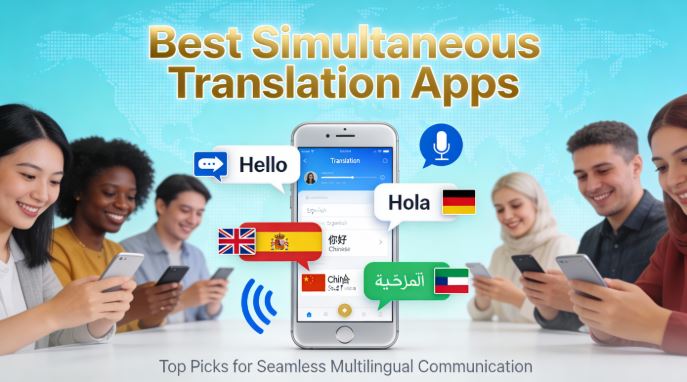
Traveling abroad or participating in international meetings no longer requires mastering multiple languages.
Simultaneous translation applications have evolved dramatically in 2026, offering real-time translation with near 99% accuracy thanks to advanced artificial intelligence.
In this comprehensive guide, we analyze the 15 best simultaneous translation apps available in 2026, comparing features, accuracy, supported languages, and prices to help you choose the perfect tool for your needs.
What is Simultaneous Translation?
Simultaneous interpreting translates speech into another language in real time, while the person is still speaking. It is commonly used in conferences, meetings, virtual events, and face-to-face conversations where fast and accurate communication is essential.
Traditionally performed by human interpreters, AI technology now offers a faster, more scalable, and more economical solution. The best simultaneous interpretation apps in 2026 deliver real-time translation without the need for human interpreters or special equipment.
Difference Between Simultaneous Translation and Text Translation
| Feature | Simultaneous Translation | Text Translation |
|---|---|---|
| Speed | Real time (less than 1 second) | Instant but requires typing |
| Format | Spoken audio | Written text |
| Main use | Conversations, meetings, events | Documents, messages, web pages |
| Naturalness | Fluent conversation | It requires pauses to write |
| Precision | 85-99% depending on language | 90-98% depending on language |
The 15 Best Simultaneous Translation Apps in 2026
1. Google Translate: The Undisputed Free Off-Road Vehicle
Best for: Occasional travelers, everyday use, complete versatility
Supported languages: 133+ languages
Main features:
-
Two-way real-time voice translation
-
Conversation mode for face-to-face dialogues
-
Instant camera translation (point and translate)
-
Offline language packs (more than 50 languages)
-
Integration with Google Assistant
-
Handwriting translation
-
AI-enhanced voice recognition
Advantages:
-
Completely free with no limits
-
Extensive language support (the widest on the market)
-
Accuracy of 82.5% on average, reaching 94% in Spanish
-
Constant updates
-
It works offline with downloaded packages
-
Simple and intuitive interface
Disadvantages:
-
Requires internet for best results
-
Basic interface without business features
-
Variable accuracy depending on the language (55-94%)
Price: FREE
Platforms: iOS, Android, Web
Verdict: Google Translate remains the gold standard for travelers and casual use. Its unbeatable combination of 133 languages, offline functionality, and free price make it the best option for most users.
2. DeepL Voice: Leading Accuracy for European Languages
Best for: Professional translation, business content, European languages
Supported languages: 32 languages (focus on major European and Asian languages)
Main features:
-
Real-time voice translation with contextual AI
-
1.3 times more accurate than Google according to experts
-
Advanced context analysis for natural translations
-
Integration with Microsoft Teams
-
iOS and Android mobile apps
-
Recognition of idioms and idiomatic expressions
Advantages:
-
Superior accuracy in European languages (65% of language pairs tested)
-
More natural and contextual translations
-
Preferred by 82% of language service companies
-
Excellent for professional and technical texts
-
Improved grammar and style
Disadvantages:
-
Fewer languages than Google Translate (32 vs 133)
-
It does not have a free plan for advanced features
-
Weak in Asian, African, and Indic languages
-
Without a robust offline mode
Price: Limited free / Pro from €5.99/month
Platforms: iOS, Android, Web, Microsoft Teams
Verdict: If you primarily work with European languages or require maximum accuracy for professional content, DeepL is unbeatable. Its contextual AI produces significantly more natural translations than the competition.
3. Microsoft Translator: Ideal for Group Meetings
Best for: Business meetings, groups, multi-person conversations
Supported languages: 70 languages
Main features:
-
Unique multi-device conversation mode
-
Connect multiple phones in one translated conversation
-
Translation of voice, text, images, and screenshots
-
It works online and offline.
-
Integration with Microsoft Teams and Office
-
Real-time subtitles
-
Translation of entire websites
Advantages:
-
Revolutionary group chat mode
-
Completely free
-
Robust offline functionality
-
Perfect for families and teams traveling together
-
Enterprise integration with the Microsoft ecosystem
Disadvantages:
-
Fewer languages than Google (70 vs 133)
-
Less polished interface
-
Slightly lower accuracy than DeepL
Price: FREE
Platforms: iOS, Android, Windows, Web, Microsoft Teams
Verdict: Microsoft Translator shines in group settings where multiple people need to communicate simultaneously. Its multi-device conversation mode is unique in the market and perfect for international meetings or tour groups.
4. JotMe: The Best for Virtual Meetings and Zoom
Best for: Online meetings, video calls, professional environments
Supported languages: 77 languages
Main features:
-
Live translation on Zoom, Google Meet, Teams, Webex
-
Integrated AI interpreter with minimal latency
-
Real-time on-screen subtitles
-
It does not require additional host or bot permissions.
-
Dynamic adaptation to mid-call language changes
-
Understanding tone and context
-
Post-call meeting summaries
-
Integration with human interpreters available
Advantages:
-
Quick and easy setup
-
It works directly on video call platforms.
-
Almost imperceptible latency
-
It maintains accuracy even with rapid language changes.
-
Excellent for technical jargon and specialized conversations
Disadvantages:
-
Requires stable internet
-
Focused on virtual meetings (not ideal for travel)
-
Limited free plan
Price: Free plan available / Premium plans available from business contact
Platforms: Zoom, Google Meet, Microsoft Teams, Webex, Slack
Verdict: JotMe is the most advanced tool for real-time translation during virtual meetings in 2026. If international video calls are your priority, this is your best option.
5. X-doc.AI Translive: Maximum Security and Precision
Best for: Businesses, travelers who value privacy, pre-recorded audio translation
Supported languages: 90+ languages
Main features:
-
Two modes: Real-time translation + audio file upload
-
Up to 99% accuracy with optimized voice models
-
Long-term memory that learns specific terminology
-
Enterprise security with a zero audio storage policy
-
Near-zero latency for natural conversations
-
Transcription and translation of pre-recorded files
-
Natural human voice
Advantages:
-
Superior accuracy (outperforms Google and DeepL by 14-23%)
-
Maximum security and privacy
-
Learn and improve with your specific terminology.
-
Versatility: real-time + audio files
-
Ideal for regulated sectors (health, legal, financial)
Disadvantages:
-
Less well known than main competitors
-
Non-public price (business contact)
-
Requires internet
Price: Contact us for details
Platforms: Web, iOS, Android
Verdict: For businesses and professionals who need maximum accuracy, security, and confidentiality, X-doc.AI Translive is the best all-in-one solution in 2026.
6. iTranslate: Integrated Dictionary and Offline Mode
Best for: Frequent travelers, offline use, language learning
Supported languages: 100+ languages
Main features:
-
Real-time voice translation
-
Integrated synonym dictionary
-
Robust offline packages
-
Two-way conversation mode
-
Website translation
-
Verb conjugation
-
Phonetic transliteration
Advantages:
-
Complete dictionary included
-
Excellent offline mode
-
Clean and intuitive interface
-
Useful for learning languages as well as translating
-
Air Translate function to link two phones
Disadvantages:
-
Advanced features require a subscription
-
Very limited free plan
-
Voice translation only available in the paid version.
Price: FREE Limited Plan / Pro $5/month
Platforms: iOS, Android
Verdict: iTranslate stands out for its integrated dictionary and robust offline capabilities, ideal for travelers who need to function without a constant internet connection.
7. Worldly AI: For Conferences and Large Events
Best for: Conferences, webinars, corporate events, partnerships
Supported languages: 50+ languages
Main features:
-
Simultaneous interpretation with AI without human interpreters
-
Support for events with hundreds of attendees
-
Real-time on-screen subtitles
-
Instantly translated audio
-
Integration with Zoom, Webex, Teams, Hopin
-
Access from phone, tablet or computer
-
Displays for meeting rooms
Advantages:
-
Scalable for large events
-
Faster and cheaper than human interpreters
-
Professional setup for businesses
-
Multiple output options (text, audio, displays)
Disadvantages:
-
No free plan
-
Overkill for personal use or travel
-
Requires technical configuration
Price: Business contact (not free)
Platforms: Web, Zoom, Webex, Microsoft Teams, Hopin
Verdict: Wordly AI is the premium enterprise solution for organizations that frequently host multilingual events. Its infrastructure is designed for scale, not for personal use.
8. SayHi Translate: Optimized for Voice Conversations
Best for: Casual face-to-face conversations, voice chat
Supported languages: 90+ languages
Main features:
-
Specific optimization for voice conversations
-
High-quality voice recognition
-
Minimalist interface for quick dialogues
-
Adjustable speech speed
-
Conversation history
-
Easily share translations
Advantages:
-
Completely free
-
Super simple interface for quick use
-
Excellent voice recognition
-
No registration required
Disadvantages:
-
Limited functionality compared to competitors
-
No camera or image translation
-
No offline mode
Price: FREE
Platforms: iOS, Android
Verdict: SayHi is perfect if you just need basic, uncomplicated voice translation. Its simplicity is its greatest strength.
9. Yandex Translate: Works Offline and Translates Entire Websites
Best for: Travelers without roaming, offline translation, websites
Supported languages: 90 languages online / English-Spanish offline
Main features:
-
Works offline (English-Spanish)
-
Translate entire websites from within the app
-
Visual recognition of text in images (12 languages)
-
Voice translation
-
Integrated dictionary
-
Writing prediction
Advantages:
-
Free and without intrusive ads
-
Excellent offline functionality without roaming
-
Translate entire websites directly
-
Good variety of features
Disadvantages:
-
Less well known than Google or Microsoft
-
Less polished interface
-
Accuracy varies depending on language
Price: FREE
Platforms: iOS, Android, Web
Verdict: Yandex is an excellent free alternative, especially if you travel to places without a reliable connection, thanks to its offline mode and translation of entire websites.
10. PolyPal (Timekettle): Ultra-Fast for Professionals
Best for: Professional meetings, multilingual events, universities
Supported languages: 43 languages, 95 accents
Main features:
-
Latency ≤1 ms (ultra-fast)
-
Customizable subtitles in real time
-
Support for up to 500 simultaneous users
-
Compatible with Windows, Mac, iOS, Android
-
Customizable glossary for specific terminology
-
Secure local data storage
-
Integration with Zoom and Teams
Advantages:
-
Virtually imperceptible latency
-
Ideal for large groups (up to 500 users)
-
Accurate recognition of multiple accents
-
Customized glossaries for specific industries
Disadvantages:
-
Requires internet for full functionality
-
Limited offline functionality
-
Non-public price
Price: 30-minute free trial / Subscription (business contact)
Platforms: Windows, Mac, iOS, Android, Zoom, Teams
Verdict: PolyPal is the premium professional option for organizations that need instant translation for large groups with minimal latency.
11. Naver Papago: Specialist in Asian Languages
Best for: Travel to Asia, Korean, Japanese, and Chinese languages
Supported languages: 13 languages (Asian focus)
Main features:
-
Superior accuracy in Asian languages
-
Voice, text and image translation
-
Translation of conversations
-
Integrated dictionary
-
Pronunciation of words
-
Handwriting function
Advantages:
-
Best translator for Asian languages
-
Completely free
-
Intuitive interface
-
Excellent for Korean and Japanese
Disadvantages:
-
Limited language support (only 13)
-
Less useful outside of Asia
-
Without robust offline features
Price: FREE
Platforms: iOS, Android
Verdict: If you're traveling to Korea, Japan, or China, Naver Papago offers superior accuracy to Google or DeepL for these specific languages.
Simultaneous Translation Devices (Hardware)
In addition to apps, there are dedicated translation devices that some travelers prefer:
12. Timekettle WT2: Translator Headphones
Best for: Extended face-to-face conversations, hands-free use
Characteristics:
-
Wireless headphones with integrated translation
-
Each person uses a headset.
-
Instant bidirectional translation
-
40 languages, 93 accents
-
12-hour battery life
Price: $349 ( See prices on Amazon )
Verdict: Ideal for long conversations where you prefer to keep your hands free.
13. Pocketalk S: Dedicated Device with Global 4G
Best for: Frequent travelers, technophobes, guaranteed connectivity
Characteristics:
-
Dedicated device with included SIM card
-
It works in 130+ countries without any setup.
-
82 languages
-
Integrated camera translation
-
No smartphone required
Price: $113 ( See prices on Amazon ) + 2 years of data included
Verdict: Perfect for travelers who don't want to rely on their smartphone or set up international SIMs. Always-on connectivity provides peace of mind.
14. Basque V4: 108 Languages for Business
Best for: Businesses, frequent business travelers
Characteristics:
-
108 supported languages
-
Photo translation
-
Multi-country SIM included
-
4-5 day battery life
-
Large 5" screen
Price: $459 ( one-time purchase )
Verdict: Premium business solution with the most extensive language support on the hardware device.
15. Interprefy: For Professional Hybrid Events
Best for: Hybrid conferences, global corporate events
Characteristics:
-
Professional remote interpretation platform
-
Combines human interpreters + AI
-
For in-person, virtual, and hybrid events
-
Multilingual audio streaming
-
Integration with event platforms
Price: Business contact (enterprise level)
Verdict: Interprefy is the professional solution when you need high-quality human interpretation with scalable technological infrastructure.
Comparison Table: The Best Simultaneous Translation Apps
| App | Languages | Price | Offline | Best For | Precision |
|---|---|---|---|---|---|
| Google Translate | 133+ | Free | ✅ | General use, travelers | 82-94% |
| DeepL Voice | 32 | €5.99/month | ❌ | European languages, professional | 95-98% |
| Microsoft Translator | 70 | Free | ✅ | Groups, meetings | 85-90% |
| JotMe | 77 | Freemium | ❌ | Video calls, Zoom | 90-95% |
| X-doc.AI Translive | 90+ | Commercial | ❌ | Companies, security | 95-99% |
| iTranslate | 100+ | $5/month | ✅ | Offline dictionary | 85-90% |
| Wordly AI | 50+ | Commercial | ❌ | Large conferences | 88-92% |
| SayHi Translate | 90+ | Free | ❌ | Simple conversations | 80-85% |
| Yandex Translate | 90 | Free | ✅ partial | No roaming, websites | 82-88% |
| PolyPal | 43 | Commercial | ❌ | Professional, groups | 90-94% |
| Naver Papago | 13 | Free | ❌ | Asian languages | 90-95% (Asia) |
| Timekettle WT2 | 40 | $299 | ❌ | Hands-free | 85-90% |
| Pockettalk S | 82 | $199 | ❌ | Travel, connectivity | 85-90% |
| Vasco V4 | 108 | $499 | ❌ | Companies, maximum coverage | 88-92% |
| Interprefy | Unlimited | Enterprise | N/A | Corporate events | 95-98% (human+AI) |
How to Choose the Best Simultaneous Translation App
For Occasional Trips
Recommendation: Google Translate
Why: Free and full language support, camera translation, works offline.
Backup: iTranslate for robust offline capabilities.
For Business Meetings
Recommendation: Microsoft Translator
Why: Multi-device conversation mode, integration with Teams.
Support: DeepL for accurate translation of professional documents.
For International Video Calls
Recommendation: JotMe
Why: Direct integration with Zoom/Teams/Meet, real-time subtitles, minimal latency.
Backup: PolyPal for large groups (up to 500 users).
For Maximum Accuracy (European Languages)
Recommendation: DeepL Voice
Why: 1.3x higher accuracy than Google, more natural translations, preferred by professionals.
Backup: X-doc.AI Translive if you need maximum enterprise security.
For Travel to Asia
Recommendation: Naver Papago
Why: Specialization in Asian languages with superior accuracy.
Backup: Google Translate for additional language coverage.
For Offline Use
Recommendation: Yandex Translate
Why: Offline English-Spanish mode included, translates entire websites.
Backup: Google Translate with downloaded language packs.
For Conferences and Large Events
Recommendation: Worldly AI
Why: Designed specifically for multilingual events with hundreds of attendees.
Support: Interprefy for hybrid events that require maximum quality.
Tips for Maximizing Translation Accuracy
1. Speak Clearly and at a Moderate Pace
Translation apps work best when:
-
You speak at a normal speed (not too fast)
-
You pronounce clearly without mumbling
-
You avoid talking over others
-
Reduces background noise
2. Use Simple and Direct Sentences
Simultaneous translation is more accurate with:
-
Short sentences (10-15 words maximum)
-
Simple subject-verb-object structure
-
Avoiding local slang or complex idioms
-
Standard vocabulary instead of colloquialisms
3. Check for a Stable Internet Connection
Most apps require an internet connection for maximum accuracy:
-
Use WiFi whenever possible
-
Have mobile data as a backup
-
Download offline packages before traveling
-
Consider devices with a built-in SIM (Pocketalk)
4. Know the Language Limitations
Not all languages have the same level of support:
-
High precision: English, Spanish, French, German, Italian
-
Good accuracy: Portuguese, Russian, Japanese, Korean, Chinese
-
Variable accuracy: African languages, indigenous languages, regional dialects
5. Combine Tools According to Context
There is no single "best" universal app:
-
Travel: Google Translate (versatility)
-
Professional documents: DeepL (accuracy)
-
Meetings: Microsoft Translator or JotMe
-
Major events: Worldly AI
Frequently Asked Questions
Which real-time translator is the most accurate in 2026?
DeepL currently offers the highest accuracy for European languages (95-98%), while Google Translate provides the best balance between accuracy and global coverage. For specialized content, X-doc.AI Translive achieves up to 99% accuracy.
Are free apps good enough?
Yes, for casual use and occasional travel, Google Translate and Microsoft Translator are completely free and offer 80-90% accuracy. For professional or business use, the premium versions (DeepL Pro, JotMe, X-doc.AI) justify the cost with greater accuracy and advanced features.
Do translation apps work without internet?
Some do. Google Translate, iTranslate, and Yandex offer downloadable language packs for offline use. However, accuracy drops 10-20% without an internet connection. Hardware devices like Pocketalk include a SIM card with global data.
Can I use these apps for important professional meetings?
It depends on the level of criticality. For informal meetings, Microsoft Translator or JotMe are suitable. For critical negotiations, investor presentations, or legal contexts, consider professional human interpreters or hybrid services like Interprefy that combine AI with human interpreters.
Do translation apps replace learning languages?
Not entirely. Apps are excellent tools for basic communication and emergencies, but learning a language provides:
-
Deep cultural understanding
-
Nuances and contexts that AI loses
-
More genuine personal connections
-
Technological independence
Which languages will have the best support in 2026?
Excellent support (95%+ accuracy):
-
English, Spanish, French, German, Italian, Portuguese
Good support (85-94% accuracy):
-
Mandarin Chinese, Japanese, Korean, Russian, Arabic, Dutch
Variable support (70-84% accuracy):
-
African languages, indigenous languages, regional dialects
Is it worth buying dedicated hardware devices?
It depends on your profile:
Yes, yes:
-
You travel frequently (10+ trips/year)
-
Do you want to avoid draining your smartphone's battery?
-
You prefer a dedicated, distraction-free device
-
You need guaranteed connectivity without configuring SIMs
No, yes:
-
You travel occasionally (1-3 times/year)
-
Are you comfortable using apps on your smartphone?
-
You have a limited budget.
-
You prefer to update software easily
Trends in Simultaneous Translation in 2026
1. Integration of Advanced AI
Large language models (LLMs) like GPT-4 and Claude are dramatically improving contextual understanding. Apps in 2026 will not only translate words, but also understand intent, tone, and cultural nuances.
2. Multimodal Translation
The best apps now combine:
-
Real-time voice
-
Camera translation
-
Written text
-
Images and documents
-
Everything integrated without changing apps
3. Personalization and Memory
Tools like X-doc.AI learn your specific terminology, industry, and linguistic preferences to improve with use. They are no longer generic translators but personalized assistants.
4. Ultra-Low Latency
Professional apps like PolyPal achieve latency ≤1 ms, making translation virtually instantaneous. This eliminates awkward pauses in conversations.
5. Greater Privacy and Security
With regulations like GDPR, leading apps are implementing:
-
On-device processing when possible
-
Zero audio storage policies
-
End-to-end encryption
-
Certified business compliance
Conclusion: Which Simultaneous Translation App Should You Choose?
There is no single "best simultaneous translation app" that works for everyone. The optimal choice depends on your specific use case.
For most users: Google Translate offers the best balance between features, supported languages, and price (free).
For professionals and companies: DeepL Voice (European languages) or X-doc.AI Translive (maximum accuracy and security) are the best investments.
For virtual meetings: JotMe is unbeatable with its direct integration into video conferencing platforms.
For groups and families: Microsoft Translator with its multi-device conversation mode facilitates group communication.
For Asian travel: Naver Papago outperforms all others in accuracy for Korean, Japanese, and Chinese languages.
Simultaneous translation technology has reached a point of maturity where language barriers are no longer insurmountable obstacles. With the right tools on your smartphone, you can communicate effectively in virtually any language in the world.
Final recommendation: Download Google Translate as a free base, and add a specialized app according to your specific needs (DeepL for work, JotMe for video calls, or Microsoft Translator for groups).