Reading Time 6
Number of Words 1342
AI search platforms like ChatGPT, Perplexity and Claude are sending real visitors to websites right now, and most website owners have no idea it's happening.
According to a study covering 63,987 websites, 63% of sites already receive AI referral traffic, and AI search traffic grew 527% in just one year.
The question is no longer "Will AI send me traffic?" — it's "How much am I already getting, and am I tracking it?"
In this guide you'll learn exactly what AI traffic is, which platforms send the most visits, why most analytics tools miss it, and how to check your own AI traffic for free, right now, without creating an account.
🤖 What Is AI Traffic?
AI traffic (also called LLM referral traffic or AI referral traffic) refers to visits that arrive at your website after a user asked an AI chatbot a question and the AI recommended or linked to your site as a source or reference.
When someone asks ChatGPT "What are the best free web traffic tools?" and ChatGPT mentions your site — that person clicks the link and lands on your page. That's AI traffic.
The key difference from traditional search: the user didn't type your URL or search Google. An AI decided your content was worth recommending, and sent the user directly to you.
📊 How Big Is AI Traffic in 2026?
The numbers are impossible to ignore:
-
🚀 AI search traffic grew +527% in 2026 year over year
-
💬 ChatGPT alone accounts for ~80% of all AI referral traffic globally
-
🌍 Perplexity drives 15% of AI traffic globally and up to 20% in the US
-
⏱️ AI visitors spend 68% more time on websites than organic search visitors
-
🎯 ChatGPT sessions average 583 seconds (~10 minutes) per visit
-
📈 Between January and April 2025 alone, ChatGPT's share of internet traffic doubled
-
🧠 Up to 15% of B2B traffic now originates from AI "Answer Engines"
The bottom line: AI traffic is small but growing explosively, and it converts better than organic search. Users arriving from AI recommendations are already pre-qualified — they clicked because an AI specifically told them your content answers their question.
🔍 Which AI Platforms Send the Most Traffic?
Ranking of AI Traffic Sources (2026)
| # | Platform | Share of AI Traffic | Avg. Session Duration | Notes |
|---|---|---|---|---|
| 🥇 1 | ChatGPT | ~80% | 583 sec (~10 min) | Dominant worldwide |
| 🥈 2 | Perplexity | ~15% | 552 sec (~9 min) | Very strong in US (20%) |
| 🥉 3 | Claude | ~3% | Up to 3.998 sec in EU 🔥 | Highest engagement per session |
| 4 | Gemini | ~2% | Variable | Growing fast with Google integration |
| 5 | DeepSeek | <1% | Variable | Emerging, especially in Asia |
💡 Key insight: Claude users spend an average of 67 minutes per session on referred sites in Europe — the highest engagement of any AI platform. Fewer visits, but massively qualified.
⚠️ Why Most Analytics Tools Miss AI Traffic
Here's the uncomfortable truth: a large portion of your AI traffic is invisible in standard Google Analytics.
When AI chatbots like ChatGPT send users to your site, they often don't pass a referrer header — the technical signal that tells your analytics tool "this visit came from ChatGPT." The result? Those visits appear as Direct Traffic in GA4, Matomo and most standard tools.
According to Loamly's research, an estimated 34% of what appears as "Direct Traffic" is actually AI-referred. That means if you're getting 1,000 direct visits per month, roughly 340 of them might actually be coming from ChatGPT, Perplexity or another AI — and you'd never know.
🛠️ How to Check Your AI Traffic for Free
Method 1: Use Lookkle
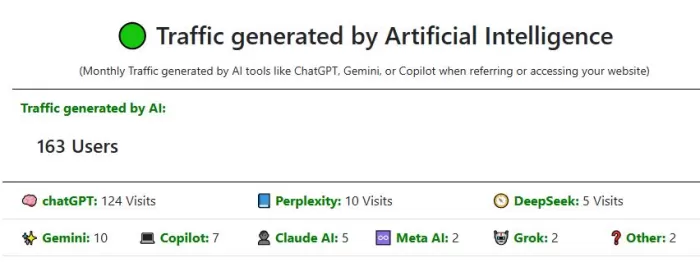
Lookkle is one of the few free tools that lets you analyze any website's traffic — including AI traffic sources — without entering a credit card.
With Lookkle you can:
-
✅ See estimated monthly traffic for any domain
-
✅ Identify AI traffic as a separate source category
-
✅ Check if ChatGPT, Perplexity or DeepSeek are sending visits
-
✅ Compare your AI traffic vs competitors
-
✅ Results in seconds
👉 Analyze your competitors' AI traffic on Lookkle →
Method 2: Check GA4 Referral Sources (Your Own Site)
If you have Google Analytics 4 installed on your site, you can manually check for AI referral traffic:
1. Go to GA4 → Reports → Acquisition → Traffic Acquisition
2. Change the primary dimension to "Session Source / Medium"
3. Search for: "chat" in the search box
4. Look for these sources:
- chat.openai.com / referral → ChatGPT traffic
- perplexity.ai / referral → Perplexity traffic
- claude.ai / referral → Claude traffic
- gemini.google.com / referral → Gemini traffic
⚠️ Important limitation: GA4 only captures AI traffic when the chatbot passes a referrer header. A significant portion still appears as Direct Traffic and cannot be identified this way.
Method 3: GA4 Custom Exploration (More Detailed)
For a deeper analysis:
1. GA4 → Explore → Create Blank Exploration
2. Name it "AI Traffic Analysis"
3. Set date range: Last 12 months
4. Add dimensions: Landing Page + Page Referrer
5. Add metric: Sessions
6. Apply filter: Page Referrer contains "openai" OR "perplexity"
OR "claude" OR "gemini"
This reveals exactly which pages on your site are being recommended by AI platforms — invaluable for your content strategy.
📈 How to Get More AI Traffic to Your Website
Tracking AI traffic is step one. Growing it is step two. Here's what works:
1. Write Definitive, Citable Content
AI platforms prefer content that is specific, well-structured and authoritative. Articles with clear headings, data points, tables and direct answers to questions are more likely to be cited by ChatGPT and Perplexity.
2. Use Structured Data (Schema Markup)
FAQ schema, HowTo schema and Article schema help AI crawlers understand your content better — making it more likely to be surfaced as a source.
3. Target "Answer-Worthy" Questions
Think about what questions people ask AI chatbots in your niche. Write articles that directly answer those questions better than anything else online. The format "Is [X]? Here's [Answer]" performs particularly well.
4. Build Brand Authority
AI platforms like ChatGPT and Perplexity are more likely to cite brands that appear consistently across the web — backlinks, social mentions, press coverage and guest posts all contribute to your AI visibility.
5. Monitor and Iterate with Free Tools
Track which of your pages receive AI traffic regularly using Lookkle and GA4. Double down on content formats that generate AI citations.
🔬 AI Traffic vs Organic Search: Key Differences
| Factor | Organic Search (Google) | AI Traffic (ChatGPT/Perplexity) |
|---|---|---|
| Volume | High | Low-medium (but growing fast) |
| Growth rate | Stable/declining | +527% YoY |
| User intent | Variable | High — pre-qualified |
| Session duration | ~3-4 min average | ~9-10 min average |
| Tracking difficulty | Easy (GA4) | Hard (often shows as Direct) |
| How to win | Keywords + backlinks | Authority + citable content |
| Free tracking tool | GA4 | Lookkle ✅ |
❓ Frequently Asked Questions
What is AI traffic and how is it different from organic traffic?
AI traffic refers to visitors who arrive at your website after an AI chatbot (like ChatGPT or Perplexity) recommended your content in response to a user's question. Unlike organic search traffic — where users find you by typing keywords into Google — AI traffic arrives because an AI specifically cited your site as a trustworthy source. AI visitors tend to be more engaged, spending 68% more time on sites than organic search visitors.
How can I check if my website is getting traffic from ChatGPT or Perplexity for free?
The easiest way is to use Lookkle: enter your domain and get an instant breakdown of your traffic sources, including AI platforms, with no account or payment required.
Alternatively, in Google Analytics 4, go to Acquisition → Traffic Acquisition, change the primary dimension to "Session Source/Medium" and search for "chat" or "perplexity" to see referral data directly.
Why does my AI traffic show up as Direct Traffic in Google Analytics?
Most AI chatbots don't pass a referrer header when sending users to external links — meaning GA4 can't identify where the visit came from and classifies it as Direct. Research estimates that approximately 34% of "Direct Traffic" is actually AI-referred. Tools like Lookkle use alternative detection methods to identify these visits more accurately.
Which AI platform sends the most traffic to websites?
ChatGPT is the dominant source of AI traffic, accounting for approximately 80% of all AI-referred visits globally. Perplexity is second with around 15%, followed by Claude and Gemini. However, Claude users have the highest engagement — averaging up to 67 minutes per session in Europe.
Is AI traffic worth optimizing for in 2026?
Absolutely. AI traffic grew 527% in 2026 and users referred by AI platforms are significantly more engaged than traditional organic visitors. While the volume is still smaller than Google organic traffic, the quality is higher and the growth trajectory makes it one of the most important emerging channels for SEO and content marketers.
Can I check my competitors' AI traffic for free?
Yes, tools like Lookkle allow you to analyze any website's estimated traffic including AI sources without creating an account. This makes it possible to benchmark your AI traffic performance against competitors and identify which content strategies are earning them AI citations.