Reading Time 9
Number of Words 1943
How many times have you wanted to know why your competition appears before you on Google, or how much real traffic a website receives, or if your SEO strategy is really working?
The good news is that you don't need to spend hundreds of euros a month on premium tools to get that information.
SEO professionals have an arsenal of free tools that do exactly the same thing, and in this article we present them all to you.
Why experts don't always use paid tools
Semrush starts at €117/month, Ahrefs at €99/month, and Moz Pro at €99/month. They are powerful tools, yes, but the truth that is rarely mentioned is that 80% of day-to-day SEO analysis can be done with completely free tools.
The most experienced professionals combine three or four free tools to obtain the same information offered by paid platforms. The trick is knowing which one to use for each type of analysis. That's exactly what you're going to learn here.
🛠️ The Best Free Tools to Analyze Any Website
1. 🔍 Lookkle Website Ranking Checker — All in one, no registration required
lookkle.com/web-analytics/seo-ranking-checker-metrics-tool
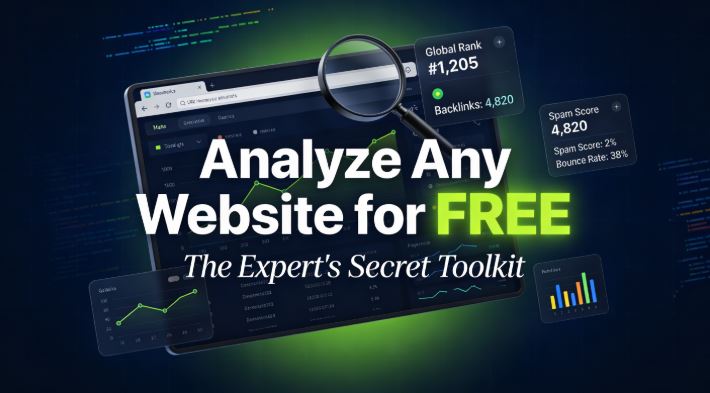
If you had to choose just one tool from this list, this would be the most comprehensive option to start with. Lookkle's Website Ranking Checker lets you analyze any URL in the world in seconds and get a complete report with the most important metrics, without needing to create an account or enter a credit card.
What data does it offer you?
-
🌍 Global Rank — Website's position among all websites worldwide based on estimated traffic.
-
🗺️ Country Rank — Ranking within the target country of the analyzed website.
-
🔗 Backlinks Rank — Estimated number of incoming links pointing to the domain.
-
🚨 Spam Score — Indicates if the domain has signals that Google may interpret as spam, which directly affects its ranking.
-
📉 Bounce Rate — Percentage of visits that leave the website without interacting, a key indicator of content quality and user experience.
-
📊 Traffic sources — Where visits come from: organic search, social media, direct traffic, referrals, or paid advertising.
-
🌐 Countries with the most traffic — Which countries generate the most visits to the analyzed website.
-
📄 Most visited pages — Which specific URLs receive the most traffic within the domain.
What is it used for in practice?
It's perfect for analyzing your competitors' websites before designing your content strategy, for quickly checking the SEO status of your own domain, or for conducting an initial audit before a client meeting.
💡 Expert tip: Enter your main competitor's URL and compare their Bounce Rate and traffic sources to yours. If they receive more organic traffic and less direct traffic, it means their SEO is working better. That gives you the exact starting point for improvement.
2. 📊 Google Search Console — The most reliable data available
search.google.com/search-console
Google Search Console is the only tool that gives you data directly from Google for your own domain. No paid tool has access to more accurate data about your website than what Google provides directly here.
What you can analyze:
-
Which keywords generate impressions and clicks for you on Google?
-
Which of your pages are indexed and which ones have problems.
-
Core Web Vitals: speed, visual stability, and interactivity of each page.
-
Crawling errors that prevent Google from indexing your content correctly.
-
Full indexing coverage of your entire site.
Limitation: It only works for your own domain. To analyze the competition, you need to combine it with other tools from this list.
3. 🔗 Semrush Free Backlink Checker — Analyzes the links of any website
semrush.com/analytics/backlinks
Semrush offers a free version of its backlink analyzer that requires no registration. Enter any domain and instantly get the top backlinks, referring domains, Authority Score, and link type (follow/nofollow).
Why backlinks matter: Inbound links remain one of the most important ranking factors on Google. Knowing how many backlinks your competitors have and where they come from tells you exactly what kind of link building strategy you need.
💡 Expert tip: Analyze the top 10 Google results for your target keyword. Count how many backlinks they have on average. That's the real barrier to entry for competing in that search.
4. ⚡ Google PageSpeed Insights — Speed and Core Web Vitals
Page load speed has been an official ranking factor on Google since 2021. PageSpeed Insights analyzes any URL for free and gives you a score from 0 to 100 along with specific recommendations for improvement.
What it measures:
-
Time until first visible content (FCP).
-
Largest Contentful Paint (LCP) — the time until the main content is visible.
-
Cumulative Layout Shift (CLS) — the visual stability of the page.
-
Total Blocking Time (TBT) — the time it takes the browser to be able to respond to interactions.
💡 Expert tip: Analyze the speed of your most important page AND that of your main competitor. If yours loads slower, you have a technical problem that is directly affecting your ranking.
5. 🕷️ Screaming Frog SEO Spider (free version) — Complete technical audit
screamingfrog.co.uk/seo-spider
Screaming Frog is the favorite tool of SEO professionals for in-depth audits. The free version allows you to crawl up to 500 URLs on any website and detect technical issues that hinder search engine ranking.
What it detects:
-
404 errors and broken redirects.
-
Duplicate or missing titles and meta descriptions.
-
Images without alt attributes.
-
Canonical issues and URL structure.
-
Pages blocked by robots.txt.
6. 🎯 Ubersuggest (free plan) — Keywords and competitive analysis
Ubersuggest offers a free version that allows you to analyze the estimated organic traffic of any domain, its main keywords, domain authority, and most important backlinks. It's one of the best free alternatives to Semrush for competitor analysis.
Why experts use it:
-
It shows the keywords for which a website is ranking on Google.
-
Identify the competitor's pages with the most organic traffic.
-
Suggest content ideas based on what works best in your niche.
💡 Expert tip: Enter the URL of your strongest competitor into Ubersuggest and see which pages receive the most organic traffic. That's exactly the type of content you should be creating too.
7. ❓ AnswerThePublic — Discover what users are asking on Google
AnswerThePublic analyzes actual user searches on Google and shows you all the questions, comparisons, and phrases related to any keyword. It's the tool content marketing experts use to create articles that answer exactly what people are looking for.
How to use it: Enter any topic or keyword and you'll get hundreds of real questions that users are searching on Google. Those questions are your next blog posts.
8. 🔎 SEO Minion (Chrome extension) — Instant analysis on any page
SEO Minion is a free Chrome extension that lets you analyze any website in real time without leaving your browser. It's the equivalent of having an instant SEO report for any URL you visit.
What it analyzes instantly:
-
SEO on-page: títulos, H1-H6, meta descriptions, canonical.
-
Redirections and redirection chains.
-
Broken link analysis.
-
Structured data (schema markup).
-
SERP preview of how the page appears in Google.
📋 Comparison Chart of Free Tools
| Tool | Type of analysis | Registration required | Analyze the competition |
|---|---|---|---|
| Lookkle Ranking Checker | Tráfico, ranking, backlinks, spam score, bounce rate | No ✅ | Yes ✅ |
| Google Search Console | Keywords, indexing, Core Web Vitals | Yes (only your website) | No ❌ |
| Semrush Backlink Checker | Backlinks and referring domains | No ✅ | Yes ✅ |
| Google PageSpeed Insights | Speed and Core Web Vitals | No ✅ | Yes ✅ |
| Screaming Frog (free) | Technical audit of up to 500 URLs | No ✅ | Yes ✅ |
| Ubersuggest (free) | Keywords, estimated organic traffic | Yes (limited) | Yes ✅ |
| AnswerThePublic | Search intent and questions | No ✅ | No ❌ |
| SEO Minion | Real-time on-page SEO | No ✅ | Yes ✅ |
🧠 Professional Workflow: How to Combine Them
Experts don't use these tools in isolation. They combine them in a logical workflow that covers all angles of SEO analysis:
Step 1 — Initial Quick Analysis:
Start with Lookkle Ranking Checker to get a comprehensive overview of any website in seconds: ranking, estimated traffic, backlinks, spam score, and traffic sources. It's the perfect starting point before delving deeper.
Step 2 — Backlink Analysis:
Use the free Semrush Backlink Checker to see in detail the inbound links of the domain you are most interested in analyzing. Pay attention to the Authority Score and the quality of the referring domains.
Step 3 — Keywords and content:
Use Ubersuggest to identify which keywords your competitors are ranking for and which pages have the most traffic. Then use AnswerThePublic to find related questions you can answer with new articles.
Step 4 — Technical Audit:
Run Screaming Frog on your own domain to detect technical errors that are hindering your ranking. 404 errors, misconfigured redirects, and duplicate titles are more common than you might think.
Step 5 — Speed:
Check your most important pages with Google PageSpeed Insights and repeat the analysis on the equivalent pages of your competitors. If they load faster, that explains part of their advantage.
Step 6 — Continuous monitoring:
Connect your domain to Google Search Console and review it weekly. It's the most reliable source of data available to understand how Google views your website.
💡 Which Metrics to Look at First (and What They Mean)
For beginners, the number of metrics can be overwhelming. Here are the five most important indicators and what they mean in practice:
-
📈 Global Rank / Country Rank: The lower the number, the more traffic the website receives. A Global Rank of 500,000 means that the website is among the 500,000 most visited in the world.
-
🚨 Spam Score: A high percentage (above 30%) is a warning sign. It may indicate that the domain has low-quality backlinks or practices that Google penalizes.
-
📉 Bounce Rate: A percentage above 70% usually indicates that visitors are not finding what they are looking for. This is more tolerable on informational blogs; on online stores, it's a red flag.
-
🔗 Backlinks: The quantity and quality of inbound links remains the most important ranking factor alongside content.
-
🌍 Traffic sources: A good balance between organic, direct, and referral traffic indicates a website with real authority. If almost all traffic comes from social media, the website is vulnerable to algorithm changes.
🆚 When is it worth paying for a premium tool?
Free tools cover 80% of day-to-day work, but there are specific cases where it's worth investing in a premium tool:
-
When you manage 10 or more websites and need to automate reporting and ranking tracking.
-
When you need historical data of 12 months or more to analyze trends.
-
When you run large-scale link building campaigns and need to analyze thousands of backlinks with advanced filters.
-
When you manage SEO clients and need professional, blank reports to present.
In all other cases, the combination of free tools you've seen in this article is more than enough to achieve professional results.
❓ Frequently Asked Questions
Are the data from free tools reliable?
Yes, with some caveats. Free tools offer estimates that can vary from the actual data by between 10% and 30%. They are accurate enough for making strategic decisions, but for precise absolute data (such as the exact traffic to your own website), Google Search Console is the only 100% reliable source.
Can I analyze my competitors' websites with these tools?
Yes. Tools like Lookkle Ranking Checker, the free Semrush Backlink Checker, Ubersuggest, and PageSpeed Insights allow you to analyze any domain without any restrictions or registration.
How long does a full analysis take?
With the workflow described in this article, a complete website analysis can be done in 15 to 30 minutes. The initial analysis with Lookkle only takes 2 minutes.
Do I need technical knowledge to use these tools?
No. All the tools on this list have very visual and intuitive interfaces. Google Search Console has a slightly steeper learning curve, but its official documentation is available in Spanish and is very clear.
🏁 Conclusion
SEO experts don't have any magic secrets: they simply know which tools to use and how to combine them. With Lookkle Ranking Checker as a starting point for comprehensive analysis, Google Search Console for monitoring your own domain, Semrush Backlink Checker for backlinks, Ubersuggest for keywords, and PageSpeed Insights for speed, you have everything you need to make strategic decisions based on real data, without spending a penny.
SEO isn't expensive. It's a matter of knowing where to look.
🛒 Start Now
👉 Analyze your website or your competitor's in seconds:
Lookkle Website Ranking Checker — Free, no registration required