Reading Time 4
Number of Words 851
Search behavior is evolving quickly, influenced by voice queries, AI-enhanced search engines, answer-based SERPs, and stricter ranking standards. This means businesses must adapt to these developments to stay competitive and drive results.
This is even more important as 2025 comes to a close. You want to start the new year strong and boost your chances for success and growth.
To that end, this is the perfect moment to audit and improve your on-page search engine optimisation (SEO). But how do you do it? While you can do it yourself, you can trust SEO experts at Digital Hitmen to audit your site and make improvements that drive results.
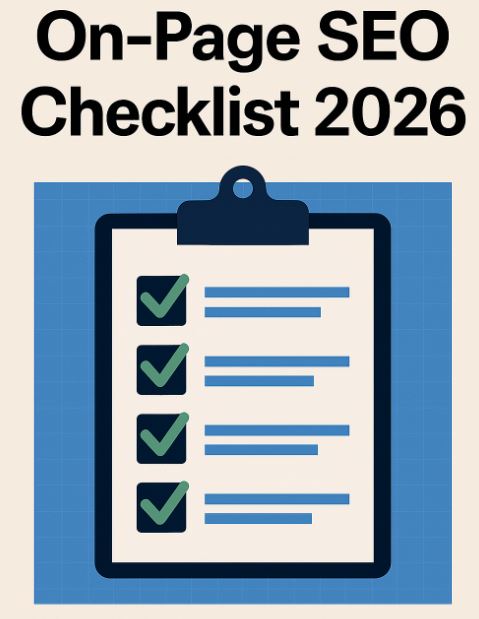
Below, we share an on-page SEO checklist to help you prepare your website for 2026.
1. Start with Search Intent Matching
Google’s algorithm nowadays pays more attention to intent than keywords. This means your content must answer what users are trying to search for or achieve.
Start by grouping your keywords or queries into four categories: informational, commercial, transactional, and navigational. Then use the queries to optimise your pages and content depending on your goals.
Ensure your titles, headers, intros, and content visuals align with that intent. Matching the intent will help push your page to the top for those queries.
2. Use Primary and Semantic Keywords
While keyword stuffing is a red flag for SEO and grounds for a penalty, you can use primary and semantic keywords to fit your content within a semantic ecosystem. Here is what you need to do:
-
Place your primary keyword in the title tag, H1, the first 100 words of the intro, and URL
-
Use semantic keywords naturally throughout your content
-
Build your entire content around a topic cluster, instead of a single keyword
In today’s AI-driven search, search engines don’t just look for keywords; they look for context. For that reason, always create your content around different phrases.
3. Create Human-Focused Content
Content is still an important factor in SEO, and you need to create content that delivers value to your visitors. Google recommends creating and publishing content that demonstrates Experience, Expertise, Authority, and Trustworthiness (E-E-A-T).
This is possible by including real examples, firsthand insights, and case studies in your content. You need to format your content for readability with headers, lists, and short paragraphs. Include unique perspectives instead of using generic AI-generated materials.
Also, adding screenshots, data, videos, and diagrams can augment the value of your content.
4. Optimise Title Tags and Meta Descriptions
Search results have changed significantly, getting more crowded with AI answers, ads, site links, featured snippets, and YouTube videos. To stand out from the noise, you need to optimise your title tags and meta descriptions.
-
Keep the title tag between 50 and 60 characters
-
Use action-driven language like best, guide, and checklist
-
Include the main keyword naturally
-
Write benefit-driven meta descriptions
Well-optimized title tags and meta descriptions can boost your click-through rate (CTR), and this is a signal that your content meets user expectations.
5. Prioritise Page Experience and Core Web Vitals
User experience (UX) has evolved significantly over the years; it’s no longer just about page speed alone. Search engines like Google also track how stable and smooth your website pages feel using metrics like largest contentful paint (LCP) and cumulative layout shift (CLS).
You can improve your page experience and core web vitals by:
-
Using a lightweight theme
-
Reducing JavaScript bloat
-
Preloading critical CSS
-
Compressing images
-
Avoiding intrusive pop-ups and ads
A fast, smooth page lowers bounce rates and improves user engagement. This sends positive signals to search engines, improving your search rankings and AI visibility.
6. Strengthen Your Internal Linking Structure
Internal links are a critical element in SEO; they help search engines to understand your site hierarchy and crawl your pages better. For every content or page you publish:
-
Add 3 to 6 internal links
-
Link to topic clusters and high-quality pages
-
Use description, keyword-rich anchor text
Audit your pages to fix orphan pages and ensure a strong internal linking structure to boost indexing, crawlability, and user navigation.
7. Leverage Header Tags for Logical Hierarchy
Always use header tags to communicate your pages’ structure to search engines and improve scannability. Header tags help search engines and people to follow the logical flow of information. For the best practice:
-
Use only one H1 per page
-
Use H2s, H3s, and H4s for subsections
-
Add descriptive language in headers, not just keywords
Header tags are even more important today as AI-driven search engines use semantic systems to parse your content.
8. Add Schema Markup for SERP Visibility
Schema markup helps search engine sto understand your content and pages better. In 2016, rich results matter because they increase visual presence and CTR. So, you need to add a schema for FAQ, how-tos, products, reviews, localbusiness, and articles
Adding a schema can lead to more SERP appearances, better contextual understanding by search engines, and higher click-through rates. You can implement your schema using JSON-LD and validate it via Google’s Rich Results Test.
Stay Competitive in 2026 with SEO
As 2026 approaches, now is the best time to improve your SEO, website performance, and user experience. And it’s not about manipulating algorithms, it’s about creating high-quality content that delivers value.
This checklist provides actionable and practical steps to boost your SEO in 2026. But if you need help, the team at Digital Hitmen is always available to support your business through the best SEO practices.